
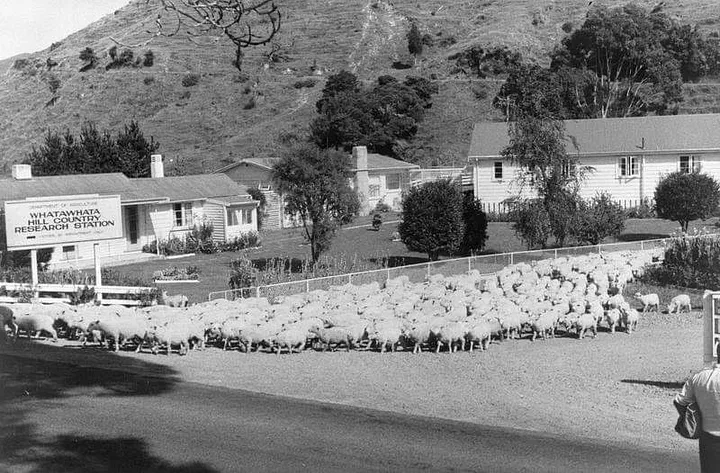
Like all small communities, the village of Whatawhata Research Station extended far beyond the farm boundary fence. Part 5 records some of the new tales, many gleaned from the friends of friends.
Lands & Survey v Maori Affairs. The success of the Lands and Survey Romney and Angus breeding schemes at Waihora, led by Superintendent of Lands Eric Gibson at Rotorua, soon attracted his former Lincoln College student mate Dixon Wright, who had a similar role in the Department of Maori Affairs run from Hamilton. They used to shoot quail together. Dixon was a very competitive bloke coaching rugby as a sideline, and his territory was also massive with thousands of Romney ewes and Angus cows, doing the same job of developing land and settling farms.
The Aotearoa block near Arapuni with over 1000 ewes was chosen to start recording two-tooths with twins (as at Waihora), and Ray Armstrong was recruited for a job there from Whatawhata because of his recording experience. There were also calves to be tagged at birth from the large herd of wild Angus cows Ray remembers well.
All seemed to go well till Dixon went on an overseas consultancy job to South America, when we heard that a Field Officer ordered the brass tags to be cut out of most of the ewes, as he believed the whole idea of Maori Affairs breeding their own rams was far too much work, and it was much easier to buy rams from stud breeders which had worked well in the past. This was the old view at Waihora too!
But some rams must have been kept, as 5 years later when Ray moved back to manage at Mamakamaru for Maori Affairs, and requested rams, some tagged ‘rabbits’ arrived which he showed Dixon, who ordered their immediate return and slaughter. Nothing more was heard of the Maori Affair’s Romney or Angus breeding project. (CliveD).
Sheep Neck Tags. Initially we remember pieces of hardboard or formica with larger numbers on that you could read from a distance to avoid the stress to the sheep of having to be caught to read the tag. And the stress to the shepherd and dogs too! Then some arrived made from thick gauge aluminium punched out by some local engineering firm. Two chain links had to be inserted in each corner, then painted with a special aluminium etching paint before writing on the numbers. Lengths of braided nylon cord were cut from rolls and the ends sealed with a flame.
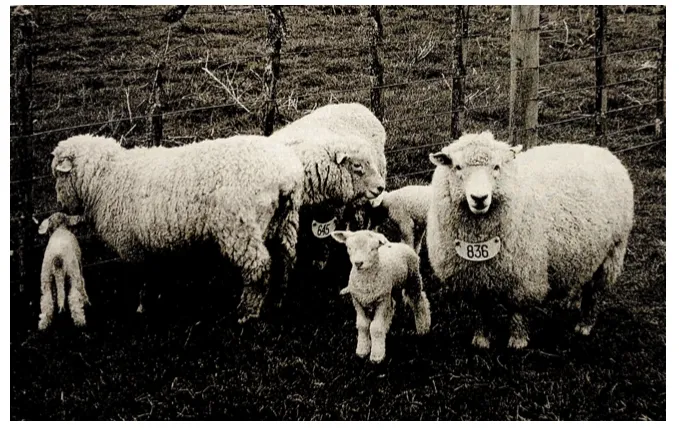
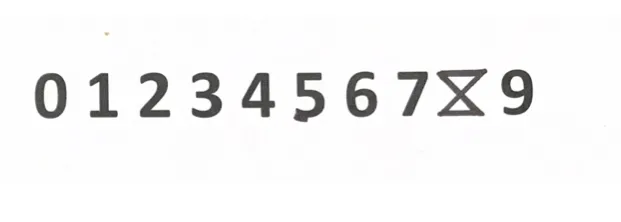
Then they had to be put around the sheeps’ necks, making a cross-reference list of the brass tag along with the neck tag number! Many years they had to be touched up or completely repainted with paint that gave off fumes. What a job! After 3 or 4 years some other outfit started making them with thinner aluminium and pressed them so they had an edge around the outside to add strength but they were never as good as the originals. We developed a cunning shape for the numbers so you could work out what the tag number was by reading the bottom half, as the top half was often covered by the neck wool. The neck tags were also useful for hobbling some ewes that were not too keen to take their lamb!
The neck tags also had to be taken off before shearing, as a shearer didn’t like discovering this nylon cord when coming up to clear the neck wool. We all celebrated the day when the large Allflex easy-to-read ear tags numbered on each side arrived — provided they were put in the proper place in the ear. (Jock Clayton)
Footnote: Jock and Ray Armstrong also remember putting Ritchey tags into sheeps’ ears with the lethal dagger device provided to push them through. I used these on wild Waihora Angus cows — a more dangerous tool was never invented! I never considered them to be suitable for sheep. (CliveD).
Brass tags as ID. The brass tag was the best permanent lifetime ID of sheep and cattle throughout NZ, before electronic tags became available a few years ago, and in many cases are still the preferred method as generally they stay put. The ear tattoo was used by the NZ Dairy Board many years ago, but had many problems and were difficult to read as they faded, got covered in gunge, and the animal’s head had to be restrained.
The Animal Health Board contracted tag companies to produce a small button tag that could be punched into calves’ ears that had a unique ID for the animal with the birth place (farm), year born, and individual animal ID. This was a combination of letters and digits, so didn’t make a lot of sense for everyday purposes, being small and difficult to read.
The little brass tag has been around for at least 70 years and made originally by The Farmacy in Palmerston North (now incorporated in one of the large tag manufacturers’ business). Any combination of letters and numbers could be machine stamped on a narrow strip of brass, cut and each end folded over. They were then threaded onto a thin stick or cardboard strip in series of 25, for dispatch. At Whatawahata we needed a large combination of letters and numbers to distinguish the many different experimental flocks.
Inserting tags. Two small tools were needed. A tag hole punch for making a hole in the animal’s ear, and a specially shaped pair of pliers to ‘close off’ the ends of the tag after it had been placed in the ear. For practising purposes with ‘new chums’ a piece of thin cardboard in the shape of the ear was used to make sure the tag was placed in the correct position. This was quite important as lambs and hoggets were tag read quite often for weighing for growth rate etc, and if the tags weren’t placed properly it could be more difficult to read. For example, if the tags were too close in towards the head, the tag could get covered up in skin folds and wool. Also if the shearer couldn’t see the tag, there was the danger of hooking a comb tooth in the tag with serious consequences! If they were too far out towards the tip of the ear, the ear would permanently flop over, and also might snag a flying comb on the hand piece.
To position the tag in the correct place the thumb of the hand holding the lamb was placed between the head (skull) and the place the tag hole was to be punched. The tag inserted through the hole the correct way round — i.e.able to be read from the RHS of the sheep when standing, then the ends carefully folded over with the ends butting perfectly. It was a good idea to apply some disinfectant to the wound, and disinfect the tag punches and tags regularly, as often a tag hole could get infected which was not a good outcome. Then check before moving on to next lambs. Remember to complete the record the birth details and put the tags, punches, and pliers back into the lambing bag! (Jock Clayton).

Modifications. Initially we were tagging in the trailing edge of the lambs ear, but found that in the leading edge, gave more space in the trailing edge for ear marks such as our Whatawhata station mark which was used to identify sex of the animal as well. Left for girls and right for boys. The thicker and stronger leading edge could support the tag better too. Meanwhile, down at Waihora where Peter Guy was tagging huge numbers of multiples lambs, found that by putting the brass tag into the pliers, he could punch and close the ear tag in one movement. This saved carting around one tool and a source of infection. This did have its problems with tags getting folded over and obscuring numbers. So, with some development feed-back to The Farmacy, the pliers were slightly altered and one end of the brass tag was made longer to self punch through the ear without folding over. (Jock Clayton)
Footnote. Some breeders put the tags for each sex in different ears , but it risked too many errors so it was never used on the Station. (CliveD).
Ian’s little helpers. Ian loved to take kids with him and they loved ‘helping’. Their main job they loved was catching and holding the lambs till they were tagged so the ewe kept in smelling distance. They felt so important! Final job was to hold the raddle stick to put an identical spot on twins or triplets so you could always see if a ewe had her correct lambs. (CliveD).
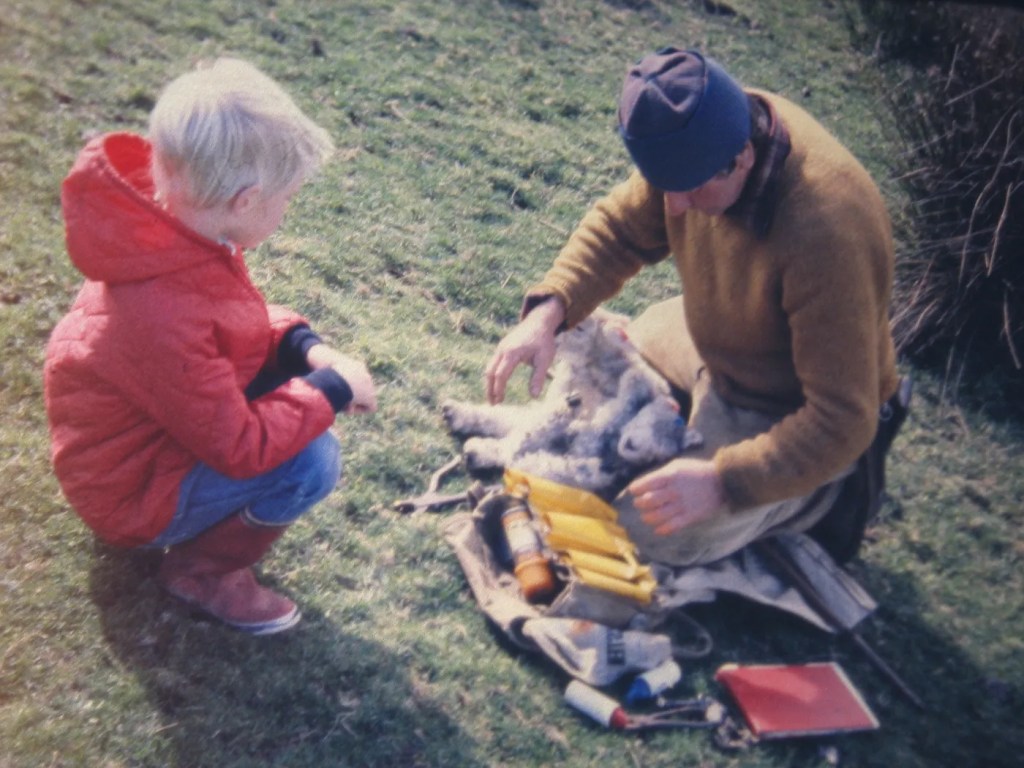
Fishing net capture. Coopworth breeder Edward Dinger at Cambridge started introducing the newly introduced Finnish Landrace genes into his Coopworths to boost fertility, and it sure did! So when it came to tagging lambs at birth he used a fish landing net to gather up the lambs (twins, triplets and quads) before they all escaped. The net firmly held them and the ewe could both see and smell them through the net so didn’t get stressed. (CliveD).
Leader tags. These were plastic tags that you could get in different colours which you slid through a hole punched in the ear and which we used to denote different groups. You could get them with numbers on too, but we relied entirely on the brass tags. Punching holes in sheeps’ ears was never a pleasant job for neither human or sheep. We often used to punch the hole and let it heal, so when we put the tag in there was no pain, or wrestling needed to insert the tag. (CliveD).
Comment from Jock. You could get letters as well as numbers on them. We bought a thousand numbered Leader tags for the original L& S twinning 2ths coloured orange that I’ll never forget! So it was known which station each ewe came from by the number sequence and how many from each station, but the information was probably never used by the managers. (Jock Clayton).
Lost brass tags. To avoid the bother of having to re-order tags that had got pulled out of ears, Bram Uljee got Jim Young, Ruakura engineer to make this anvil to stamp individual blanks with replacement numbers.

Rain rain. David Hall remembers 20+ days of solid rain during one lambing, and never out of wet weather gear and everything soaking wet. The arrival of waterproof paper in record books was a memorable development he remembers. (CliveD).
More on tags and tagging. It was always brass tags for all births, calves and lambs. Graham Hight was involved with the BL x Rom breeding trial at teh Station run by Ted Clarke, and there were coloured Leader tags used for different Romney flocks, and the different generations of BLxRom crosses. Naturally the F1 had the highest fertility and reducing at each further generation. I think we got as far as F4. There was no selection done apart from the obvious culls — bearings, teeth, udders etc. So, they weren’t the exact Coopworths which the breeders could do selection within the crossbreds.
The calves had a brass tag, as well as a self-punching aluminium tag which were ‘life time’ tags. The aluminium tags were imported from the USA (Ketchum tags I think) and had sequential numbers punched in them by the manufacturer. Being natural aluminium, the numbers were difficult to read, so we painted the numbers with etching paint, then smeared black paint into the impressions for some contrast. A wet weather job! The number part of the tag was about the size of a penny and was the largest tag on the cattle beast and had to be read for all identifying at weighing and sorting. They only got the brass discs on a neck chain as pre-calving heifers, and kept on till the chains or brass discs wore out, or culled. No readable ear tags till the Ritchey tag came on the market.
The other aluminium tags were similar, but longitudinal with numbers as well, but larger than a brass tag. I don’t remember using them though, and I think they were bought as a precursor to the brass tag from the Farmacy. The brass tags were used because they had the year date stamped on them which was necessary for ageing the cows, as needed.
The aluminium tags were bent into an open triangle shape and loaded on to a triangular bent strip of cardboard held with a paper clip at both ends. When the cardboard got wet/damp, the tags would often end up in a mixed-up bundle in the bottom of the calving bag. It was judicious to have only a short sequence of tags so that there wasn’t a jumble to fossick through in wet weather. (Jock Clayton).
Docking at birth. For a few years we docked newly-born lambs with rubber rings as part of the recording routine. This supposedly was to save work when docking them later at 3–4 months old. But then Jock remembers that it became essential to vaccinate for pulpy kidney, and scabby mouth which increased and could be spread to humans, so the wee lambs were spared the pain till later in life, and it was one less chore for the shepherd. The law has now changed so pain relief must be given at docking now. (CliveD).
Wanted: Experienced driver. Back in the 70s/80s it was common practice to put all job ads in the Waikato Times. The Station was looking for an experienced driver and duly advertised. After the usual interview process with Joe McLean, an ‘experienced’ driver was appointed (not to be named!!). However within 2 weeks he had managed to:
- Get a build up of bracken fern slash under the engine of the air-cooled SAME tractor and cause a fire which burnt out most of the electrical wiring
- Put the truck over the bank
- Twist the chassis and hoist on the truck so that the tray no longer fitted.
- Damage a post hole borer and twist the bar on a chainsaw
- Generally alienate himself to the other staff.( Neil Wood reckoned that he could break a crowbar)
Joe was getting a little annoyed as were others by this time, and he ruefully confided in me that he felt that he had been conned by the previous employer,(from a general contracting business in Hamilton) and was a victim of the ‘Perfect Reference’ trick. Joe explained it this way…If you wanted to get rid of a worker with out sacking them, the trick was to actually find a new job for them in the paper( preferably better paid), then encourage the worker to apply..tell them how good they were and how it was time for them to step up etc etc — even help them wth the job application. However the most important part of the deal was to supply the worker with the perfect reference and with any luck they would get the new job. Yes, said Joe, I was the sucker in this case.(Lew Willoughby).
Joe’s many interviews. There was a period in the 1980s when the government Labour Department tried hard to get folk off the dole and into work, and they were only allowed so long on the dole having to prove that they were actively seeking work. Scores of them came out to the Station and poor Joe had to interview them, and fill in the paper work to say if they were suitable or not. Most of them made sure they showed they were not suitable and made it clear they had only come out to the Station for the ride. (CliveD).
Jack Dowd. You may have heard of Jack Dowd who was a very well known shearer in the NZ Shearing competition, and held Shed Records in the 70s and 80s and even a bit later. Jack was a bit of a larakin, very good looking with dark hair of which he was very proud, and it was swished back in an Elvis Presley style.Well some time around 1980s Vince Gainey who was the contractor at the Research Station is those days, sent Jack with the gang to do our crutching.
The job of the crutchers was to do a Pre Lamb Crutch — Full Flank, half Belly, Eye wig and one blow under the ear. In those days we had mainly full wool Romney ewes with huge wooly heads. The ‘one blow under the ear’ was a Station special, and not done on any other commercial farms. The idea was to clear the ear so that the technicians could clearly read the plastic ear tags of the ewes as they recorded the lamb birth details in the paddock. Jack was fast but he was also rough, and regularly ‘forgot’ to do the one blow under the ear. It was my job to give him a ‘bomb’ for his error, which I duly delivered. In the midst of his sheep, Jack paused momentarily and said — ‘Look mate, I came ear to get a cheque not a blardy reference’! (Lew Willoughby).
Ah So, Ah So! Ram score marker! After a visit by the German President which went very well, the Station was firmly on the tourist map, at least as far as the big wigs in MAF were concerned. So we became very used to busloads of overseas visitor turning up. One day, I was asked to meet a group of Japanese Meat Importers ( this was in the days when we were still trying to convince Japanese housewives to eat lamb).
They were accompanied by their wives so there about 20 all together travelling in a coach with an Interpreter We met them at the small set of yards and implement shed down at the Station entrance at Heddon Road and it was either John Fitzgerald or Ian McMillan with me.One guy started poking around in the shed and came out with a Ram Harness. Through the interpreter he asked what it was for. As manfully as possible we gave a full and frank explanation which the interpreter then explaIned to the interested group, who by now had finished lunch and were ready for whatever came next.
It was obvious that the explanation had not got through as there were puzzled looks and more questions all around.The visitors were having lunch sitting around on hay bales etc (too give the rustic ambience) and the interpreter tried again with the same result. More puzzled looks. However one guy did get it and to make it clear to the group, he ordered the interpreter to get down on his hands and knees and then he put the harness around his own torso with the crayon in position and then he “mounted” the interpreter who looked a little startled!!
The Japanese ladies could barely contain themselves as they tittered and giggled with their hand to their mouths in astonishment .In the meantime the two of us had retreated behind the shed where we virtually split our sides laughing. (Lew Willoughby).
The wether that never lambed. Despite all the care of recording and data handling, in one of the Breed Comparison flocks we discovered a 3 or 4-year-old wether — believe it or not? It had hidden its identity all those years, and even hadn’t been discovered at shearing. We didn’t advertise the fact and the worst thing was that after keeping it all that time, the baarstaard never lambed! (CliveD)
Four-titted ewes. Some farmers with Coopworth ewes and high-fertility flocks would let ewes feed triplets, but quads were just too many for a ewe with two teats. But there was always a ewe with two extras and interest started about the possibility of selecting for these extra teats. Rob Moore did a little ‘research’ on multi-teated ewes at the Station as some ewes had small extra teats, and he thought he could select them and produce ewes with 4 teats like a cow, to feed the extra lambs from the multiple births the NZ sheep farmer was going to have to deal with in the future from the high fecundity ewes!
I think he may have picked up some ewes at shearing, after weaning when the ewes were still drying off. The ones that had a functioning extras didn’t have enough mammary tissue to produce more than a drop of milk, but it didn’t discourage him. I told him he was wasting his time, and cited a report I had read in a New Scientist magazine some time previously, and had photocopied, as I had found it quite interesting. The research had been done by Alexander Graham Bell (the telephone man who had a farming interest) in Nova Scotia about 1930, and he had established a flock of multi-titted ewes, but had no luck in developing any ewes with any extra significant milk supply. I think this stopped Rob in his tracks.
However, I was quite keen to see what percentage of the Whatawhata ewe lambs had supernumeraries and when we dragged them over the board for an autumn fly crutch, I got the guys to record all the tag numbers of those that had 3 and more. Surprisingly, there were quite a lot — not sure what percentage. Having the tag numbers, I was able to go back over the birth records and find those that were born as twins. This turned out to be 30% which was a surprise as well. The corollary to this was to make sure when selecting the replacement stock, check for supernumeraries and as this can be done early when the twins may not be large in size, there is less chance of them being culled to the saleyards. We know that the extra teats are useless for extra milk production, but are a quick, rough method of picking twin ewe lambs. I did not repeat the observation in subsequent years. (Jock Clayton)
Footnote. I remember being approached by husband and wife Coopworth breeders in the central plateau somewhere who had made great progress in selecting ewes for extra functional teats. The reason he approached me was to get my support as a MAF sheep scientist to help them stay in New Zealand and carry on their sheep breeding, as they had failed to get the appropriate papers and were being deported. They were from central Europe somewhere. Their years of work would probably have ended up at the meat works. (CliveD).
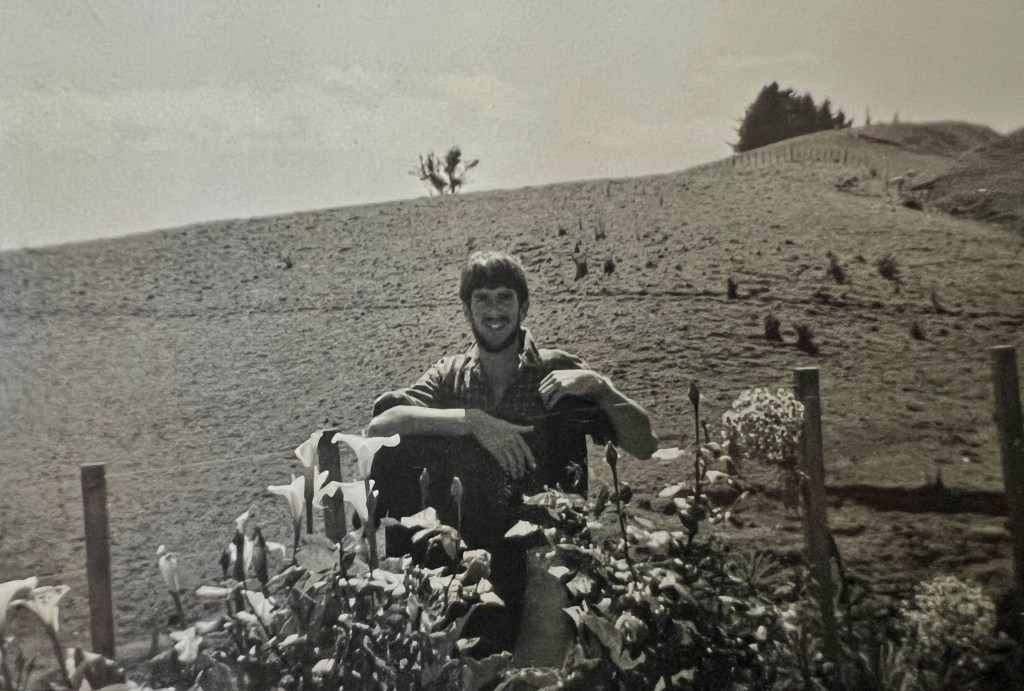
Skippy. The first trial I did at the Station with David Hall as Technician who did the field work was coded RW8. This was the reference of the ‘Project Proposal’ (meaning Ruakura Whatawhata No 8) that had to be signed off by the Director of Ag Research, after going past folk like statisticians to make sure it was properly designed and would provide valid results from crossing Merino rams on to Romney ewes. We called the offspring ‘Merneys’ and wrote the story up in the NZ Journal of Agriculture. An orphan lamb ended up from the work which I kept for the kids and was named ‘Skippy’, probably after the very popular TV series at the time with a catchy theme tune about ‘Skippy the Bush Kangaroo’. He must have lived for around 8–9 years producing a fleece every year that I turned into cash at the wool merchants in Frankton.
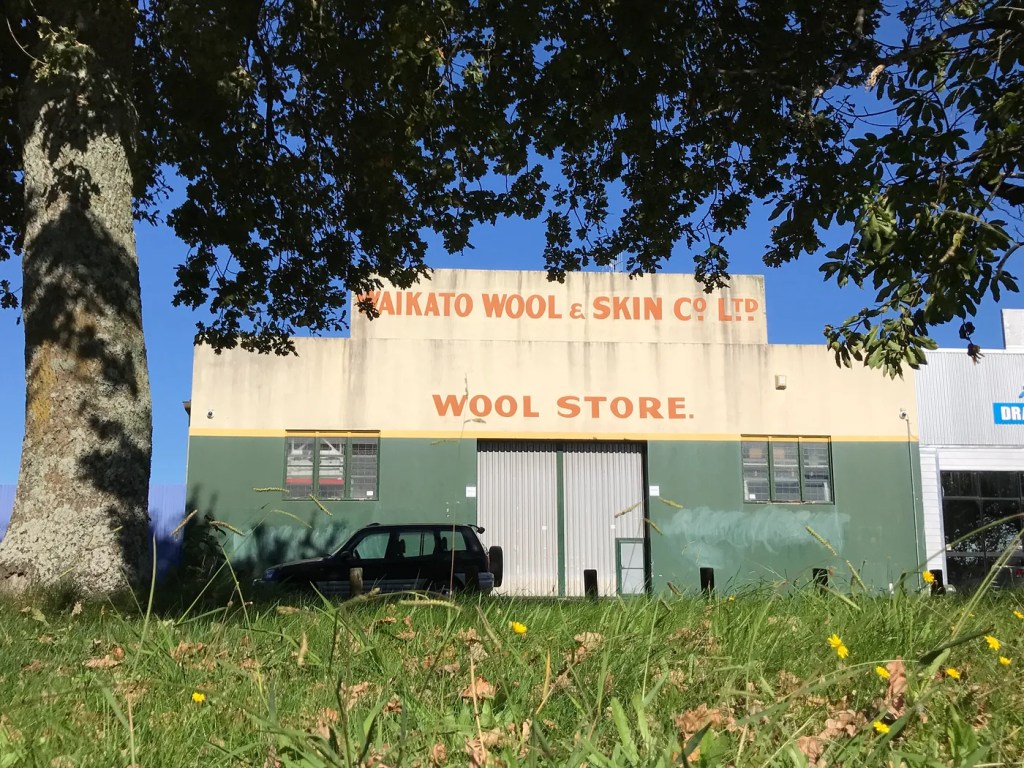
The wool buyer was always interested in it as he only saw strong wools and wondered where I had got it. One year we got about $30 for it which I spent on buying a watch for both Paul and Nigel.
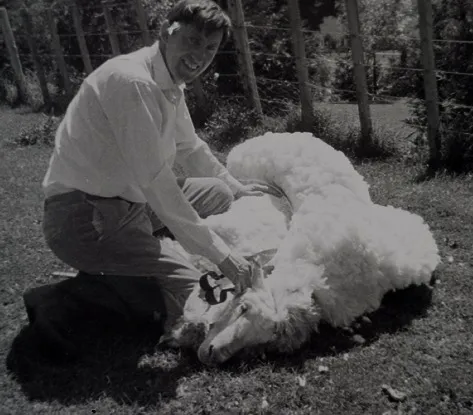


Skippy lived in the paddock by the house on his own and drank from the drain coming out of the mine hole. When it got really dry the garden hose was appreciated. He always answered with a single bleat when we shouted his name.
Flushing. To increase ovulation rate and final lambing percentage (lambs weaned/100 ewes to the ram), the traditional practice was to ‘flush’ ewes by putting them on good feed for at least three weeks before joining with the rams. This was especially important with the New Zealand Romney, as the demand for meat and wool had changed the original imported English Romney Marsh into a short legged wool-blind sheep, with an average lambing percentage of 90%. Many hill country flocks docked only 50% due to low ovulation rate initially, followed by high lamb mortality.
Research at the Station on flushing, and how the effects of these treatments were quickly revealed came when the laparoscopy and scanning were developed. There was lots of tweaking done with timing of the different treatments and levels of feeding to get improvement.
Flushing by shearing before the rams went out was also known to stimulate the appetite of ewes, so trials were done on this too. Shearing 2-tooths in particular gave the best response. On the Station, the period after weaning lambs was tricky to manage, with trying to fatten some for the works, cleaning up rank pasture with cattle, trying to put some weight and condition back on ewes (especially the ones that had reared twins), dealing with oncoming drought conditions, as well as preventing fly strike, and worrying about the inevitable facial eczema season. What a bastard of a job drenching for FE prevention was, bringing mobs of sheep into the yards on a regular basis and drenching with a concoction of zinc and other ingredients that wrecked drenching guns, stained the wool and leaked all over the place. Difficult to mix the ingredients and difficult to keep the zinc in suspension.
One of the issues with pre- tup shearing was that the length of the wool. It was OK if it could be 5–6 months staple length, but pre-tup shearing MA ewes produced wool that was short and worthless, and ended up in the dags! There was little proof that this boosted ovulation in the older ewes, and the farmer had to wear the extra shearing costs. But the main emphasis was on pre-tup shearing 2-tooths that gave a better response and their wool was more marketable.
Then there was pre-tup drenching to kill worms and improve ewe condition, pushed hard by drench companies, as they made millions of dollars from it. They didn’t tell farmers that mature ewes had developed a high immunity and internal parasites were not a problem in well fed ewes. And vets didn’t tell farmers either, as selling drench was a major earner for their clinics. What it did provide were large containers for the drench that made great rubbish bins, and there was quite some competition among the Station staff to grab them when empty. (Jock Clayton).
Footnote. See earlier story about discovering the effect of ‘Ram Smell’ stimulating oestrus and ovulation.Jock remembers a Henshaw cartoon where the shepherd had the crush pen full of ewes and he’s hosing them down — to ‘flush them’!
Johnny Bregman’s family farmed at Te Mata and his father always took him to the Ruakura Farmers’ Conference chaired by the famous Director Dr CP McMeekan. He remembers one year at the end of a report on pre-tup shearing, McMeekan summed up the research results by saying that ‘you older ladies should leave your fur coats on before mating, while the younger ones should take them off’! Only McMeekan could get away with a comment like that! (CliveD).
Jack Beaumont’s Mum. She was one of those salt of the earth people, so capable at all the old skills, a women without frills you might say and so kind. A couple of years into married life and heavily pregnant with our first child, I mentioned to her that I would like to preserve some fruit to store away for our family. She offered to come and spend a day peeling and preparing fruit and show me what to do. So I found the fruit, bought some more jars to supplement the ones my mother had given me and all the other bits and pieces, and we set to on a very hot day mid February in our kitchen at the research station. I think Mrs Beaumont, (always that) sat at our kitchen table in our Station house all day preparing fruit and I did the cooking and bottling. Mrs Beaumont was quite disabled, though I don’t remember why, and so wise and fun. And a fine example of how to manage with age and disability and still lead a happy productive life. I loved the way she just nodded off in her chair for a five minute nap in the middle of a conversation and came back rejuvenated ready to continue.(Denise Hall).
LANG, Douglas Robert. B Ag.Sc. (UNZ) MS (Cornell) Ph.D (UQ) Died 15th August 2022 aged 88 years after a short illness. Doug passed peacefully after a wonderful life filled with adventure and learning. He had a long, happy marriage of almost 59 years to Bev. Treasured Dad and father-in-law of Fergus and Deanie, Jordan and Lorne, Megan, and Ben and Stephanie. Adored Poppa to 16 grandchildren and 4 great-grandchildren. The best of men- he will be greatly missed.
SPECIAL MEMORIES
TRIBUTES. Doug went from the family’s small horticulture block in Levin to Massey College, and then took off on his OE, calling in at research stations across the US. At Cornell he got a Scholarship to work in the reproductive physiology group, and then went to UK where he taught school for a while hoping to study at Oxford. But he took advantage of a free voyage to Australia accompanying immigrant children, to work at Armidale and then Brisbane University. He then worked for CSIRO in the northern WA with cattle that didn’t like humans! Gordon Edgar recruited him to work in Wattie Whittlestone’s group at Ruakura, and then to take over as Superintendent at the Whatawhata Hill Country Research Station when Ted Clarke moved to Ruakura to start and run the National Flock recording Scheme. While still carrying on his sheep and cattle reproduction work at Whatawhata, he also led an expanding team of scientists from NZ and overseas to meet the expanding drive for increased production from New Zealand hill country. Doug was also the instigator of the Romney and Angus cattle breeding work with L&S at Waihora near Rotorua. He later moved into private business specialising in embryo transfer and exotic cattle breed genetics. (Clive Dalton)

Personal tribute. Clive Dalton. I owe Doug a special tribute, as when the Ag Departments at Leeds University along with Oxford and Glasgow were closed due to oversupply of graduates we were told, I was jobless with no jobs in UK, but happened to meet a Kiwi Scientific Officer from the NZ High Commission in London at a NAAS conference in Leeds. He said he’d drop a line to a Lin Wallace at a place called Ruakura, which we undergrads at Kings College, Newcastle got sick of hearing about from our new Dean — a tall gangling Kiwi who wore tweed suits and called us by our first names. He was Mac Cooper, and had been a good mate of another Mac he kept telling us about — McMeekan!
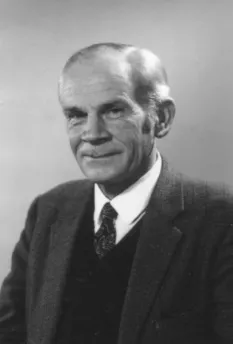
There was a vacancy at a place called the Whatawhata Hill Country Research Station, as Dr Manika Wodzicka-Tomasweska had left to go into Ruakura after her husband Matthew had died at the Station. Doug appointed me which I always kept reminding him of the massive risk he took, of appointing a Pom ‘sight unseen’! And I kept quietly thanking him for changing the life of the whole Dalton family, who after 53 years in Godzone have decided to stay, thanks to Doug! Poms from the north of England don’t like rushing decisions!
By now, seventy hard copies of The Whatawhata Research Station memories have been printed, and folk other than those of us working at the Station under Doug’s leadership, have really enjoyed them and enjoyed a laugh or two. Readers’ overall comments are how we all seemed a great whanau and worked so well together. We didn’t wear our ranks — if there were sheep to dag or crutch, we all got stuck in. We were a whanau for sure, and that was due to Doug’s leadership, which we will all always remember. With Doug’s passing, a mighty Totara has certainly fallen in the bush up behind Back Range on the Station. RIP mate. (CliveD).