
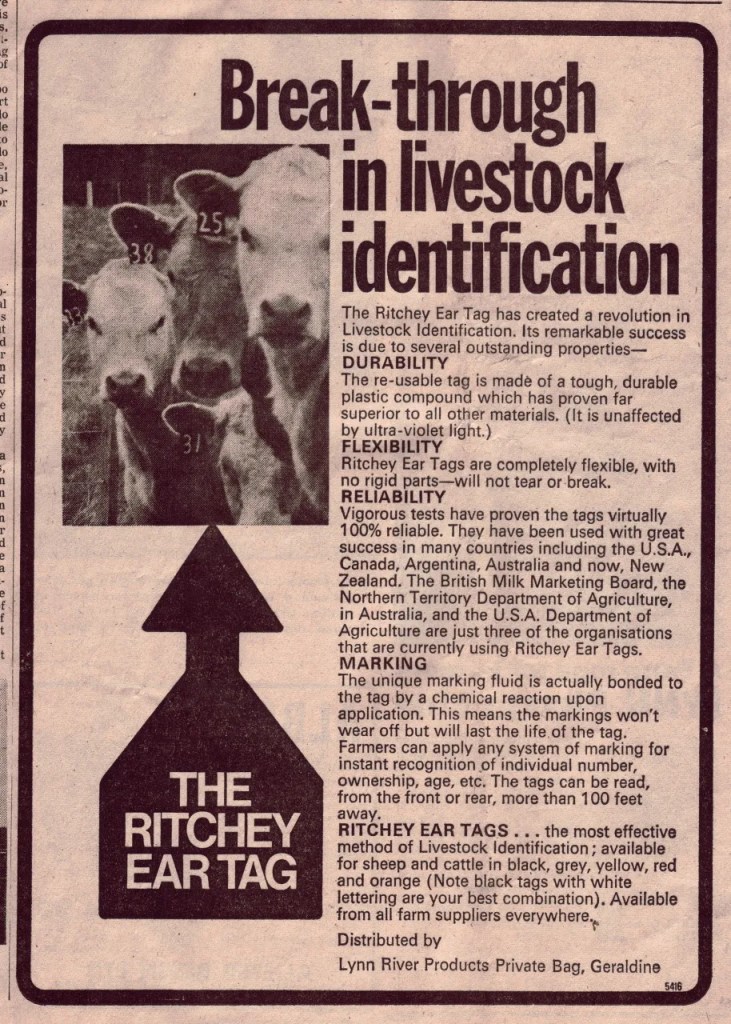
Ritchey tags. When I took over the L&S Angus breeding scheme at Waihora, we had to decide on how to ID the 600 wild cows, and as our Station had used round brass tags on chains for years, Graham Hight thought they were the only choice. Thankfully the Ackland brothers of Mount Peel station in the South Island had bought the agency to produce the USA Ritchey plastic tags.
They had an arrow shaped part on the back that you placed in a nasty looking dagger, poked it through the ear and the arrow prevented the tag coming out when you pulled the arrow out. The numbers were written on with permanent white ink. The tags were made by Plastic Products in Te Rapa and I got the first lot — still warm out of the oven! Graham I’m sure was disappointed that they were ideal for the job. But there sure was some fun putting them into a slobbering unhappy wild cow in a head bale, me poking a dagger through its ear and manager Peter Guy with his hand up its bum doing a pregnancy test. If the cow’s head moved and the ear flicked when you were half way through with the dagger, the ear got split along its length so the cow then had two ears on the one side! It was certainly safer to work on your own to prevent your helper being stabbed. (CliveD).
Footnote. Jock Clayton remembers them being used on sheep on the Station, with the same experience of how dangerous the insertion dagger was.
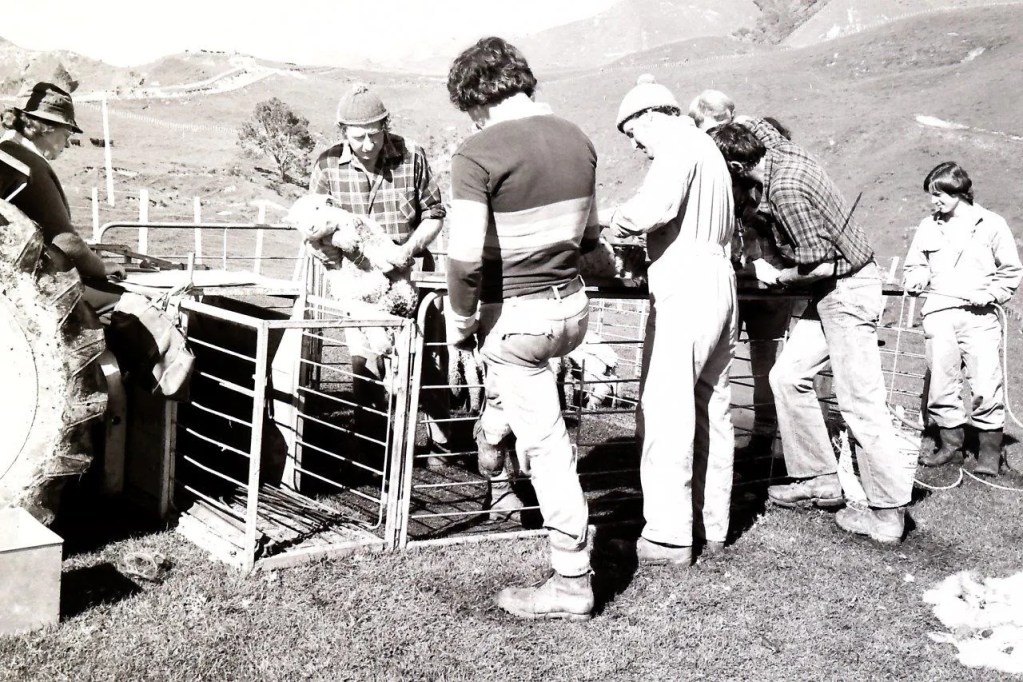
Weighing sheep. This was almost a full-time job on the Station, and accuracy was the main aim, which relied very much on clarity of speech with so much noise going on. There was the shouting of people pushing the sheep up the race to the scales, the dogs barking and especially dogs that could not be commanded to shut-up, then there was the banging of the doors entering and leaving the scale crate. So the important trick after the tag reader had shouted out the number, for the recorder to find it on the record sheet, was for the recorder to repeat it aloud, so the reader could check again. Unrelated conversation was banned, as was a tag reader who smoked and always had a dead fag in the side of his mouth so his lips were permanently half closed.
But the biggest hazard was a person who had a brain affliction that transposed letters and numbers and they didn’t know it! That’s why the records person repeated the number back to the reader. There were also people who could retain numbers for a long time after a sheep had gone through previously. And we always checked the readers colour vision with the wide range of coloured tags used! (CliveD).
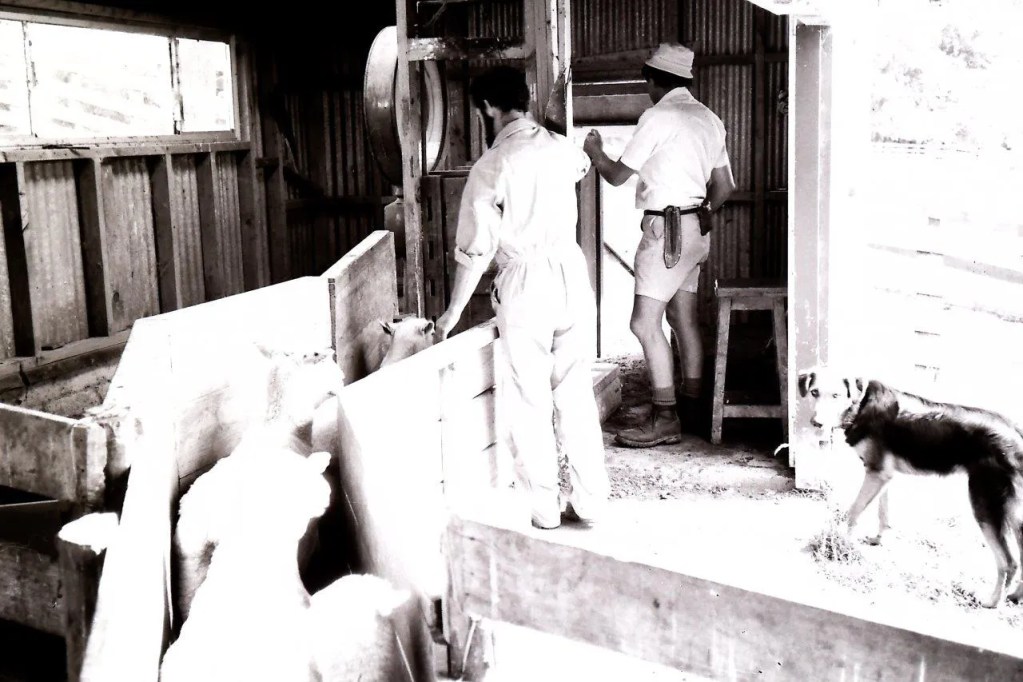
Feet and teeth. These are two very important traits in sheep selection, and Joe built a raised race beside the woolshed to do this which we copied from Waihora to make the job easier. It was great, as you didn’t have to grab and hold the sheep and do battle over the job. It was especially valuable for feet as you could inspect them in a normal standing position.(CliveD).

Ram butt. Joe made a great job of the sheep yards at Barkers, especially with one of the two crush pens. It was made very narrow for one person to work through sheep, without ending up with a hernia from stretching their legs wide apart to block the sheep just finished with. Jock and I were in it one day harnessing two Perendale rams. Jock at one end had the ram sitting on it’s bum, and he was head-down bent over checking the raddle block. I was blocking off the other ram at the other end (so I thought), until I felt the sod bolt past me at full tilt and hit Jock a fair wallop! It happened in a flash — as Perendales can. Jock could have been concussed. Don’t like to think about it now! I don’t think Jock remembers it! (CliveD).
Lambing/Calving books. It’s hard to believe in this age of electronic devices with waterproof touch screens, that at lambing and calving, we had to record data in small books printed by the Government Printer (Ref AgR ?), complete with a sheet of carbon paper in the back to make a duplicate copy of each page. The top copy was torn off along a perforation and given to the office technicians (always girls), to write up on to A4 or A3 data sheets to go to the card punchers in the biometric section at Ruakura.
Recording in the paddock was a great job when the sun shone on your back and everything was dry, but when it was raining and worse, it was a whole different world. Then we worked with the book inside a plastic bag, which soon got soiled so was hard to see through. Your hand was permanently wet and this wetted the page, so we had a bit of card for our hand to rest it. But soon the card got wet, so you had to keep a spare piece.
It was also prudent to have a few plastic bags as they could end up holding dead lambs, placenta, a foetus, all for post-mortem examination. Only a pencil would write on wet paper, which was tied on a bit of string attached through a hole in the book. The other essential was a towel around your neck to stop the rain running down, and to regularly dry your hands. After really wet days the soggy muddy shitty pages had to be dried out in the office before they could be read by the staff.
The carbon copy in the book allowed you to check for errors from mis-read tags, mixed-up tag numbers, or from animals that had lambed or calved in previous days and had somehow given birth again! It was once suggested that we use tape recorders to save all the writing, but none of us took it up, despite some top farmers using them. We didn’t dare risk losing data as there was no carbon copy inside a tape recorder!
The one benefit of the war was the gas mask bag which we got long pockets stitched on the front to hold the brass tags from the Farmacy in Palmerston North. Initially these came on strips of card that got softened by the rain, so the tags were repacked on to wooden sticks, and held on by a rubber elastrator ring on the end to stop them all falling off into the grass. You only let that happen once! (CliveD, JockC).
Divers’ paper. The thought struck me that divers also needed to write under water. And after doing a bit of research, I found that there was a suitable paper for writing on in wet conditions. I managed to track down the firm making the paper and sent a sample page of the recording books with a covering letter to the Government printer.
I soon got a reply stating that they could print the recording books for us in MAF. This was music to our ears. (Bram Uljee).
Footnote. When designing the Sheeplan field notebook, we found a source of waterproof paper used in surveyors’ notebooks which was excellent for the job. (CliveD).
Wet notes. Following on from the success of Bram’s work for the lambing/calving books being printed on waterproof paper, the use of ‘wet notes’ for visual pasture rating was adopted. These note books were off-the-shelf divers’ notes, and solved the problem of soggy writing paper when recording data from pasture assessments. The problem was caused by dewy or wet pasture after rainfall when collecting grass samples, or rating the quadrants which were randomly tossed around the paddocks, as well as for plotting Dry Matter ratings. Fortunately, pasture rating wasn’t done in the rain very often. (JockC)
Data handling. In today’s techno world of mobile phones, tablets and laptop and desktop computers, it’s hard to think of how many hours we must have spent copying out data onto sheets of paper with printed squares to write in. No spread sheets or copy and paste facility then. The first government computer to arrive at Trentham, Wellington was made by the UK company IBM, and was used by a wide range of government departments.
It had MAF data on it, Sheeplan and Beefplan recording schemes and God knows what else. So when it had a sicky, everyone had one until the designers came out from UK to fix it. It was purchased as the latest model, which meant the makers couldn’t guarantee that it wouldn’t break down, which it regularly did! The Waihora Romney and Angus breeding data were analysed at Ruakura by Ken Jury and his team — and there was a lot of it! I can’t remember who handled my cattle data, either the office technicians or Rose Guy, the Waihora manager’s wife, but Graham Hight did all his own Waihora sheep data. He loved copying out tag numbers of individual sheep, in his extremely neat hand with a fine ballpoint pen. I went up late one night and he was still in his office, an ashtray full of fag butts writing out screeds of sheep tag numbers. I suggested he get a printout from Ruakura and he thought I’d gone bonkers. But the pen-written sheets were just the start.
They all went to Ruakura when a small army of computer staff punched the data on to cards making holes, then they punched them again to be lined up to see if the holes matched to check for errors, before being run on Ruakura’s newly arrived very own computer. This monster filled an entire air-conditioned wing of the Tower Block and I used to take visitors in to see the massive cabinets with their rotating disks. In later years I was given a chip about the size of a wafer biscuit that could do all the same work. (CliveD).
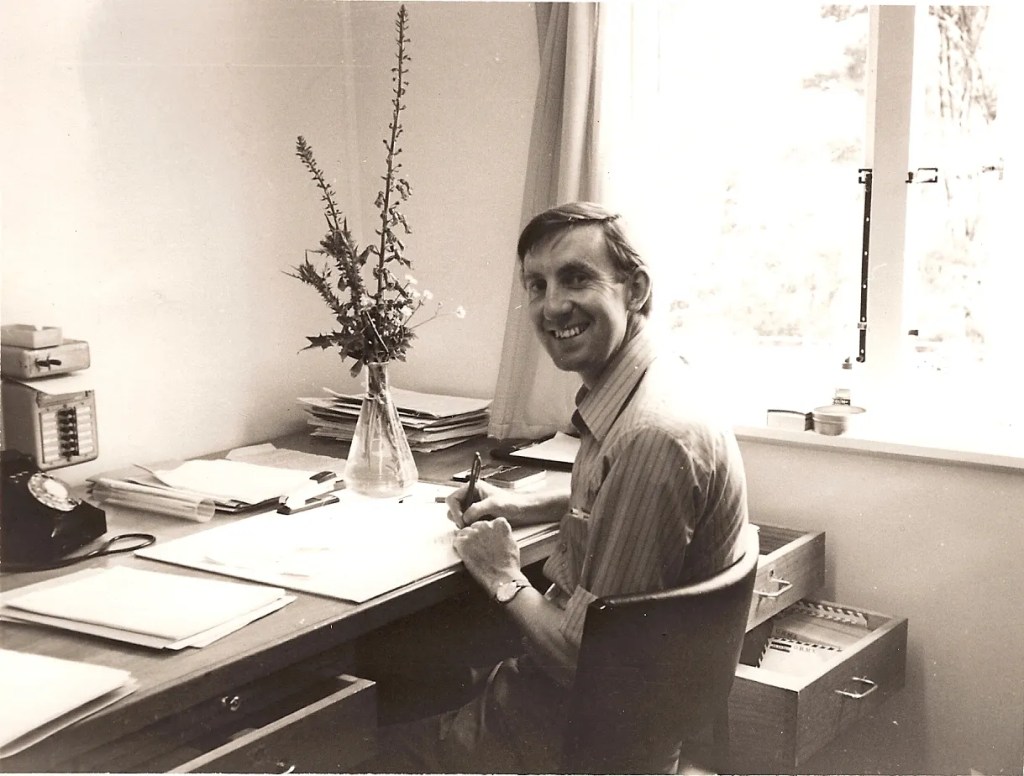
Statisticians. The branch of mathematics that became statistics was pioneered by the world famous R.A.Fisher, and before this, all researchers could do was to crudely compare means and the biggest won the day, without concern about how reliable it was. Statistical analysis of research at Ruakura and from the Station really began in the 1960s by Ruakura staff who went overseas to study, mainly at Cambridge. The key people who analysed our Station data were Ken Jury, David Johnstone and Dave Duganzich, assisted by their teams of technicians.
The output from the massive Ruakura computer came out on ‘line-flow’ paper which were large sheets of faintly lined high quality paper, printed only on one side, with holes at each edge for the printer to spit it out. The statisticians kept this in cardboard boxes in their rooms, so they appeared to inhabit paper caves.
I grabbed many a box heading for the dump for the kids at Frankton school, as it was high quality paper to write and draw on. The staff were so grateful and some commented on what all the figures were on the used side! (CliveD).
Open days prep. Getting ready for the annual Ruakura Farmers Conference held in the Farmers’ Hall at Ruakura, and then our Open Day at the Station was no mean mission. If any of us had papers to present on the Beef and Sheep day on the Tuesday, (Dairy day was on the Monday), we had to get it written and approved well ahead. Then if we had material to be presented on slides at the conference, or on 8 x 4 boards at the Open Day, this took longer as it needed the skills of photographer Don McQueen, graphic artist Pauline Hunt, and sign writers Ken Feurs and Peter Ballock. They were a mighty team. Don could be in a lab photographing a bacteria down a microscope one day, and a Charolais bull in a paddock the next!To make slides, you took your data to Pauline who with stencils and Indian ink converted them into a format which Don then first photographed, and then mounted them between two pieces of thin glass, held together with masking tape. The finished slide was then clearly marked with details and a spot on one corner to hold the slide when put it in the projector cassette, upside down and back to front.
There was a small projection room high up in the back of the upstairs gallery in the Farmer’s Hall , and at the appropriate moment in your talk, you either shouted to Don – ‘next slide please’, or banged the pointer on the stage floor which was an accepted change signal. God help you if your slides were loaded the wrong way, and they appeared on the screen upside down, and you expected Don to fix it for you while still talking, hoping the audience would also be able to twist their necks to see! It was best to avoid Don for a day or two after that.
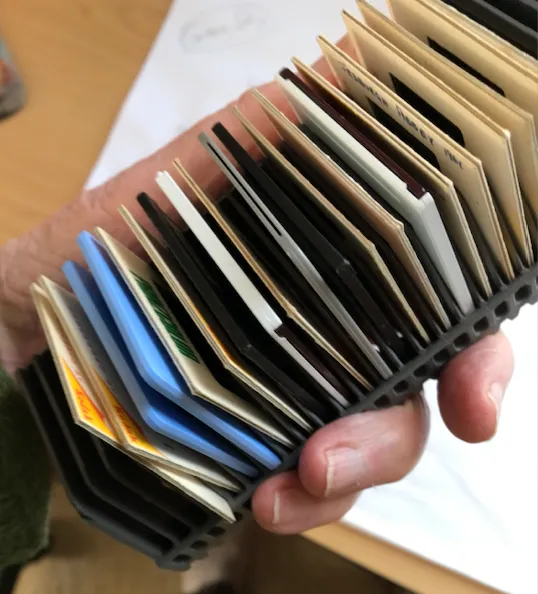
But the mother of all disasters was when you had carefully loaded your slides in order into the projector cassette (which had no top) and on the way up to Don’s pigeon loft, either you weren’t paying attention or you met somebody and stopped for a quick word, and the cassette got a tip and all the slides hit the blardy floor! The panic to check them, and get them back in order and right way up in time does not bear remembering! I well remember this happening to Murray Bigham, and my efforts to help only added to his trauma!
The other hazard was the solid wood pointer which was the size of a surf casting fishing rod, needed as the screen was massive covering the entire back of the stage. The pointer was parked up against the curtains on the stage when not needed and had a knob on the thin end to prevent it damaging the screen when in use. Neil Clarke remembers some scientists confusing this know for the handle leaving the heavy end for the pointer! If you didn’t take care to park it properly after use, many a time it started to slowly fall without you knowing. The audience, to their delight saw exactly what was going to happen, and enjoyed when it hit the hard stage floor with a mighty crack — and your surprise reaction. This greatly helped to make your paper memorable!
For the Open Day, you took your information in to Ken on a bit of paper which he then turned into an artistic masterpiece in no time. We had about 50 boards for our Open Day, and he must have done double that for the Ruakura Open Day. When done, you went in to check the boards and he would do any alterations. We needed the farm truck to collect our boards as they were no light weight, and it was no small job putting them up and securing them on frames. After the event they were taken down again to be used with new data next year.What’s interesting about those hundreds of Ruakura and Station boards, is that’s they are often the only place you’ll find the results of so many trials over many years that were never written up formally and published in recognised journals. (CliveD).
Dead lambs. Lamb mortality was, and still is, a subject not given much airtime by hill country farmers because it has always been a serious problem, and they just learned to live with it. So the rule was not to count dead lambs at birth or soon after, and get them quickly down the offal hole out of sight. The easiest official count of ‘fertility’ was done by the number of tails at docking if removed. Even then, I remember hearing that some Lands & Survey shepherds were always generous with their docking tallies sent to the office, so the ‘number of lambs weaned/ hundred ewes to the ram’ (the true fertility/fecundity measure) didn’t look too bad, and hence reflect on their management.The slink skins business caused some fun as farmers had to put the dead lambs at the gate for collection and for all the neighbours to see — and the kids to skite at school about how much pocket money they got from Dad for them!
So lamb mortality was a major long-term research topic at the Station, and involved many scientists with papers published in peer reviewed journals. We also wrote articles for the popular farming press and especially the NZ Journal of Agriculture which every farmer subscribed to. We also gave regular presentations at the Ruakura Farmers’ Conference and at our own Station Open Days. Both Graham Hight’s selection lines and my breed comparison trials over many years provided a mountain of dead lambs, (literally a stinking mountain if we’d kept them), which technicians like David Hall and Peter Lynch did post mortems on. The dead lambs collected from the lambing paddocks were delivered to the woolshed either in plastic bags or tied on bike handlebars with baler twine. They were damned heavy to carry around! The plastic bags were an essential to bring in aborted lambs.
The main causes of ‘perinatal death’ (defined as in the first 4 days after birth) was starvation/exposure for multiples, caused by mismothering, and dystocia (lambs too large for delivery) for singles. Jock Clayton remembers in the early years, before our staff were trained to do PMs, that all the dead lambs were taken in the Landrover to the Animal Health lab at Ruakura — another stinking job he remembers. That’s where any aborted lambs were taken too. Our Station research exposed the enormous size of the problem — and the sheer waste to sheep production, especially at a time when increasing production from the hills was paramount. In general terms 20% of lambs born never made it to weaning, and there were all sorts of ways to describe ‘lambing percentage’ to hide this statistic. It was, and still is a problem, and still not talked about freely. What makes sheep production losses even worse is the very difficult subject of embryo mortality, exposed by the advance of scanning ewes before lambing, so you can accurately measure loss of potential lambs between conception and birth. Research again has shown this to be around another 20% and of course is never seen on the farm. Nobody has found a solution to this loss either, and is on the list of things farmers don’t like to talk about!
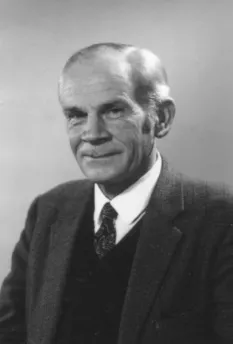
I well remember getting a call from the Ruakura office of Dr Wallace, MAF Research Division Director no less, to explain my article in the NZ Journal of Agriculture about the lamb mortality work we were doing at the Station — and the losses. What concerned him was the shocking figures of how many lambs we were losing, and why did I need to expose this to the farming community? I left with a flea in my ear but my backside was not bruised! I suppose his rear end was in the firing line from the Director General in Head Office, and then the Minister of Agriculture from questions in the House and if the media got on to it. Brian Talboys — a real gentleman was Minister at the time. Happy memories! (CliveD).
Photo calls. As the official MAF photographer based at Ruakura, I went out to the Station six or seven times, and one time I decided to take some late afternoon shots of the low sunlight, modelling the hills in the usual pictorial manner. Left it a bit late and by the time I came down the hill from the top yards, I found the gate at the bottom was closed and locked. I walked up to the offices but not a soul around! I then walked back to the car, wondering if I was going to have to spend the night there. Thankfully the boys who closed and checked all the property gates were secured for the night, turned up behind my car. Big sigh of relief!
My other Station memory was at Ruakura. Phone rings — ‘Scotty here. Get down here to the garage and bring your bloody camera. Quick as you can’. On arrival Scotty (the station mechanic) was in full flight — ‘We’ve just had this ute drive in from Whatawhata. Have a look under the bonnet’. There, tucked securely between the battery and the radiator was a bird’s nest complete with chicks, all with their mouths wide open obviously wanting to try this new Hamilton cuisine. I never found out if the poor wee things got back home, but no doubt there were two very concerned parent birds back on the Station wondering where the hell their kids had gone! (Barry Wylde).
Wild cows. On two occasions the station was visited by ‘commercial’ farmers who were most unhappy with the performance of our beef cows which were a fair representative of Raglan hard hill country cattle, regularly dealing with steep hills and droughts. They weren’t exactly their big fat types grazing the easier hills in the King Country and under-stocked. The visitors were mostly members of the Angus Breed Society and offered to sell us ‘good’ beef cows that would perform. The cows duly arrived over 2 or 3 days from various farms throughout the King Country and were offloaded at the main road cattle yards near Joe Maclean’s house. The handiest paddock was just out of the yards, about 8ha with two hills on each side and a creek running through the middle. They were left there to settle down for 3 or 4 days which meant spending all day huddled in a mob on one hill or the other, and grazing early morning or late evening. Anyone moving within 100–200 metres would put them into ‘anxiety’ mode. Inevitably they had to come to the yards for ID checks and be tagged with the Station numbering sequence for future research. Our adrenalin was at high level as we started them up the race.
They were so fat that it was a squeeze to get them up the race but were helped along by bulldozing from the one behind. They didn’t care! Underneath, or over the top, one bitch got herself completely on top of another in front, and squashed her down on to the ground. We backed off the ones behind as they were planning to do the same thing. Eventually we were able to get the one on top to scramble forward, then deal with the downer cow. We had visions of a dead cow jammed in the race, but with tactical use of alkathene waddies and shouting and cursing, we were able to get her up on her feet, without removing any rails. Having tagged them all, which was an exercise fraught with extreme danger, they were let out of the yards back into the paddock by Joe’s house.
They were the sort of mob, when shifting, you would open the gate(s) first, then let them find the way themselves. To get them across the main road, there was a team of us to control that. Two staff up and down the main Raglan road to stop the traffic, and several stockmen with dogs to ‘guide’ them across onto the main block side, once released from the yards. It took them a long time to settle into Station life and our trials never did satisfy the Angus breeders. (JockC).
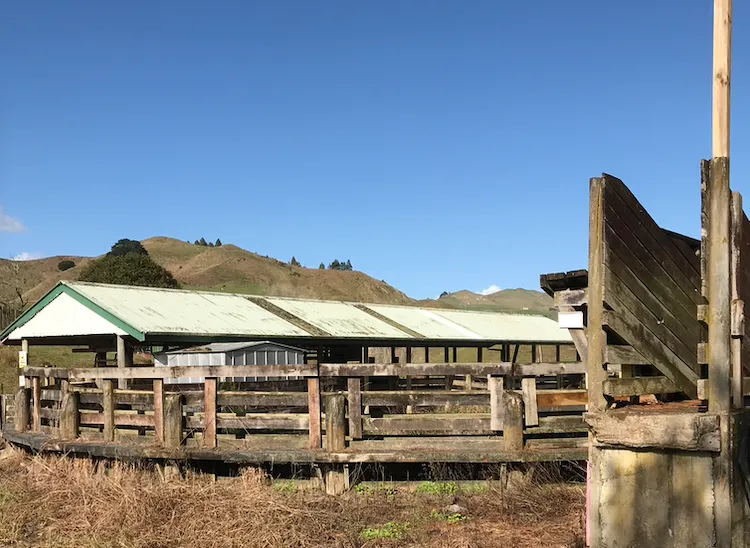
All Black Friesians. On a sunny autumn day as I shifted the new Whatawhata Friesian herd on to the new Yeoman’s Block. The herd moved easily and the cows headed down the steep slope towards the small bridge over a creek before they started frolicking and kicking their hind legs into the air. My thoughts were ‘Oh Shit’, what will happen when the lead cows get to the bridge?. Well I didn’t have to wait long, as the unstoppable throng of cows soon demolished the sides of the bridge as they dived into the boggy creek. When I arrived at the scene, cows were churning up the black stinking mud, with many having landed on their backs, and others thrashing around in the mud. It took a while, but much to my relief they all made it to the opposite bank. It was a sight to see, an ‘All Black’ Friesian mob climbing up the other side of the gully! The bridge needed new sides and strengthening for sure after that.(Bram Uljee).
More on mad cows. Jock Clayton and I were expected to calve these nutty cows that loved to chase dogs and people. One cow about week or so after arriving got crook, went skinny and quite mad, and wouldn’t move with the mob. So when I went back later to shoot it, she had disappeared. But reports from Alf’s pig hunting trips over the next few months described ‘a cow doing OK in the Bush’.
Much later I heard it turned up in the neighbour’s beef bull herd ready for trucking to the works. The neighbour was quietly told to send it off with the bulls and keep the proceeds! We also had a couple mad cows calve together. They rolled their calves up and down the paddock bellowing blue murder, then swapped calves and settled down a notch or two, but the next day one cow appeared to have broken her back. As I was walking up to her for dispatching with the rifle, she crawled towards me using only her front legs with head in a mad bellowing fury spitting fire.
Amazing vigor right up to her final moments, as the poor beast probably knew what I was about to do. (Aaron Malthus).
Meat Board trials. In the 1980s, Duncan Smeaton was running a farmlet trial comparing single and double-suckled calves. The trial was funded by the NZ Meat Board, so was overseen by a Meat Board rep and a small group of ‘mentors’ from farming backgrounds. At that time, we had a mixed herd of cows consisting of Angus and Friesian x Herefords, but they decided we should introduce another cross breed — Hereford x Angus. These were scarce as hen’s teeth, but after a lot of searching, a herd was located near Rangiwahia, east of Mangaweka and adjacent to the Ruahine ranges. The truck and trailer units with them on board arrived at the top yards, and even with the trucks stationary, they were still shaking violently with the movement within the crates. The drivers told us about the scary and dangerous job of loading them at Rangiwahia and said that every stock driver in the North Island that day had heard about ‘these wild cattle’. So we knew we were in for a heap of trouble. The calves on the top decks came off first followed by the cows. All were kept in separate pens to prevent smothering or smashing rails.
The truck drivers left, most relieved they had got rid of their loads. The appropriate gates were either open or closed to allow the cows and calves to move to the paddocks I had allocated. By the time we had let the last mob out of the yards, the first lot of cows and calves were running past the airstrip, not knowing where they were going, but going like the clappers. After a couple of days, they were all brought back to the yards for tagging and any other ID to be recorded.
I spent many hours over the next few days on a strategic hill or under cover, with a pair of binoculars to match up the calf with its mother. Any disturbance would have them moving into a mob and away as far as possible from human activity. We discovered that they were off a rough hill country farm run by an old codger who was giving up farming.
They had been ‘handled’ only from horseback, so a human on foot was an alien species, and they probably only saw a set of yards once or twice a year for Tb testing. The truck drivers told us the farm yards were totally inadequate and almost destroyed when they left. They had to leave a few behind as they couldn’t be loaded. ‘And are we supposed to do research with these bitches’, I asked Duncan! (JockC)
Lesson for Duncan. When Duncan Smeaton was doing beef cattle research in the mid 80s with support from the Meat Board, he got one result that he didn’t publish. It was the discovery that you never leave your car door open and window down when lively mad cattle are going past, as when you go back to your vehicle, your door isn’t there. And when you find it, it’s hard to fit it back on again! (Aaron Malthus).
Mating harness for bulls. When Doug Lang arrived at the Station, he surmised that it would be useful to have a method of indicating the oestrus activity of beef cows, and an adaptation of the ram harness might be a good start. Bram Uljee was appointed ‘development officer’ and must take credit for all the work that went into producing something that in the end worked particularly well, providing a heap of data on pre-mating, mating, and post mating activity.
It turned out to be a long difficult journey with differing shapes of harness, and experimenting with a range of colours and mediums that might work. Fortunately we had a mature Angus bull that was very quiet, and was suitable as a guinea pig to try out all the various models and materials. He was called ‘O bull’ as he had a white circle of hair on his side which some Angus strains have.
He got so used to all the handling, that Bram was able to walk up to him in the paddock and adjust straps and buckles without having to walk him back to the yards. The first harness was modelled on the ram harness but made from canvass and leather by Frank Paviour’s company based in Hamilton, and who was involved in most stages of the harness development.
A big sponge in a canvas pad arrangement was attached on the brisket like the ram harness, with a plastic pipe up the side of the girth strap that was used to fill the pad with some concoction of white lead and oil. This lasted for a short time as various other fluids and viscosities were tried. The pad was soon discarded as most of the fluid was squeezed out on the ground when the bull was resting. I don’t think it even saw the back of a cow. (JockC).
The Chinball. Then Doug Lang and Graham Hight had a bright idea. Why not try the principle of the roll-on deodorant applicator? The idea was given to a skilful sheet metal operator at Ruakura who made a small stainless steel box thick enough to enclose a large steel ball bearing inside a sleeve, and spring loaded to force the ball against the carefully ground hole on the outside of the box. A brass screw-in plug provided the entry point for the fluid.
Frank Paviour was contracted to make a leather harness to which the steel box was attached. The harness was made on the same lines as a cattle halter, but was a good sized piece of leather that went under and to the rear of the jaw, partly up the side, with a strap over the nose and one around the back of the ears and head, and attached to the rear piece under the jaw.
While this was being developed, Bram was busy in the ‘paint’ department. He had acquired a black cattle hide from the abattoir which was hung on a fence outside the old woolshed. Every combination of colour, product, and fluid medium possible was tried with samples painted onto the hide and weather tested. Nothing worked! Even the most intensive colour (rhodamine dye which was used in the gorse spraying) would wash off in the ‘rain’. House paint was ok and intense enough, but would have dried out in the container and bung up the hole.
There was heaps of advice from most of the staff while Bram was on the phone contacting painting and colour specialists. Finally, the best suggestion! Printers ink, and when a sample arrived, Bram knew he was on to the right thing. There was a range of colours, it was a thin creamy fluid, and came in 1 litre plastic bottles so could be easily poured into the tank on the bull harness. What’s more, it showed up well on the cow’s hide and withstood weathering for a couple of weeks. The Chinball was born! (JockC).
Chinball tank problems. Frank Paviour who did the leather work for the harness did a first class job using top quality leather. But after a while complaints were coming in from farmers about the stainless steel tanks made by a Te Rapa company. The tanks were getting easily dinted, causing the roller balls to drop out or disappear inside the tank, and allowing the paint to escape.
It took some time discussing the problem with the makers, till it was found out that they had moved to a thinner steel, without telling us , presumably to reduce costs. So much for company integrity! We told them to go back to the originals and there was no more problems. (Doug Lang).
Footnote: Ray and Ruth Armstrong on a motor-home trip in 2020 called in at a woolshed museum at Waimiha near Taumarunui, and there on the wall was an old well-used Chinball. Ray said the owner didn’t know what it was, and appreciated Ray’s explanation — minus a bull! I told Ray he should have bought it to hang on his lounge wall! (CliveD).
Bull power. The bull mating harness had to be changed regularly, and this was usually done at the cattle yards with the aid of the head bail. As one Friesian bull was quite docile, to save us at least an hour to drive him to the yards and back, a fellow technician and I thought the change could be done in the paddock. So the plan was to get him behind a gate and shove an iron bar behind his rear to hold him tight. As a backup we slipped a long rope over his head and tied the other end to a big tree stump. It worked like a charm, and the old harness came off his head quite easily. But when trying to slip the new one over his nose, the bull became very uncooperative and kept his nose close to the ground. No amount of prodding was successful in making him lift his head up, and he became very agitated so we could no longer hold him behind the gate. He broke free and took off down hill. The rope tightened around his neck, and then to our utter amazement, the big tree stump came right out of the ground. The bull then headed down into the tree-filled gully, and the next thing we heard was a lot of thrashing and banging and we found him on his side in the creek. So what we thought would be just a half hour simple job, turned out to be something very different. (Bram Uljee).
Alf and the bull. On my way home one day I saw Alf Richards jumping the main 7-wire fence by the old radio shack, with a bull following him in hot pursuit. So I raced up to the beast, dropped the bike and threw my raincoat around spooking it back towards the woolshed where it spent the night on top of the hill daring the adventurous to approach. It turned out that a truck driver was just changing his load around at the yards, and this bull took the opportunity to do a runner and then make a statement! (Aaron Malthus).
Japanese visit. We used to entertain special visitors in the homestead lounge, and showing them the bull mating harness was always a feature. One group I remember hosting were having difficulty (probably though translation problems) of understanding what the bull harness was for, until there was a loud ‘Ah So’ from one guest. He leapt to his feet and made his mate get down on the floor on hands and knees, then he with harness held below his chin, he mounted him. The whole building shook with loud cries of ‘Ah Chinball, Chinball, Ah So, Chinball’! (CliveD).
Rat tucker. We must have had more than 20 ram mating harnesses with their different coloured wax crayons and along with many ‘Chinball’ bull mating harnesses. So when not in use, the lads dutifully treated all the leather with raw linseed oil, and put them in a cupboard in the store at the top yards to be nice and safe. But there was a problem — rats love leather soaked in linseed oil, and when we went to get them out next season — Hello, why are so many of the straps missing and what are all these little black pellets? The rats must have been feasting in there big time. (CliveD)
Taiwanese Ninja. A student of Asian agriculture called David Chang stayed in the hostel for a week or more, and John Lane was asked to look after him this particular day. While out the back doing a stock shifting job, they came across a ewe which had died a few days previously and in an advanced state of decay. John didn’t want to take the carcass back to an offal hole and decided to sling it into a patch of scrub over the edge. John explained the swing ‘1, 2, 3’ method.
So John on one end of the carcass and the Taiwanese lad on the other, they swung and counted. John let go on the count of 3, but the lad didn’t ,and he flew over the side with carcass into the scrub and gorse. There was a profusion of Mandarin, and he struggled out with arms and legs flaying like windmills. John thought it wise to stand clear and not ask him to go back down to check the ear tag number which John had forgotten to do! (JockC).
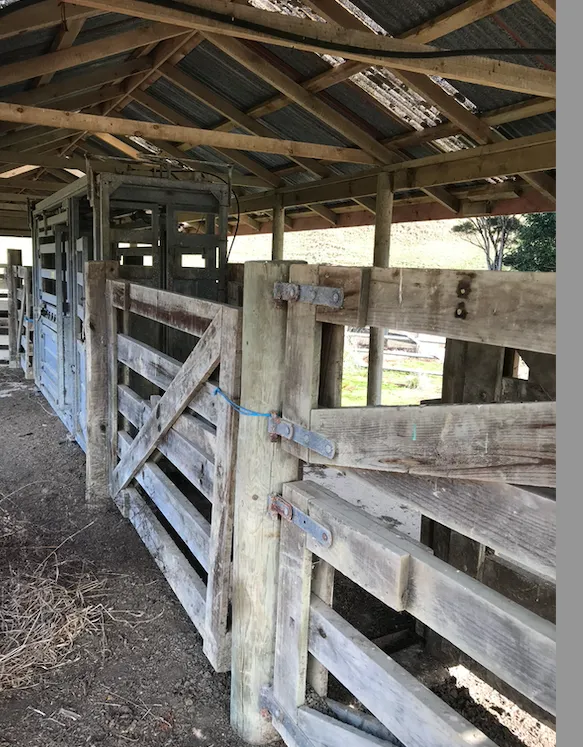
Farm transport. After the two Land Rovers (short and long wheel-based) died, a weird 4×4 vehicle arrived with a Nissan front end, but the back was a tall structure like a prison van painted dark blue and with no side windows. When you opened the single door at the back (with a small window) it was lined with aluminium and had two rows of what could be called benches along each side.
We were told it had come from some Government Department in Wellington (Harbour Board I had heard), but Jock remembers it had been an ambulance used in one of the Pacific Islands — and was now surplus. It was so useless for the Station’s needs that Neil Wood took the back off eventually and fitted a flat deck which made it of some use.
But then Jock remembers the donors wanting it returned, so thankfully the back had not been made into a chook house or dog kennel so Neil put it back on again before saying farewell, and before we got a brand spanking new powerful 4K Toyota Landcruiser. This had two major problems in my view. Being designed for Japanese, there was no room to rest your boots in the space behind the peddles and before the petrol tank. Mr Toyota had designed it for Japanese feet. And the other serious one was the complicated back door setup.
With a bucking ram held between your knees, first you had to unlatch the very heavy spare wheel and swing it aside, then there was a top section of the door to lift up, and then two small doors below that which opened to each side. After you heaved the ram in, you then had to shut all these four bits before he jumped out at you. With the old Land Rover you only had one door to shut which could be used to block the ram! Many times, I had composed a letter to Mr Toyota to come and try putting a ram into the back of one of his fancy blardy vehicles! (CliveD).
Nuffield over the side. There was the wheeled Nuffield tractor at the Station when I started, as well as an International BTD6 crawler, and at some time a small Ford Dexta. One morning, Dick Thornton and I were heading down the track on the Nuffield for lunch, and on the way down we turned off the road by the Cliffs gate and drove up into the Wilsons paddock next to the Plantation. (This track was eventually to become the down track).
Dick had eyeballed some old native wood logs handy to the track, and wanted to grab them up for his fire. The carry-all was attached to the tractor rear so we started loading the firewood onto it with the Nuffield parked on fairly level ground. Then I noticed it start to roll slowly towards the edge of the track. In an instant, a wheel was over the side, and there was no stopping its ever increasing momentum. Dick’s Huntaway bailed out quickly as the tractor took off down the hill. Very quickly it rolled over and over while gathering speed.
The front axle bracket broke off the chassis frame and the wheels and axle were being flung around with each rotation of the tractor, but were still attached by the steering rod. Fortunately the tractor stopped rolling about 20m from the top of a much steeper part of the paddock. The bully was used to pull the Nuffield back up, and it was taken down to the workshop where a new bracket for the axle and a new steering rod were attached, and the old girl was ready for use again. The only sign of the accident was a slight dent on the petrol tank! (JockC).
Another Nuffield slide. A colleague who shall remain nameless and I were tasked to return, using tractor and trailer, a number of ewes that had been to the woolshed for Laparotomy surgery back to their paddock in Browns 3, which was serviced by a track with some steep gradients. I was driving the tractor and before we got to a rather slippery slope on the track, I stopped the tractor and asked my mate to inspect the track to see if it was safe to proceed. He had a look from above the track and soon called out ‘she’s safe as a church mate’!
So I slipped the tractor into gear and as soon as we got onto the slope the tractor started to slide, and the heavily laden trailer pushed the tractor along. By this stage I had lost steerage, and to my left a huge drop into a gully loomed up. However, It was fortunate that the front 2 wheels of this UK specialist row-crop tractor got into the water table, causing the trailer to jackknife towards the bank and we slid backwards down hill some 10m before coming to a stop.
A very close call! Thinking back, It was not uncommon for wheeled tractors to be abandoned in tricky situations, and it was always left to Joe McLean and Neil Wood with the faithful International bully to retrieve them.(Bram Uljee).
The ‘SAME’. The Nuffield was designed for row-crop work on flat paddocks on arable farms in UK, and would have to be one of the most dangerous tractors with its high centre of gravity for a hill country farm. Nobody knows where it came from to the Station — probably a cast off from Ruakura where it would be suitable. Thankfully it was replaced by a much safer Italian SAME, 4-wheel drive with large front wheels and tyres, and you sat astride the gear box. Jock remembers it had a strange arrangement of a high/low ratio gear box, and no synchronous changing on the move unless you got the speed exactly correct, so you had a lot of grinding and crashing of the gear box. Some of the controls were in Italian and there was one ‘Aviamento’ that I have Googled and it means ‘Start’! But you certainly got a better feeling of stability driving it with it’s very solid safety frame than on the old Nuffield. (CliveD).
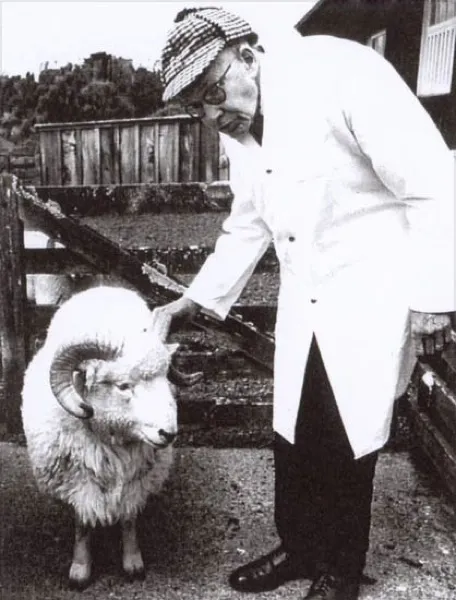
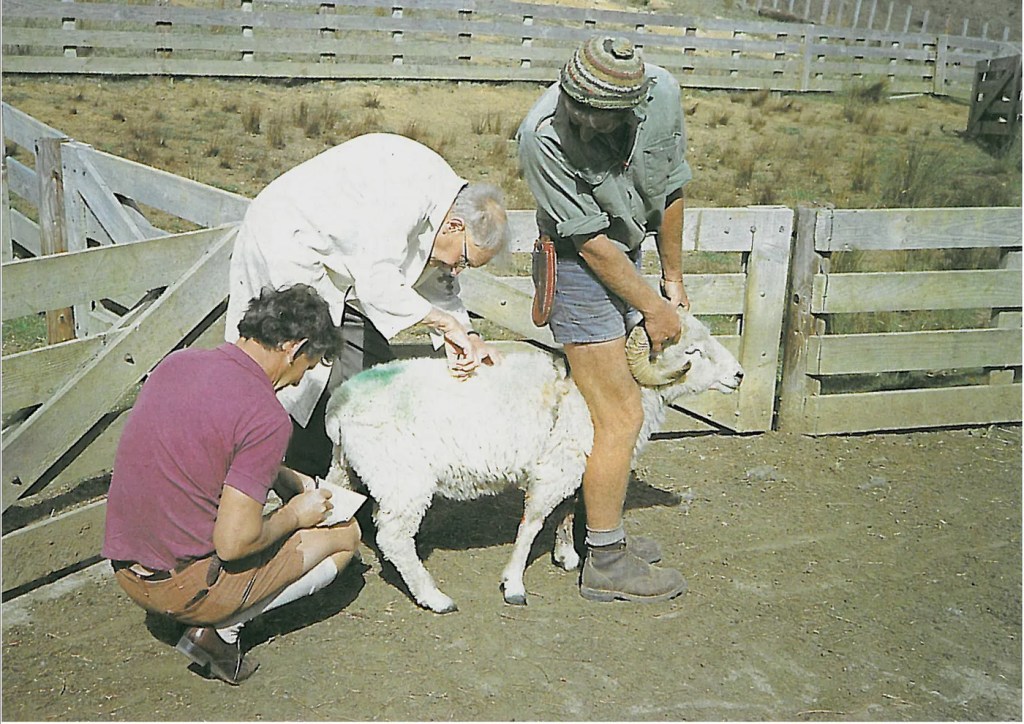
Daddy Dry. Get his full story on the rest of the Woolshed 1 blog . Look for Dr Dry in the index on the right hand side. He stayed at the Station for a week or more once looking at the fleeces of our Drysdale flock, especially the rams which we had to lease from the carpet company UEB who owned them, to make sure they had a monopoly on the wool for their carpets. Daddy took over a lab and was even there in the evenings.
His special bit of equipment was a piece of black velvet on which he laid out fibres as they were easy to see. I called in one night to see what he was up to and for a chat, as he took over my office in the Ag Dept at Leeds when I left. We talked for at least an hour and during that time he held a single ‘super sickle fibre’ (one of the many classifications he coined) in a pair of tweezers for the whole time. I felt like suggesting he find a place somewhere to put the blardy thing down! It was starting to get on my nerves! (CliveD).
The Station ute. I inherited the Station ute when I first arrived, and its main function soon became obvious; it was a mobile kennel for my dog Ted! We lived in the house up on the hill from the office with a very steep twisty drive up to it. I became very adept at parking the ute on the slope ready for a smooth getaway with a keyless start. Our private car was a brand-new automatic Holden; our first automatic for which of course I failed to read the manual.
As I was leaving early for a meeting at Ruakura one day, I parked the Holden the night before in the ready-to-go position. I jumped in next morning put it in gear, released the brake and we began to roll, and of course it failed to fire, and I quickly found I had minimum steerage and almost no brakes either. I managed in great panic to get round the two hairpins and hurtled towards the entrance and luckily hit a large bump that swung the nose of the car enough to cross the cattle-stop and bridge. I hit the highway at a fair speed and was lucky that no other vehicle wanted the same bit of road. I stopped outside Neil Wood’s house in a great sweat, glad that I had done my toilet chore earlier! Nobody had told me about needing to have the motor running for steerage and brakes to work, but I do read the manual of any new toys I get these days. On looking back, I was quite lucky not to have become ‘the ‘former Superintendent’! (Doug Lang).

The Headbail. With so much new cattle work started on the station, new yards were needed and were built with staff involvement. One day I went past the site and saw a head sticking out of the ground. It was Doug, deep down digging a hole for one of the main roof supports for the cattle yards! A headbail was needed and fortunately Doug had worked in the Northern Territory with wild Kimberley horned cattle, where they had a model made by a local engineer. So he brought the plans to the station and Neil Wood made one up. There was really nothing on the market like the fancy ones today, but at the time this was the tops which the engineer at Whatawhata Products took up and sold for many years. (CliveD).
The swimming pool. J.J. Stewart the Principal at Flock House (and famous ex-AB coach) knew all the Public Service tricks when you wanted major infrastructure projects done that would never get approval. You called them something else! So when the station population increased, it was clear to Doug and Joe that the houses needed fire protection, and only a decent sized storage facility would do. The paperwork was somehow approved, and the end result was a ‘fire protection reservoir’.
The MOW must have made some mistakes when building it, as it ended up shallow at one end and deep at the other, with steps down into it with handrails and painted blue. There were of course pipes to the houses and across the road to the offices. It was a key facility for both Station adults and kids, and their town friends to socialise and learn to swim — and thankfully never had to be used for its main intention. It’s still going strong. (CliveD).
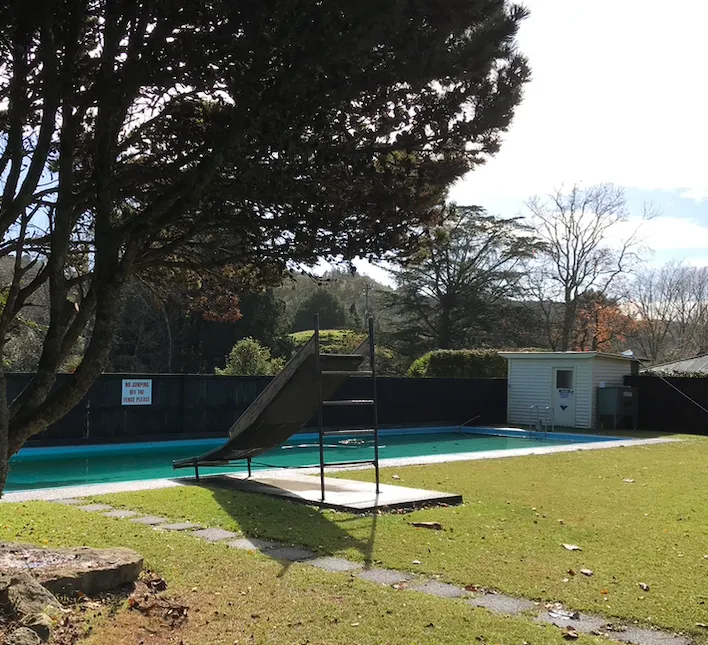
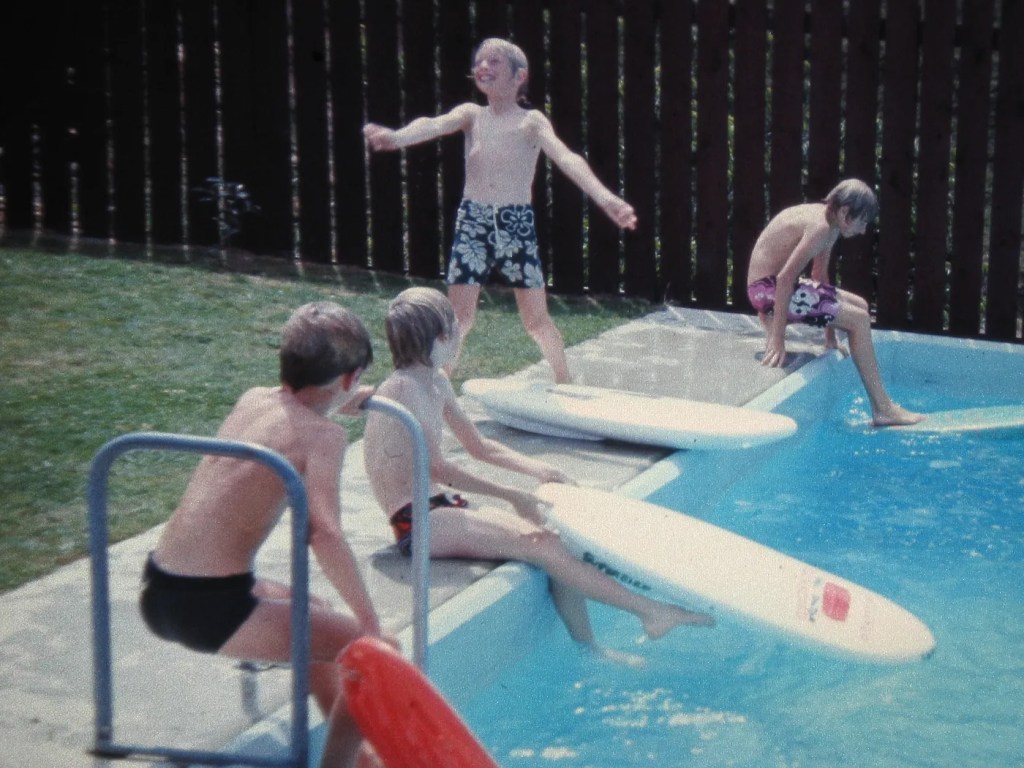
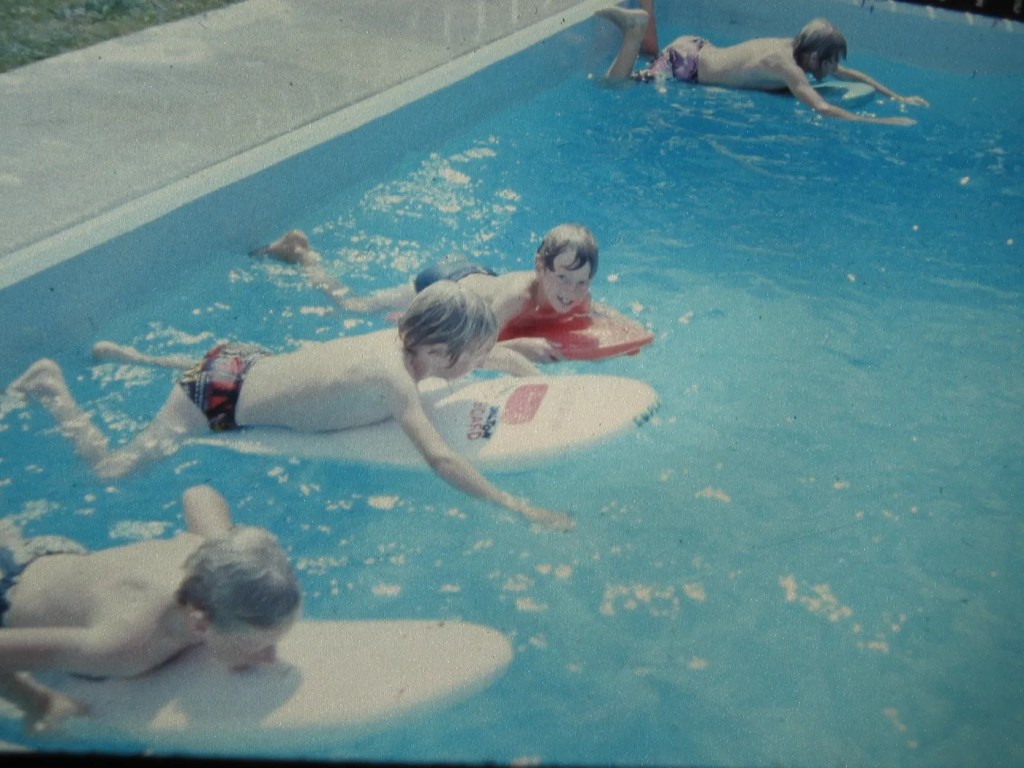
The old swimming hole. Many years before the new pool (fire reservoir remember!) was built, Station folk could cool off in a blocked up part of the creek over the fence from the Superintendent’s house, that came down through Wilson’s paddock. Somebody made a concrete barrier to form a dam deep enough to swim in, and it was drained after each summer by pulling a wooden bung on a chain which let the creek flow normally again.
Jock Clayton remembers how it was always blardy cold, and the shade provided by the overhanging trees didn’t help warm it up either. The somebodies I remember were the Clarkes, Steph Haynes, Bob Stack, Godfrey Mackersey and Graham Umbers. Graham was the main director of operations which involved Dolly the draft horse pulling a drag bucket to pile up a 6-foot high earth dam about 12–15 yards away from the little waterfall.
I greatly enjoyed this adventure having served an earlier apprenticeship with Dolly under Joe MacLean’s guidance, snigging strainer posts up a creek for a new fence near Back Range. There was nevertheless much barrow work involved in the pool construction as well, to shift the swampy mud near the waterfall and around the edges to achieve a pool width of around 6–8 yards. The big deficiency of our first effort was the construction of the slipway — the first dam being washed out after of couple winters. Concrete and timber were used in later constructions. It certainly was a cold hole, but that did little to dampen the drunken enthusiasm of Ian Inkster and his Hamilton Old Boys Rugby Club team-mates, who used the facility for a couple of their Christmas parties. (JN Clarke).
Pool social events. When the pool was finished, the surrounding area was landscaped and somebody (probably the Station joiner) must have made some of those ‘Cape Cod’ wooden chairs with wide arms to rest your food on and legs over like the Aussie Squatter’s chair. They also had a sloping back for comfort to nod off. At one gathering I remember noting that the grey-painted chairs were getting a bit worse for wear, and the untreated timber on many had starting to rot.
One chair had no back at all, and it was this one that Rob Moore sat in at a gathering, as being an Australian and hence an accepted gentleman, he was last to get his meal from the BBQ and come to find a seat in our group. We had all grabbed the safe chairs and Rob started off OK remembering to sit on the front edge of the seat, and lean forward while eating. But half way through his meal, Rob must have forgotten and leaned back. We lost him as he disappeared with a classic back somersault, with only his large arse pointing towards the heavens.
We all downed our plates to his rescue, but we had a hell of a job and it took more helpers to unwind him as he was no small lad. But all was not lost, as his remaining dinner was still on his plate in perfect order, tight up against his chest, so he could carry on and finish it. The hardest part was not letting him see we had all wet our pants trying to smother our laughs at the poor bugga! (CliveD).
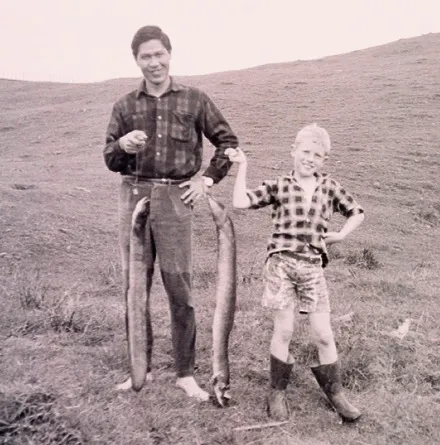
Elvers. To get quickly from our house to the office, I used to go across the small paddock across the road, then step across the creek and climb up the steep hill, over the style and down to the road entrance to the Station. But after a series of floods the walls of the creek that used to start away on Johnstone’s property kept falling in, and the creek became too wide to leap.
So the kids and I built a bridge and noticed what we thought were earth worms stuck on the clay sides of the creek. On a closer look they were not worms but elvers (young eels), literally hundreds of them, and we learned about these amazing creatures, where old eels after maybe spending 50 years in the creek left NZ for the Kermadec trench to produce eggs which hatched, and the wee elvers came back to where their mothers had lived.
We always had a world map on the kitchen wall, and it was mind boggling to to see how far these critters had travelled on their way back up our creek, to spend their lives there till they were old enough to go on their great journey. (CliveD).
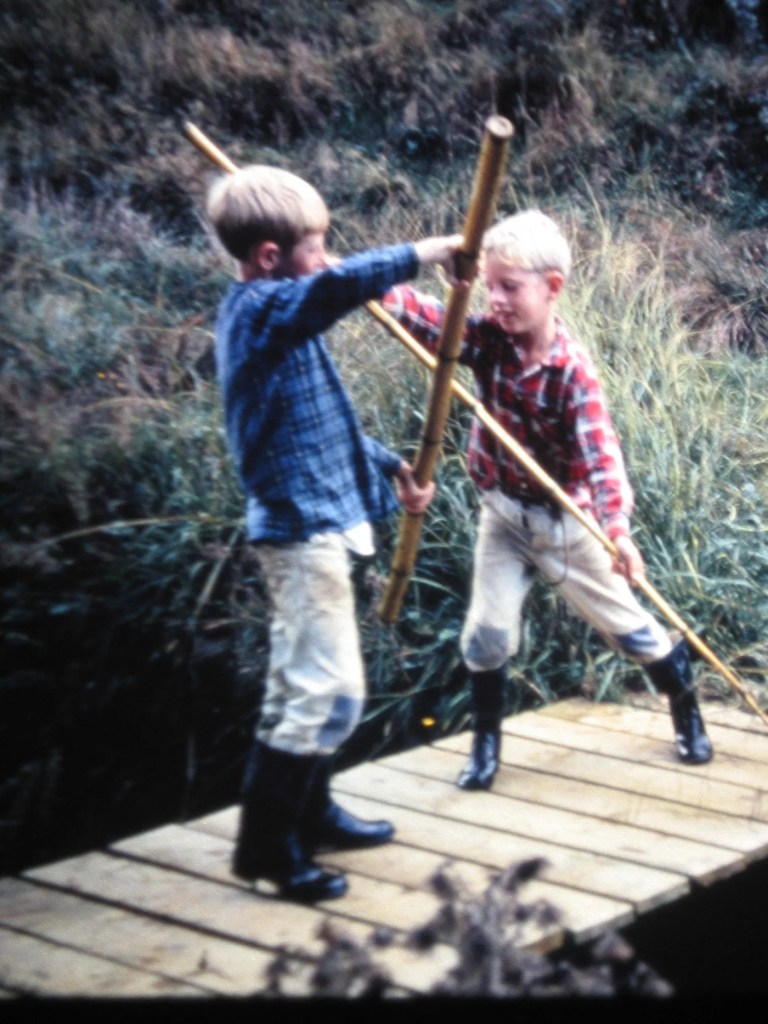
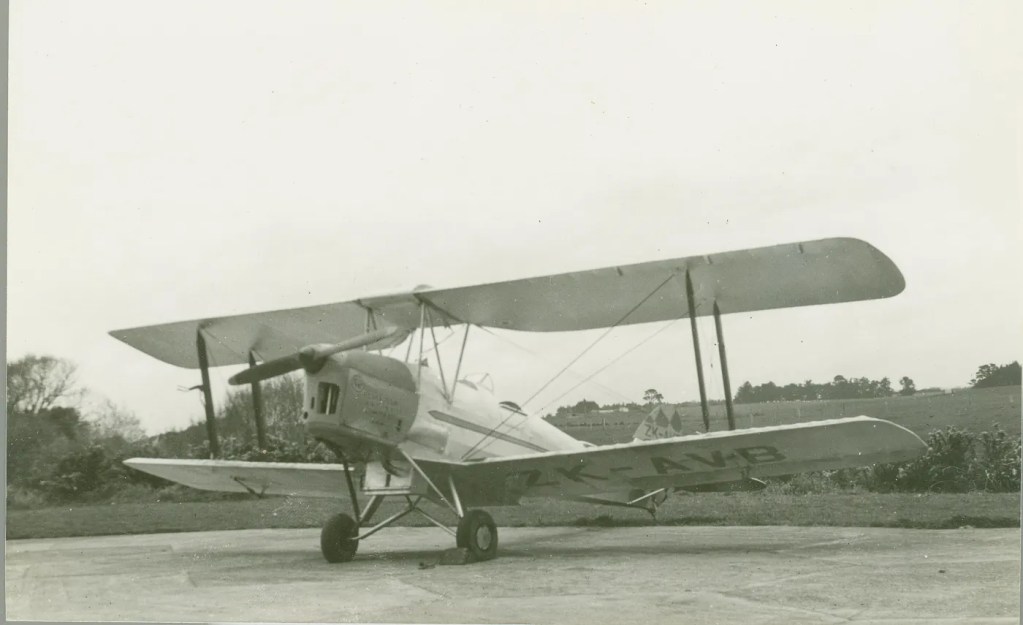
Ossie James. Ossie was the pioneer of aerial top-dressing in NZ and started out in the Gisborne hills but shifted to Hamilton in the early 1950’s. My father Ted was also an early advocate as part of his hill country development goals for the new Whatawhata Hill Country Research Station. Ossie’s early efforts were based around Tiger Moth biplanes, often on downhill runways and carrying excessive payloads.
I remember one early morning I had the worrying experience of watching Father Clarke being flown off Johnson’s airstrip beside the Karakariki straight in Ossie’s Tiger Moth.
Father was sitting on the lower wing holding on to the struts, while being taken on a flight to make the Station boundaries clear to Ossie. After that and a few spreading flights, we adjourned back to the station hostel for breakfast cooked by Mrs Allen who was in charge of the single-person’s accommodation. She was another character and was always up for a bit of banter. On this occasion she was suffering from a sore shoulder and while changing for breakfast she called out from her room — ‘Can anyone help me do up my bloody bra?’ ‘I’m no use’ called back Ozzie, ‘but I’m pretty good at undoing bras’! (JNClarke).
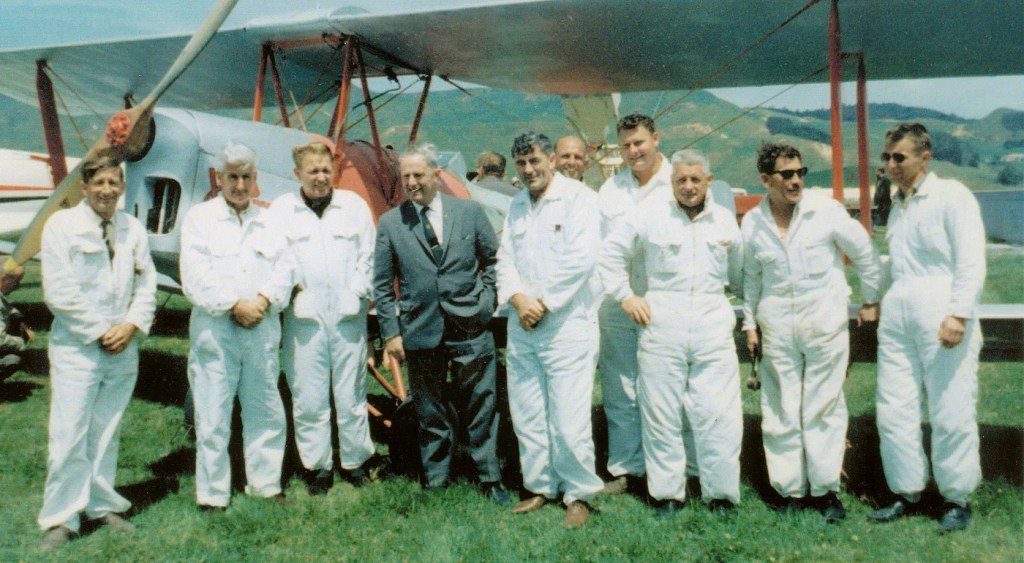
‘Hood’. Ian Inkster had a Huntaway called Hood who he taught all sorts of tricks, like standing on his back legs and climbing ladders. Hood was a likeable fool, but absolutely useless at herding sheep or cattle. Father Clarke became foster-parent to him while Ian went to study reproductive physiology at Cambridge University in UK. Hood went with Father everywhere in the boot of the car, often spending the night in confinement when he was left there by mistake.
Hood’s biggest claim to fame was to sire a litter of pups, one of which was ‘Mogi’ who became the best Huntaway I have ever owned. There was a tradition at Ruakura that staff went to Cambridge to do research towards a Ph.D. under the world-famous scientist Dr John Hammond, who actually came out to Ruakura. At Cambridge CP McMeekan worked on pig growth, Lin Wallace on lamb growth, both completing their Ph.Ds as well as publishing their work in a highly respected UK research journal. Ian Inkster didn’t! It was said he had a great time at Cambridge and was enormously popular, but not surprisingly, his Ph.D. never appeared! (JNClarke).
Deputy Director. Ian Inkster was a candidate to be Wallace’s deputy Research Division Director based at Ruakura, but there was a fair group of scientists strongly against this idea, as there were plenty other better applicants who had done great research and published it, which Inky had not. I remember Doug Lang coming back from the definitive Ruakura meeting where the rebels had planned to vote Inky out. I asked a depressed looking Doug what had happened, and he likened it to a dog pack where the yappy terriers were going to dive in low and chew up the proposal. But they had just sniffed around and cocked their legs, had a squirt or two — so Inky got the job.
Don’t know what happened in Ian’s career after that, as the last I saw of him was in a tiny office upstairs at No 3 dairy that Ron Kilgour had built for animal behaviour studies. Ian only had two chairs, one well filled by himself, and the other with exclusive rights to his Dalmation bitch Giovani! I had to stand during our chat as none of the pair offered to move. But I was happy not to linger, as it wasn’t the tone of our conversation that hastened my departure, but stink of a dog or a human that hadn’t been bathed out for a very long time! At least I assumed it was the dog! (CliveD).
Docking. This was a farm job that needed a team, so there was always plenty banter and opportunity for mischief. John Lane was the master prankster, and for some reason he had developed a trick of when holding a ewe lamb on the docking board to have the ring put on its tail, he could squeeze it to put pressure on its bladder so a jet of pee would squirt out and hit the unsuspecting person applying the rings fair in the chest. Many of us tried the trick, squeezing lambs in all directions, but were damned if we could ever get it to work. We should have given the trick an official name! ‘The Lane Jet’? (CliveD).
Typing. It’s amazing now looking back in this age of keyboards and the death of pens and handwriting, that all of the work we scientists did was written by either pen or pencil for a ‘copy typist’ or secretary to type. Betty Farrelly was our typist/secretary at the Station for many years, and she sure was a skilled operator being able to read all our individual scribble, and produce a perfect copy for us to check. Sometimes I would see the page was perfect except for a missing comma, which I would sneak in with a black fine ballpoint pen so she wouldn’t notice, before giving it back to her saying it was OK and ready to send off. But she would see that blardy comma, and would retype the whole page again as there was no copy and paste function on a typewriter.
Rob Moore was the only scientist who could type, and if you walked past his door you’d see him sitting at his desk, still in his full wet weather gear fresh from the sheep yards, hammering away on his portable. At least Betty would have a better chance of reading Rob’s prose than reading our scrawl and correcting our grammar.(CliveD)
Social club funds. We always needed money for our kids’ Christmas parties and also staff functions, and we always had a lot of waste wool from the wool lab. Ruakura were not interested in it, so we sold it along with dags from the woolshed to a local buyer called ‘Cobber’. We struck a deal on the price and he always paid in cash, so I made sure I always had another person with me to make it legit. We did well out of these sales, but not as well as feral goat sales, but that’s in another story. (Stuart Peterson).
Wood borer. The whole office block and woolshed was riddled with borer, as clearly when it was built ‘treated timber’ had not been invented. I had never seen so many holes in a wooden structure still standing, and it was fun sitting on the loo (in official time) to check the holes in the wooden walls to see if there were any beetle heads sticking out to be executed with thumb nail. You don’t often see the final stage of the borer cycle emerging, and mistakenly thinking when you see a hole that there’s a worm in there. The worm has turned into a beetle and flown off by then! I sure loved executing those little baarstaards. (CliveD).
Giant wasp nest. One late summer period, it was obvious that there was a lot of wasp activity crossing the track just passed the fertiliser bin. Someone decided to investigate where they were coming from and found 30m within the bush, up in a large pine tree and out of range, a huge wasp’s nest. Within a few days everyone working on the station went for a look. It would have been about 1.8m tall x 1m wide, and the wasps were working furiously supplying water and other material to increase the size even more.
One day there was a thunderstorm and deluge, and the nest was too large when soaked with water to support itself, and mostly collapsed onto the ground and must have burst open. So the colony must have died before winter and may even have been poisoned by someone, as it should have been. Did anyone ever get a photo? This was long before cell-phone cameras. It was not a place to linger! (JockC).
Ratus ratus. Peter Burton asked me to help him move his dog kennel to a new site. These were large heavy individual kennels made of Rimu with a veranda out front, situated near the old woolshed /office block. Peter lifted one end and me the other, and then a blardy great rat which had made a cosy home under the kennel ran out and right up Peter’s leg. Peter and the rat which had reached his thigh by then, looked at each other in horror, and the rat leaped off like a rocket and disappeared, while Peter threw his arms in the air and dropped his end of the blardy kennel. I was still hanging on to my end, and it had the effect of hurting my shoulders. But I couldn’t stop laughing at the sight of Peter dancing around in circles in shock, imagining the rat was going to go for his jugular! (Stuart Peterson).
Ratus phobia. Most folk have a phobia about rats. I remember one day at the top yards a group of us were about to start work and were standing around looking at a dead rat by the dog kennels, debating what had killed it. John Lane (who else?) sneaked up behind Peter Burton and nipped his rear calf muscle. The result was electric — the message went via Peter’s optic nerve to his brain, to tell him he’d been bitten by the rat, judging from the height his leg muscles reacted to lift him off the ground. But Mr Lane of course had long gone before Peter returned to earth seeking vengeance. This trick sure works as I’ve used it once or twice before myself with unsuspecting folk! (CliveD)
Government cars. There was a certain hierarchy about having a Government car in the early Station days with the Dept of Agriculture. After we arrived in Hamilton from Palmerston North, Father Clarke was eventually allocated a Ford Prefect previously ‘owned’ by McMeekan, and passed on via MJ Campbell the Farm Manager at Ruakura. It was mostly used for the many trips between the Station and Ruakura, at a steady speed of about 25 mph. This suited Father admirably as these trips were ideal for concentrated thinking. Many a time Pavlovich’s rattly plywood school bus flew past us in the green Prefect as we travelled along the Whatawhata straight. Later on it was replaced by a Vauxhall Wyvern, also ‘inherited’ from MJ. McMeekan had the 6-cylinder Velox version, sometimes allegedly spotted at the Te Rapa Racecourse. What a load of junk it was!
On one occasion while doing a hill stop at the double-gates between Wilsons and Cliffs paddocks, it moved slowly through the opened gates past Father on its own, and bounced into the gully below. Amazingly it stayed on its feet. But as it stopped the boot flew open and out jumped Hood. She merely gave a shake, looked back up the hill and trotted to heel wagging her tail.
On another occasion while coming back down the farm track with a load of visiting overseas dignitaries, the column gear shift lever departed from the steering column as Father changed down. He nonchalantly threw it out the window and carried on talking and driving, much to the consternation of his passengers. (JNClarke)
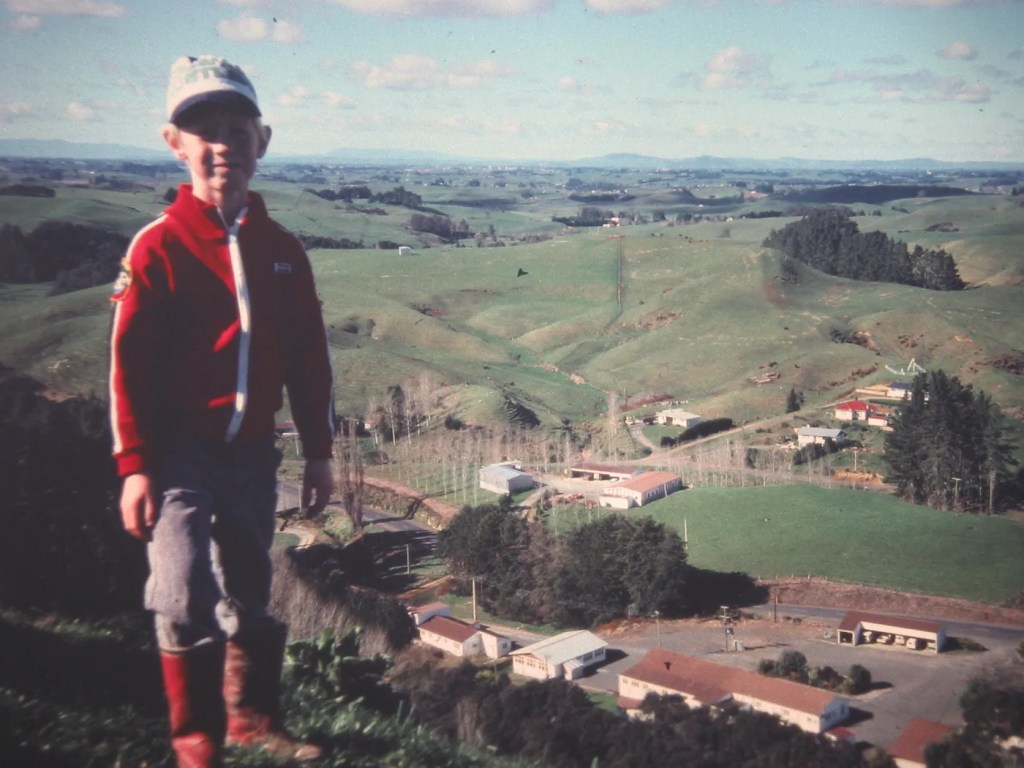
Number 1 golf tee. This was the name we kids gave to the big cone hill facing the main road in the Woolshed paddock — hence called Woolshed1. It started off as a place to fire off our homemade bracken-stalk arrows, with bows fashioned from lancewoods harvested from the Hospital paddock. It progressed to a golf tee and the ‘Number 1 tee’ name stuck. The initial goal was to reach the creek flowing past the woolshed. I was hopeless, barely reaching the farm track, but not so my schoolboy mate, Big Phil Hockey who later became a farm advisor, competitive swimmer, my best man, and near-scratch golfer.
With the aid of a long-handled driver, he eventually managed to hit the woolshed roof. Unbelievable! However, at this point, the game was terminated and the tee closed! If only we had realised that some terrified staff were in there having smoko at the time, and wondering WTF had hit the roof! (JNClarke).
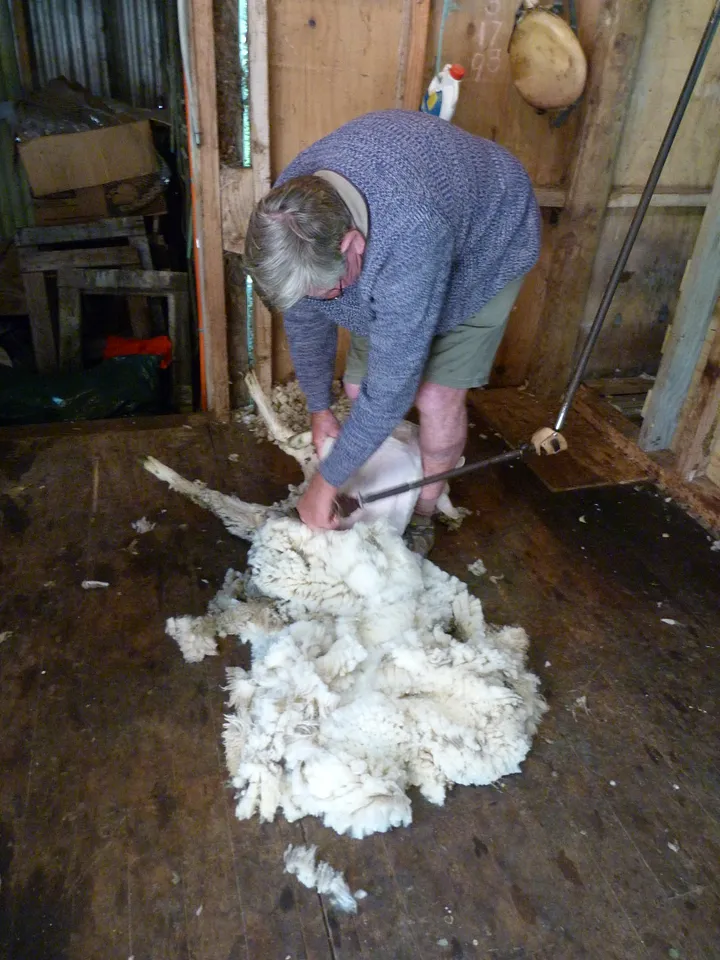
Shearing. I had learned to shear (clip) sheep with the blades from my early days as a farm laddie in Northumberland, and when I went to Wales to do my Ph.D. they had a Lister shearing machine with narrow combs and a flexible drive shaft. I had a copy of Godfrey Bowen’s book called ‘Wool Away’ and learned the basic blows from that. Godfrey demonstrated all over UK and I once went to see him shear a Wensleydale sheep with long pencil staples — him blindfold!
The crowd was aghast! But coming to the Station with a proper woolshed and all the gear that I had never seen before was a scary experience. So I managed to learn how to dag sheep with a shearing machine with wide comb and fixed drive shaft.
We used to shear a few sheep, so I learned from Murray Bigham and Roland Sumner, and from all the other lads who could all shear. Ian McMillan of course was a gun shearer and he tried to teach me some finer points.
But there was a major problem — Ian was left-handed, so I found it a total impossibility to improve my shocking slow technique. It was being tied to that damned down tube that bothered me, and the handpiece getting hot from spending so much time cutting air!(CliveD).
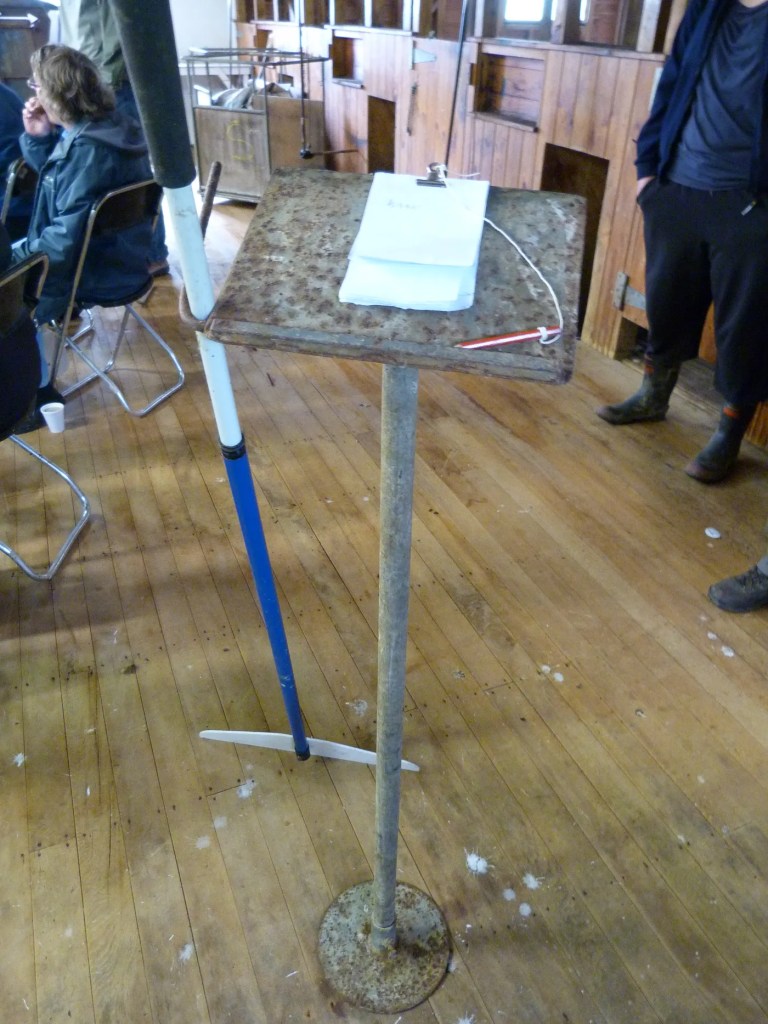
The lecterns. Recording fleece information at shearing was a full-on race. If you didn’t get the brass tag number when the shearer started to open up the belly, and the sheep’s head and hence its ears were sticking out on the shearer’s left leg, you were in deep trouble as there were few other opportunities to get it after that. Although our shearers were paid extra for shearing tagged sheep, they were reluctant to stop to let you read a tag.
You wrote the tag number after reading on a piece of paper while held in your hand, or resting on your knee, and held the paper between your lips until the fleece came off when it went on the wool table. You also had a broom to hang on to, and oh boy — shearers do NOT like a broom handle hitting the wooden floor with a crack right by their left ear!
So Roland Sumner designed a proper mini lectern to be anchored through a hole in the floor to hold the wee paper pads we had to write on, had a pencil on a string that never got lost, and a very cunning metal loop to hold the blardy broom handle! Neil Wood made one for each stand and the last time I was in the woolshed years ago now — they were still there in a heap in the corner — now scrap, with great nostalgic memories! (CliveD).
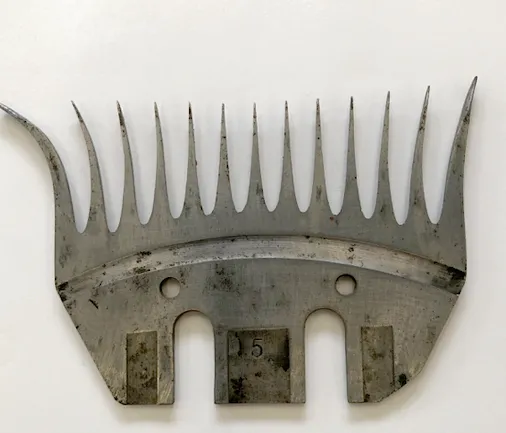
Rusted shearing gear. That last time I was in the woolshed at a farmers seminar on sheep worms, I was appalled to find beside me on the wool table a box of rusty shearing handpieces and combs. Solid rust! I wondered what Ian McMillan and Jock Clayton would have said. Gear was always carefully cleaned after use and locked in the metal cupboard Neil Wood made, as we once had a handpiece stolen after a shearing.
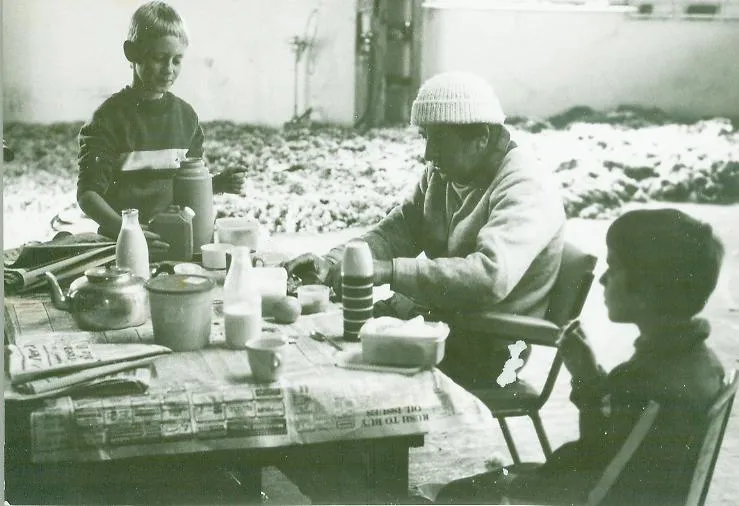
Well I was so disgusted that I became a thief too that day and brought a comb home, cleaned off its rust, varnished it and gave it to son Mark mount it on for my son Mark, who spent many lambing beats as a child with Ian, along with other Station kids, and they always had lunch in the woolshed, eating off the wool table suitably covered in the Waikato Times. The comb is in pride of place on Mark’s desk in Wellington with many memories of Ian. (CliveD).
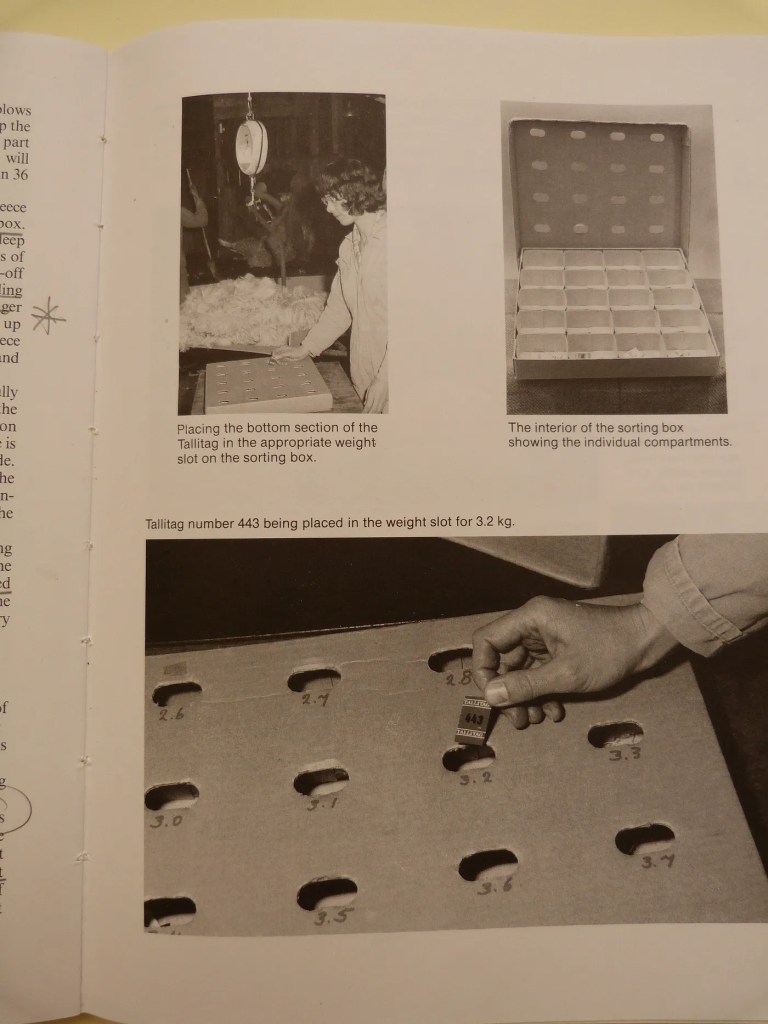
The cardboard computer. When the Station flocks selected for high hogget fleece weight had to be shorn, the task was to get the data without slowing up the shearers. The problem was solved by a King Country farmer who invented the ‘Tallitag’. This was a small label with the duplicated number separated by a perforation, and fixed to a bit of elastic that you stretched around the sheep’s neck, while it’s head stuck out through the shearer’s legs before the last blows.
Roland Sumner and NZ Wool Board field officer John Hutchinson designed a flat cardboard box with many small divisions, and a lid with holes like a mail box. And that’s what you did. You tore off the half the label, held it while weighing the fleece placed on a cardboard tray on the scales (also designed by Roland and John), and then posted the label through the appropriate weight hole. Dead simple. So at the end of the day, you could go and easily find the sheep you wanted — and rip off the elastic necklace. I remember some were found by shearers at main shearing who wondered what they were! (CliveD).
Merinos. In the breed comparison trial, the Merinos hated the Station, and right from the start, all the staff and especially the dogs hated them. We got the very best of Merino genetics from Central Otago through the Breed Society and things went OK at the start. But then footrot caused by the wet pastures and fleece stains from the high rainfall became major challenges for them. There was always a big heap of toe nails from them on the woolshed floor after endless trimming. They didn’t like being mixed up in the main mob with all the other breeds, and when they could, separated out on to a different grazing spots.
They were a menace in the yards, as under pressure from staff and dogs they just squeezed into a tighter and tighter circle, and if you were in the middle, you got squeezed off your feet. You could only unwind this crush if one made a mistake and spun off the side, or you dragged one away for the rest to follow. We bought rams from top breeders but over time, the flock fertility dropped so low that we didn’t have enough ewe hoggets to keep the flock of 200 ewes going.
So the end of them in the trial was when we only had 11 lambs to wean from the flock of 200 ewes. We had great plans to work on fertility, and Doug managed to get two very special Boroola rams from Australia which had a gene for high litter size. This was a very clever move, mainly because Doug knew the famous Australian sheep geneticist — Dr Helen Newton-Turner, as export of Merino rams from Australia was banned.
They arrived when our Merinos were dying out so we gave them to Dr Jock Allison at Invermay for their research into Merino fertility at MAFs High Country station (Tara Hills) near Omarama. Shearing was the worst time for them as few of our Station shearers must have worked in the South Island or in Australia, and they didn’t have the skill to hold the sheep or stretch its skin to flatten out the wrinkles to prevent ‘boot laces’ coming off the poor brutes. One shearer I’m sure twisted the sheep’s head around 2–3 times to try and tighten the neck skin, and get a flat surface for his comb. (CliveD).
Cheviots. After the Merinos, the Cheviots were the next most disliked sheep in the breed comparison trial, and they reinforced their reputation every time we had to drench them. The basis of the trial was that all breeds were treated the same, but after you had made 2–3 attempts (at least) to get the drench gun down a moving fighting Cheviot throat, and finally gritting your teeth and with a half-nelson around its neck with a curse of ‘you baarstaard’, the sheep got at least 3–4 squirts to satisfy your frustration!
The shearers had a love-hate relationship with them, as although they could up their tallies with the light fleece and often bare bellies, they didn’t like those back feed drumming a tune on the floor when the sheep was sitting upright. If you were down below in the count-out pens, you always knew when the cheviots were being shorn by the drumming. I remember one shearer getting so frustrated he bashed a sheep on the head with the handpiece which was a massive NoNo in the trade, but nobody said anything to him. He should have been sacked. (CliveD).
Bearing flock. This small group of ewes had been collected from sheep which would normally have been culled for ‘bearing trouble’ at lambing time. They had been established from about 1960 and when I arrived at Whatawhata, with Manika Tomaszewska as the scientist in charge. Over the time they were at the Station, they were bred and added to by culls from other Station flocks, (with pleasure, but less dog tuckers for us)! Manika was investigating the volume/capacity of the vaginal tract to measure the differences between ewes.
To do this, water was fed from a burette, through a tube with a condom attached and inserted into the vagina. The difference in the water level in the container gave the volume/capacity of the tract. I don’t know if there was any analysis done on the data Manika collected, but after she left, the flock disappeared quite quickly! She must have been doing some measuring on commercial farms too, as once as she passed through Dinsdale, and realised that the condom supply was running short, she sent her technician, a very embarrassed Roly Walmsley, into the Dinsdale Pharmacy for a carton of condoms! (JockC)
Footnote. He’d have problems if he went to Cyril Scott’s pharmacy, as a devout Catholic with six kids he wouldn’t stock condoms! Now how did I know that? Somebody told me! (CliveD).
Speeding sheep. Ron Kilgour and I did some behaviour work on the speed of moving sheep as a project for one of his Waikato University students. I remember her presenting her report at the NZ Society of Animal Production meeting in Dunedin, and she featured her lovely legs when walking from the back of the hall up to the lectern. How can I remember that?
So we got Ian McMillan to quietly chug along on his bike and drive a similar sized mob of each breed from Barker’s yards along the race to the main yards, and then put them up the ramp into the woolshed. As expected, the Merinos were last having blocked the doorway into the shed with their classical ‘squeeze circle’. The Cheviots won the competition hands down, getting into the woolshed and back out again ready to meet Ian before he even got there! (CliveD).
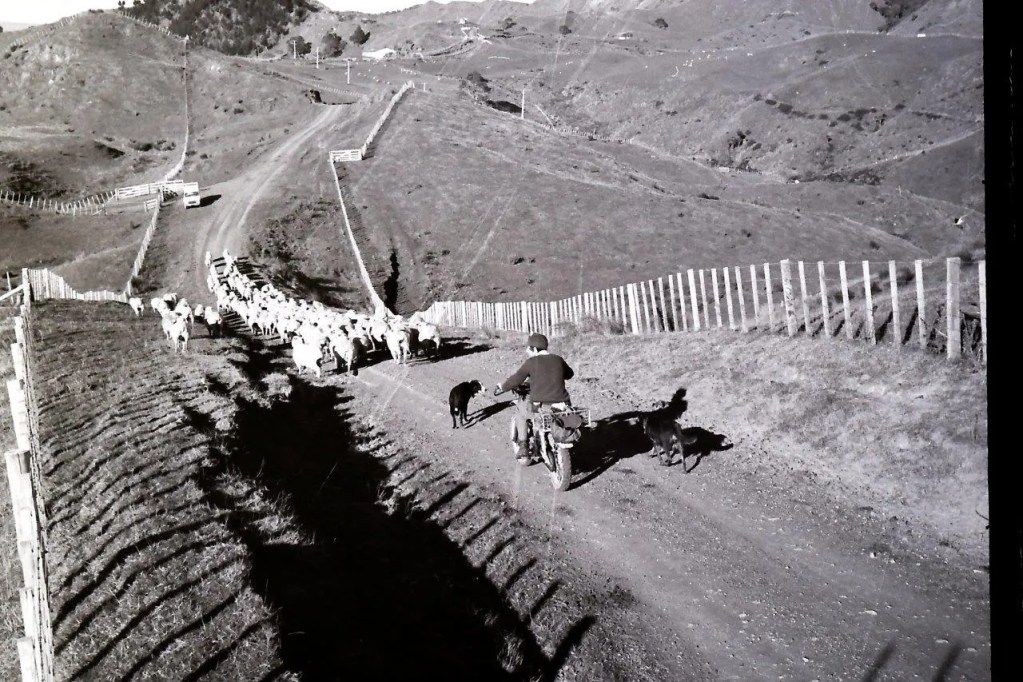
Sheep grazing behaviour. Ron Kilgour also did some behaviour studies on how sheep grazed steep hill country, so he brought out his caravan from Ruakura which he used for staff to record data in comfort from a distance. The shape of the paddock opposite (part of Wilson’s block) was traced on a piece of perspex with a grid imprinted on it and by viewing through the perspex, the position of the sheep could be marked within the paddock boundaries viewed from Ron’s small caravan.
Just a dozen or so sheep were introduced quietly by Ian McMillan, usually from the top corner gate. Trouble was the caravan wasn’t anchored to the ground enough and one windy night (and fortunately not during the day) it took off and ended up in the bottom of the gully. I don’t think it was ever or was worth while recovering and could still be there.
Jock Clayton thinks they also used a small portable loo-type shed on legs which got blown down the gully. David Hall remembers similar behaviour work being done by Ron’s group (after his tragic death in a car accident) up behind the houses, when another unanchored observation caravan was blown away into the gully. (CliveD).
Home for pet lambs. I remember one year ending up with 4–5 pet lambs of different breeds from the Breed Comparison Trial at the Station returned from friends, and having to find a home for them after they’d done their service at various school Calf and Lamb days. The new Hamilton Zoo was keen to have them, as Murray Powell and his wife were developing it from their game (pheasant) farm.
I heard from Murray that the lambs were one of the most popular exhibits at the zoo with the kids, as the could pet them, be nibbled, feel their wool and lead them around. It showed how the urban-rural gap was starting to widen, and it sure has continued apace since, where most kids in town now will never have even touched sheep’s wool. (CliveD).
Fertility survey. From 1978 to 1981 the Station collected data from other farms to find out why lambing performance was so bad on so many hill country farms. A major reason was that rams were joined too early, trying to get early lambs for the UK Christmas market. But this failed because ewes were not cycling so early in the year, and it only achieved a long drawn out lambing, with poor feed control post lambing. Another effect was fewer twins being born. The ewes’ ovulation rate was also affected by season with low rates early in the year reaching a peak in mid April.
The main problem was partial failure of multiple ovulations, and while we never found a way to reduce it, delaying joining, better feeding and importation of high fecund breeds made a massive improvement.
So after these changes and scanning to identify single, twin and triplet ewes, and lambing them on safe areas of the farm, my main area of research shifted to better lamb survival, especially for triplets. On some of the better farms they were getting over 80% survival of triplets. (Terry Knight).
Bill Forster. I went with Terry Knight on a few visits to local farms in the survey, and my favourite was to Bill Forster’s farm at Aramiro just over the hill from the Station. Bill had a great sense of humour and Perendales — a trait not common in all shepherds! Well everybody knows that Perendales are not sheep that linger, either in the paddock, and certainly not in the yards, and you sure need good strong boots when working with them in the crush! Well I nearly fell over when I saw Bill sorting the sheep for us to weigh, and he was working in the yards and the crush in his bare blardy feet while I had my steel toecaps on!(CliveD).
Goats. After a number of years of goat research at the Station, the soil damage they did was so obvious but never featured or discussed, which surprised me. One of their main grazing areas was in the paddock beside the main cattle yards, and with a 45 degree slope and facing north, it always got maximum sun which the goats loved. Over time with them digging out areas to expose the soil and form sun-heated holes to lie in, the whole hillside could have slide down into the gully in heavy rain. The goat work seemed to fold for some reason after that, so more pasture damage and talking about it was avoided. (CliveD).


CGS. An innovation called ‘Controlled Grazing Systems’ or CGS appeared as many things do in farming, and we got involved at the Station being guided by Malcolm Smith, local Farm Advisory Office (Animal Husbandry) based in the Hamilton Office. Malcolm worked with local farmer Bill Short and they both got the NZ Society of Animal Production, Sir Arthur Ward Award in 1982 for their work in developing and communicating the concept. It was then promoted country wide from the highest level. The concept was simple. To get good pasture control especially on hill country, you put all the sheep and all the cattle on the farm into one big group, and moved them every 2 days, leaving a well-grazed and high-quality sward that would regrow evenly for when they came around again. And all the animals in the mob would get a fair go at the feed as soon as they were shifted, so the tail-enders would not get pushed out. I remember handing out AgLinks on the subject by the armful at Mystery Creek one year when Malcolm Cameron our DG no less, graced us with his presence. In my view it was a total blardy disaster for steep hill country, but I dare not comment.
The reason was from ignoring the basics of animal behaviour. The stock didn’t know that their shifts were every two days, or what day of the week it was — so when they heard a dog bark or a bike start up — they assumed that it must be shift day, so took off down hill at full steam to the gate, to be first through and get their heads down to feed. So the Station staff had to keep away from the paddock they were in, and keep their dogs quiet. You could see the long skid marks down the steep slopes of the steep paddocks that the cows had gouged out when they got the news of a shift. And if the gate wasn’t open — total disaster could occur, and on many steep farms it did, because the gates were always at the bottom of the hill inviting a massive pile up and smother. What happened to CGS? Like so many other great ideas it disappeared — thank goodness. The CGS AgLinks from MAF Head Office are all in the Wellington landfill. (CliveD).
Headed notepaper. After MAF was ‘restructured’ into separate businesses, each location had to have it’s own headed note paper, as we did at WHCRS. But if I was sending a hand-written note in to a mate in admin at Ruakura like Barry Keenan, who had a great sense of humour, I would add some special artwork of my own to the official Station paper. Mine was a steep cone hill like Woolshed 1 with a shepherd standing on the top with raised waddy, and a balloon from his mouth shouting a command to his dog ‘Wag’, that was halfway down the hill waiting for further instructions. The gully at the bottom of the hill was full of tightly packed sheep, all with their feet pointing skywards in a monumental smother! The words in the balloon were always appropriate at the time for the receiver of the note! (CliveD).
Sam ‘ouch’. I think it was Christmas 1972 when after an early muster and a day in the yards, we headed for the dog kennels down the hill to the Office Block when I called my dogs to ‘hop up’ on the Jawa motorbike dog platform. ‘Tyne’ the heading dog sat supreme on the flat area of the dog carrier frame on the back, and ‘Sam’ the big hairy ginger Huntaway was perched crosswise on the seat directly behind me. So far so good, then 100 yards down the road there was an almighty bellow from Sam, followed by excruciating pain in my right buttock.
Poor Sam had lowered his back leg getting caught in the bike chain and the sprocket, cutting off 3 toes, hence he clearly blamed me and shared his pain with me using his teeth. Sam recovered well but I still bear the scars I think! Must get Chris to check some time and I’ll let you know! Two staff members say they can remember me being nipped on another part of my anatomy, but I claim no memory of it!(John Lane).
Speak up Bruce. When working sheep in the yards Peter Evans, Peter Burton and I often tied our dogs up so that left Jock Clayton and his dog Bruce — a lovely friendly black and tan Huntaway, who he reared and trained from a pup, could make any noise if needed. The only trouble was that if I raised my arms above waist height, Bruce saw it as a signal to zero in on a human leg for a quick nip, but never that of his boss. I could never remember to keep my arms down, and I remember Peter Burton in particular, not being very happy one day after Bruce responded to my unintended signal! (John Lane).
McMillan’s Jason. The McMillan family had a little golden or cocker Spaniel called Jason, who was very much part of the family as their kids grew up, and he came to the Station with them from Ian’s former job on the Johnstone property on Old Mountain Road. Apart from eat, sleep and be petted, Jason saw his role in life to be on 24/7 duty to keep a close watch on all the bitches on the Station, and the stage of their oestrus cycles, so he didn’t miss an opportunity for further liaison. Trouble was, he never got the message that owners didn’t have much use for spaniel x huntaways or spaniel x heading dogs, so when they saw him coming on his rounds — he was not very welcomed!
Olive discovered this one day when she went to our gate to pick up the newspaper off the ground, just as Jason was passing on his afternoon rounds. She had only started to bend over when Jason went from 2kph to 20kph in about two strides. He clearly was a keen observer of human body language, and knew that a human bending over, even slightly, it inevitably meant the start of a missile attack! When I related this memory to Jock, his automatic reaction was a loud — ‘blardy Jason, the baaarstaard’ — which was the dog’s standard memory! (CliveD).
Dalton’s Bob. Clive wanted a pup for the kids and certainly not a working dog as there were plenty on the station — at one time 35 according to Betty Farrelly’s book. Clive’s dog Bob came from an unplanned mating ‘by Ted out of Graham Derrick’s Sue’, and was the only one of the litter that wanted to work sheep! Bob easily learned how to get up and back sheep, so that if the sheep were tight in the race when weighing or the entrance to the woolshed, Bob would enthusiastically jump up and run along their backs causing them to run forward.
One day while working in the yards with the others, a big bus pulled up with Spanish agricultural visitors. Clive said he would show them how we worked dogs in N.Z. and all went well until Bob’s leap failed, and he ended up on the rear end of a ewe and began humping it. I will always remember the gasps and a few sniggers from this young Spanish girl crying out ‘What eeezzzz he doing’? To this day, so-called friends remind Clive of Bob’s party piece! (John Lane).

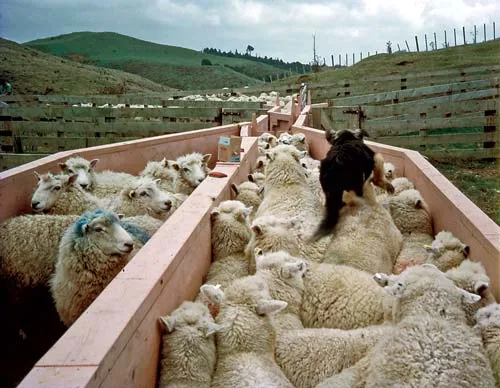
Lang’s Ted. The most famous (and infamous) dog ever to grace the Station was Doug’s dog Ted. I told his life story elsewhere on this blog which you can find by Googling and then find ‘Ted’ in the index down the right hand side of the front page. I also told his story in Betty Farrelly’s book under the chapter on Station Dogs. (CliveD)

Christmas bum sniff. During one Christmas, we were at home, so I offered to feed the dozen or so Station dogs kennelled on the side of the creek behind the offices on Christmas day. This was a simple task — just let them off to do the ritual bum sniffing of their mates (as dogs keep their CVs in their anal glands), let them run about for a while on the way down to the creek, then throw them a bit of already-cut-up meat from the frig into each kennel. Then chain them up again. Simple? Not blardy likely! Ted arrived!
The baarstaard had sneaked down from Lang’s up the hill when he probably heard the commotion, and suddenly all hell broke loose. This group of happy socialising dogs suddenly turned into a rolling ball of snarling, biting, barking fighting canines heading down into the creek. I didn’t have a stick so tried shouting, swearing, kicking and even quoting the Scriptures — but to no avail. But then it suddenly stopped, and it all went quiet! Peace and tranquility reigned! What had happened? Ted the baarstaard had buggered off home, as he’d obviously had enough entertainment for the day starting the canine maul! He didn’t get a pat from me the next time we met!(CliveD).