

Firewood. Before winter, getting stocked up with firewood was an essential for every householder on the Station. The Station had a circular saw which fitted on the back of a tractor driven by the PTO. It was a terrifying machine, and not helped by many people who had a few skills in using it. You put a log on a bench and then rocked it forward towards the screaming massive rotating circular blade by your right ear, where it fell off at the end — you hoped and didn’t get stuck. When the blade was blunt, the cut was accompanied by a cloud of blue smoke It was death in the making.
Whenever I saw anyone using it without even ear muffs, never mind face protection or body armour, I never offered to help and kept well out of the way having only used it once with assistance. The most terrifying sight was Rob Moore (not noted for his manual dexterity) using it on his own beside the pine trees next to Stuart Peterson’s house. I had to go inside, draw the curtains, shut the doors and my ears and keep the phone handy. (CliveD).

Dog dosing strip. I knew very little about hydatids, sheep measles or other canine internal parasites, so when it came round to the ‘dog dosing’, I was interested to go to the dosing strip and see what went on. Doug Lang asked me to take his dog Ted as he was busy which I did willingly, as Ted would go with anybody.
What was interesting was that before we left, Jock Clayton had first call to tie his dog Maid in one corner of the truck, and then Stuart Peterson tied his bitch Buller in the other corner, otherwise all hell would break loose as those two ladies were never great friends. All the other dozen or more dogs couldn’t wait to get into the truck, assuming they were going somewhere really exciting. They were, but when the dosing strip on Heddon road came into view things changed.
Some of them (especially Ted) were so reluctant to disembark that they had to be dragged out of the truck and tied to the iron peg the smiling Hydatids Officer Les Dobson from Raglan, in his broad brimmed sunhat had hammered into the ground. Les prided himself in getting dog owners with unregistered pups to spill the beans from his tricky questions.

Dogs can remember — and especially that squirt of something nasty down the throat and then having to strain to produce a faecal sample to be sent to a lab for inspection, and the man who caused the experience! Ted was a noted non-purger and we could see he would delay our getting home, so to produce a sample, he aways got one up the other end too. One time I remember this still didn’t work either so took him home, and later in the day I reported to Doug that Ted hadn’t purged. Doug said not to worry, he had — at Johnstone’s corner in the back of the car on the way to town. (CliveD).
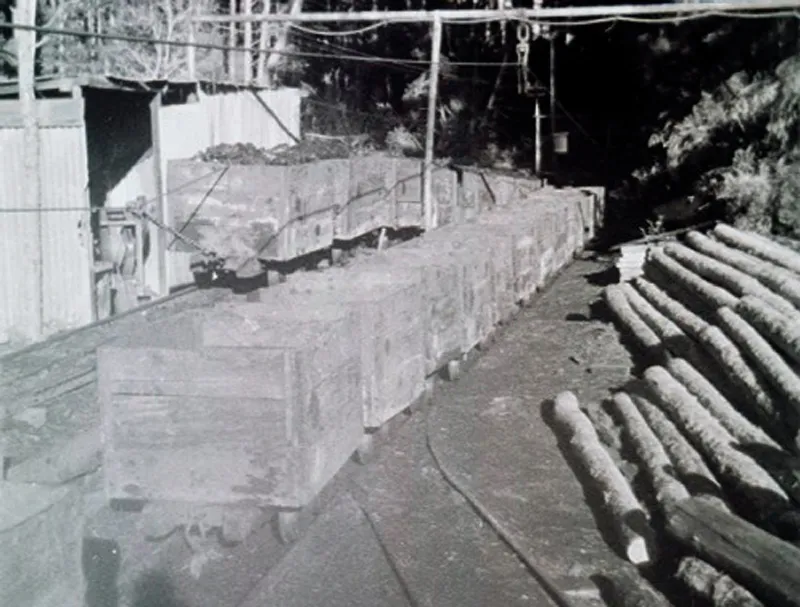
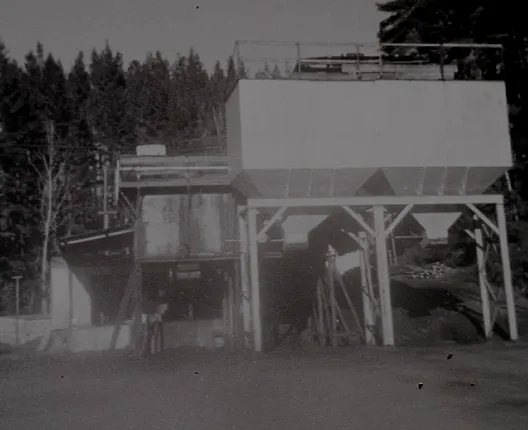
We need coal? When we arrived at the Station our new house had a coal fire, so my first question was, where do I go for coal. The answer was simple — you get it at Johnstone’s mine down the road. So what do I need? First you need half a dozen sacks and borrow the farm-truck and go down to the mine and a bloke will fill them for you for 50c a bag. Stupidly I acquired some large grain sacks which I thought would do the job perfectly. But when I got to the mine and the solid Maori lad put them under the hopper and filled them to the top, I saw I had a problem. There was no way I was ever going to lift them, especially when at the end for good value, he put an enormous lump of coal in the sack neck to top it off. I had to get help for sure when I got home to carry the bags in below the house where I had built a bunker. (CliveD).
Blardy Puks. There was a permanent group of Pukekos on the station that populated the paddock around the old mine hole on the Johnstone’s boundary. The kids loved finding their nests and watch the little fluffy black balls grow into adult squawking adults. But I had a love/hate relationship with them when they used to visit and decimate our vege garden at first light each morning.
So one day I borrowed David Hall’s .22 and shot an unsuspecting bird (protected by law). The rest sure got the message, as all I needed to do after that, was to go out with the kitchen broom to sweep the path to the clothes line, and hold it to my shoulder like a gun and bingo — they were off! They must have quickly learned the shape of this lethal threat. Very smart birds! (CliveD).
Magpie dive-bombers. These uninvited Aussies are both intelligent and very territorial, and a family must have laid claim to the trees along the roadside beside Johnstone’s cattle yards on the way to the Station. Bram Uljee remembers when Alan Barclay (moved from Ruakura office staff) became a regular target as he cycled each day from town to help out with the Station admin, with the aim of keeping fit at the same time.
But the sentry magpie (always a male) knew the Public Service hours so could plan his attacks precisely. After being regularly attacked, one day Alan was armed with his bike pump on the home trip, but he missed the raider and his pump fell out of his hand and on to the road to be flattened by a passing car! ‘Quardle oodle ardle wardle doodle’ to you mate! Rex Webby also remembers being targeted at the same spot, and probably by the same bird, when running back into town each day while training for a marathon. But the smartest bird must have been one at Barkers where Peter Evans remembers the saga with Dave Taylor who was a stockman at Barkers for a year or so. Dave was keen a hunter and kept a close eye on the feral pigs out the back of the Station, which Peter Evan’s reports pissed off Alf Richards immensely, as he considered he had sole rights to hunting the bush adjacent to Back Range and Barkers, being a ‘local’ resident. Dave dealt to a magpie with a shotgun while wearing a red checked Swannie, and for ever after that, a red Swannie was a target for a payback attack by a bird that must have been its mate. (CliveD).
Bamboo. When I saw the long bamboo sticks growing at the bottom of the hill up to Doug’s house, I cut a few to make fishing rods for our boys. Then I thought it would be a good idea to have a permanent supply of our own, so I dug out a root and planted a couple of bits on our back fence. Bamboo was such a novelty in UK, as all I ever saw were garden canes my father bought, from which we used to make bows and arrows.
We left the station and bamboo never came into the conversation till I met my friend who had bought our old house from Mr Balme. He said he wished he knew the idiot who planted that F-ing bamboo as it had taken over the whole length of the back fence. I agreed with him that it must have been a real nutter — maybe a Pom! (CliveD).
FFS Tai hoa Jack. Our new house on the Station was plonked in a paddock, and before Joe fenced us in, he thought we needed a flat bit of lawn at the back, as it had been on bit of a hill. Jack Beaumont and the trusty International bully were tasked with the job. Fortunately I always went home for lunch as on one day Jack was still blading the bank at the back. After waving to get his attention I was able to roar at him — ‘FFS Tai ho mate! We don’t want a blardy tennis court’!

The way he was working it could have ended up a soccer pitch for the lads. A light covering of soil over the clay, and a dressing of ‘bush burn’ seed grew something you could call a lawn. It was always a challenge for the old second hand mower (and me) that I bought at Paul Matenga’s shop in Dinsdale. (CliveD).
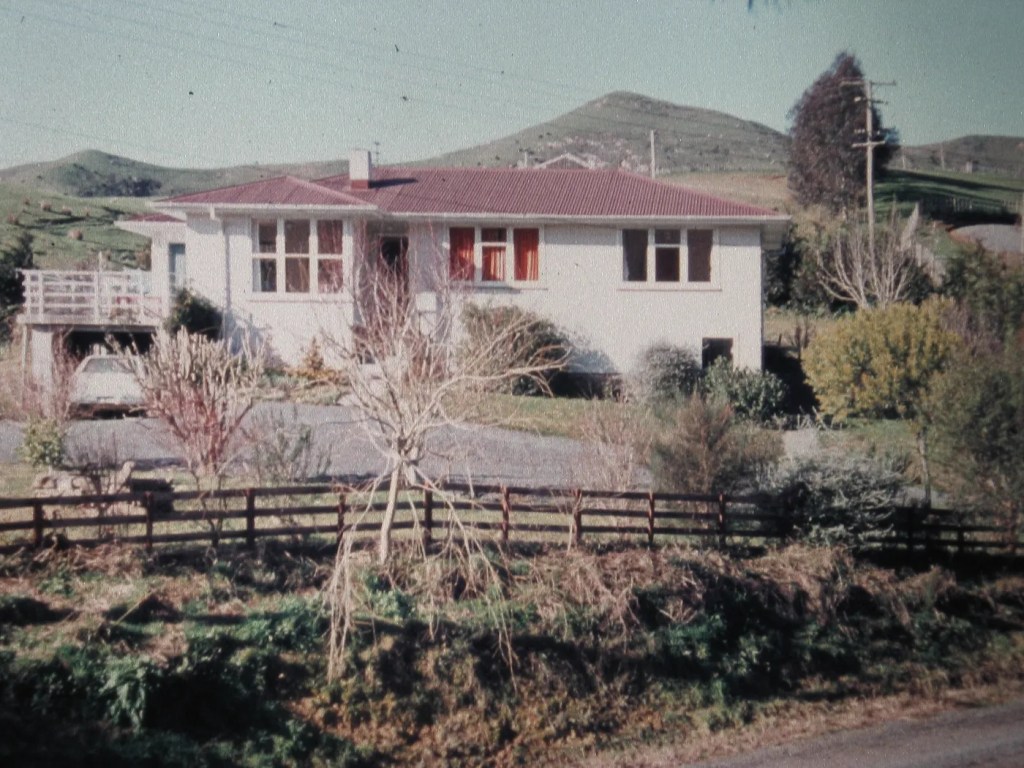
What to grow. Coming from the Northern Hemisphere at the equivalent latitudes of near the Auckland Islands, we knew how to grow apples and pears, and then gooseberries, black currants and rhubarb — especially rhubarb! But citrus were a big unknown as we’d only seen the fruit in shops imported from Spain. But there was plenty of neighbours’ advice on the Station, so we ended up planting a lemon and grapefruit tree but didn’t bother with all the others, as there was always plenty going begging from long established neighbours’ trees.
Pommie visitors were always amazed to see citrus fruit growing. Then we were told with great enthusiasm that we needed a ‘Chinese gooseberry’, and to make sure that we bought both a male and a female. This we surely did, and I made a bit of a frame as I was told they liked climbing– growing great long annual leaders to grab the telephone lines above.
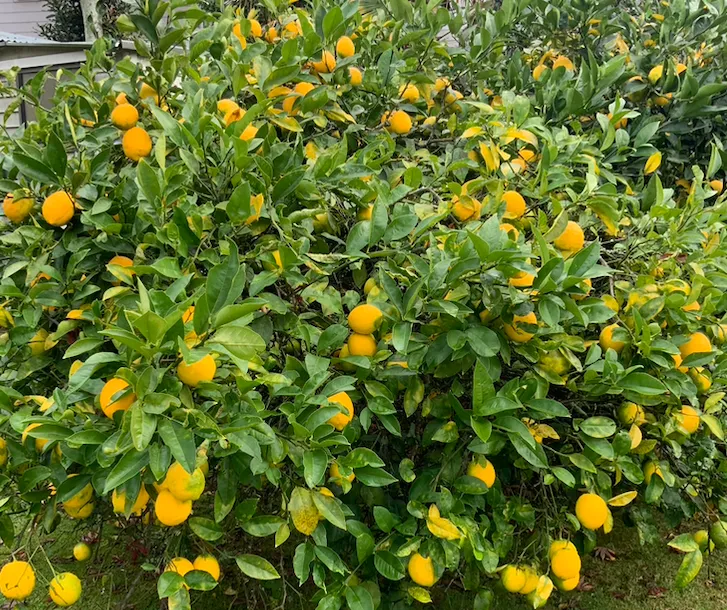
We waited and we waited to harvest some fruit, although to be fair, we were warned it would take a year or two. Well it sure did — round about 6–8, which coincided with us moving into town, and when Geoff and Lynn Nicholl moving into our Station house. The Nicholls weren’t very keen on the plants that we had left around the house, nor the newly named ‘Kiwi Fruit’, so Geoff pruned it — which was the first year it really fruited. He pruned it nice and low — right off by the ground! The lemon tree we brought to town and it has cropped for 50+ years. (CliveD).
Fruit stone out the window. I noticed what I thought looked like a plum tree by its leaves about a foot high in the roadside grass by the milk boxes at the Station gate. Obviously grown from a stone thrown out of a car window, so I dug it out to add to the fruit tree collection in our new garden. The darned thing grew into a decent sized tree with masses of fruit that were not plumbs! Again I had to quietly ask the neighbours and learned they were nectarines — another new experience for us and for our many Pommie visitors. (CliveD).
Pigeon rollers. Dave Saunders was a pigeon fancier and our kids, (who kept canaries, budgies, finches and quail in an aviary I made them), loved to go along and see Dave let his birds out for an evening fly around. But there was something weird about them, as after flying straight for a while, they’d do a complete somersault or roll over, as if something had clobbered them from above, and then they’d keep on flying straight again. Dave explained this was a genetic trait developed supposedly to fool a diving predator like a hawk. It was hard to say quietly — why would anybody keep such stupid blardy birds! (CliveD)
On guard ‘Skye’. Dot short assisted by Maria Barker were technicians working in the small fibre lab on the end of the old hogget shed. Dot got a lovely heading dog pup from Ian McMillan which she called ‘Skye’, and loyalty to Dot was its main purpose in life. So when it came to work each day with Dotty, Skye took guard in the lab doorway for any likely threats that went past — both human or canine. So you had to watch your heels from this pocket rocket. But its initial speed turned into a waddle over the years from too much of Dotty and husband Jim’s TLC. (CliveD).
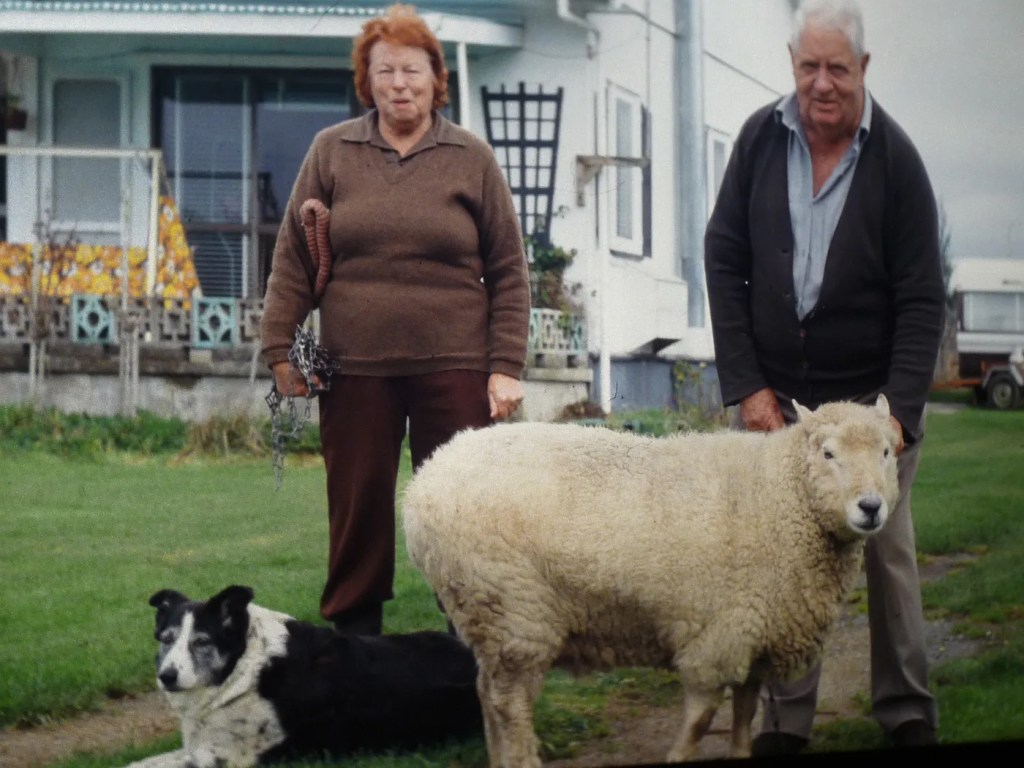
Joe Bishop — master fencer. When Doug Lang took over the station as Superintendent after years of neglect of basic infrastructure, there were miles of old fences to be replaced. The original ones had been built by Joe Maclean and his father when the station was taken over as the ‘Ruakura Hill Station’ in the 1950s. Doug employed the incredibly skilled fencer Joe Bishop who had only one eye. This didn’t limit him in anyway, and in fact improved his skills as when he was putting a line of posts in, he never used to guide wire. And when putting in a staple, it went right in with one blow of his hammer. His finished job was a masterpiece to behold. Johnny Morgan was his skilled assistant, but the poor lad died early with cancer. Doug kept him unofficially on the pay role after he was unable to work till he was bed ridden and died. So sad.(CliveD).
Electric fencing. Gallaghers did a lot of their early ‘power fencing’ (the official term not ‘electric’) development work on the Station to meet the challenges of fencing on steep hill country, and especially to get power to the back of large properties. Many farmers strung wires across gulleys to get there, which created a suicidal hazard for top-dressing pilots unless well marked.
If a power fence was not properly earthed at source or along its length, ‘impedance’ caused current to build up, and although the fence was supposed to produce 4000v max at the back of the farm, it could easily be 8000v or more. Dogs and horses and unsuspecting stockmen sure didn’t like that.
The ‘Grass Fence’ was used on the station with a section running up Woolshed 1 and on Barker’s block. It had a row of Australian Jarrah hardwood battens knocked into the ground, with three wires attached directly to the battens — believing that the wood was so hard, current wouldn’t earth through it so no insulators were needed. The grass grew up below and along it and died, so stock could see the hazard and the theory was that this would not earth the fence. The idea like so many others only lasted a few years. (CliveD).
How’s the water Doug? When we moved into our house at the station I asked Doug about the domestic water supply as it had a tinge of brown. He said ‘oh don’t worry, you’ll scour for a couple of weeks and then you’ll come right’. These were the days before there was any filtration, and we were alarmed to hear that a beast had done a somersault down the steep slope ending ‘ balls up’ up in the creek and our water supply. We were worried! (CliveD).
Bull beef tea. An SOS was sent to Jackie Jones! A bull had fallen down the steep hill in the Falls creek 70m from the water intake for domestic water supply. We were all panicking over the prospect of beef tea from our taps! Jack duly contacted his mate at the Te Pahu quarry, and carried out his specialty with more than a few sticks of gelignite with outstanding success! That afternoon I went back to survey the results. Nothing — not a sign of a dead bull anywhere.
Except for the sound of some blowflies and a faint whiff of decaying flesh. All I saw was a few very small pieces of skin. A year or so later while working in Mount 2 paddock next to the paddock where the bull was scattered, I found the skull among some fern/scrub on the steep hillside. It had travelled about 50m. I wonder how high it had gone! Jack certainly saved us a lot of work in difficult places with his disposal technique. (JockC).
Sheep sulkies. One of the scientists in the 1960s was Manika Wodzicka-Tomasweska — the daughter of the Polish Ambassador to NZ during WWII. Manika wanted some information on the distances a sheep might travel during the day, so she designed a sulky which could be fitted to a sheep and trailed behind with the wheels recording the distance travelled. The sulkies were like those used in the trotting races but made from aluminium tubing, bent to shape to fit around the sheep and attached by a leather strap around the neck.
The rear end was an axle assembly with two small wheels and a measuring device (cyclometer) which when attached to a cycle wheel, would record the mileage ridden. This was all fixed to the axle assembly and lined up to trigger a pin on the wheel. About 10 of these were constructed, probably by Neil Wood in the workshop. On the day of launch, the sulkies were fitted to the victims and even when released from the sheep crush out into a pen, it was obvious the sheep were very agitated by this object attached around and following and chasing them.
When all sulkies were attached, the sheep were to be ‘walked quietly’ to a nearby paddock — in this case it was to Mount 1, which was through a gate above the old woolshed yards. Well, once let out of the yards, the sheep took off with the sulkies bouncing and flailing around, and this made them panic even more! Finally, they got to the paddock and left (we hoped) to settle down. Manika’s technician watched the sheep during the first day in the paddock, as well as some ‘curious observers’! What a laugh — the sulkies ended up in all sorts of disarray. Some had bounced over the sheep and were hanging off on the side.
One had been caught on a manuka stick and stranded the sheep, and one or two had escaped from the sulky altogether. The sheep were brought into the yards next day to sort out the mess with more panic racing and crashing. After straightening out the bent frames and adjusting straps, the sheep were taken back to the paddock and the ‘experiment’ lasted for a few more days, then abandoned.
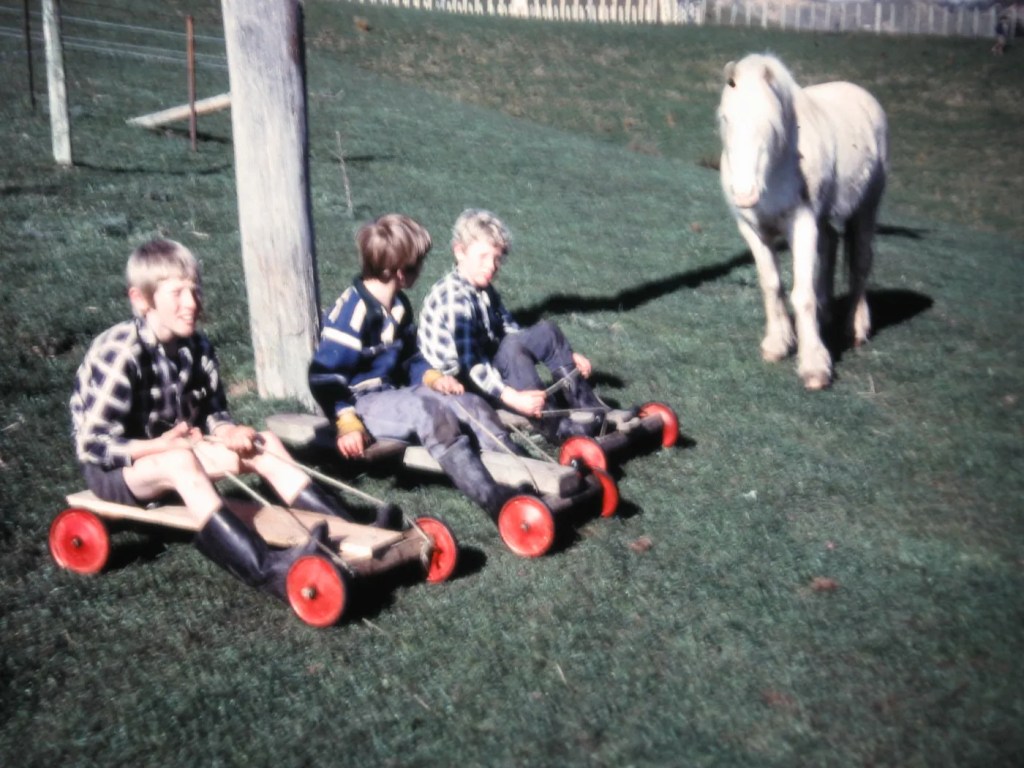
The sulkies were thrown into a store shed and forgotten about. One day Clive spotted and enquired about this junk, and removed 4 pairs of wheels to make a couple of trolleys for the Dalton and Peterson kids to race down the hill next to their houses.
The kids had as much fun with these trolleys as we did watching the sulkies self-destruct out in the paddock. Some years later I picked up a battered piece of trolley hooked up in a tree stump while doing a lambing/calving beat in Mount 1. The then lot of stockmen and technicians were most amused when I described what it had been. (JockC).


Memories of Manika. I first met Manika when we lived at Ruakura in the early 1950s. She was staying with the McMeekans, working I believe as a summer student. She was probably about the same age as McMeekan’s daughter Robyn. I was introduced to her as the daughter of an immigrant family living in Wellington. Her father wrote a book called ‘Introduced Mammals of NZ’ and I think he was associated with the Dept of Conservation/Victoria University.
Later she turned up at Whatawhata to work on wool where she met and married Matthew Tomaszewska who was working there as a tractor driver. Matthew was rather sickly and shy and he had only one lung and died very young, so Manika moved to Ruakura but then left for a job in Armidale (University of New England).
She came back to NZ and married Francis Cockrem who worked in genetics at Ruakura. But that ended in tragedy as Francis died of a heart attack on his back door step after returning from a run. She returned to Australia where she died. (JNClarke).
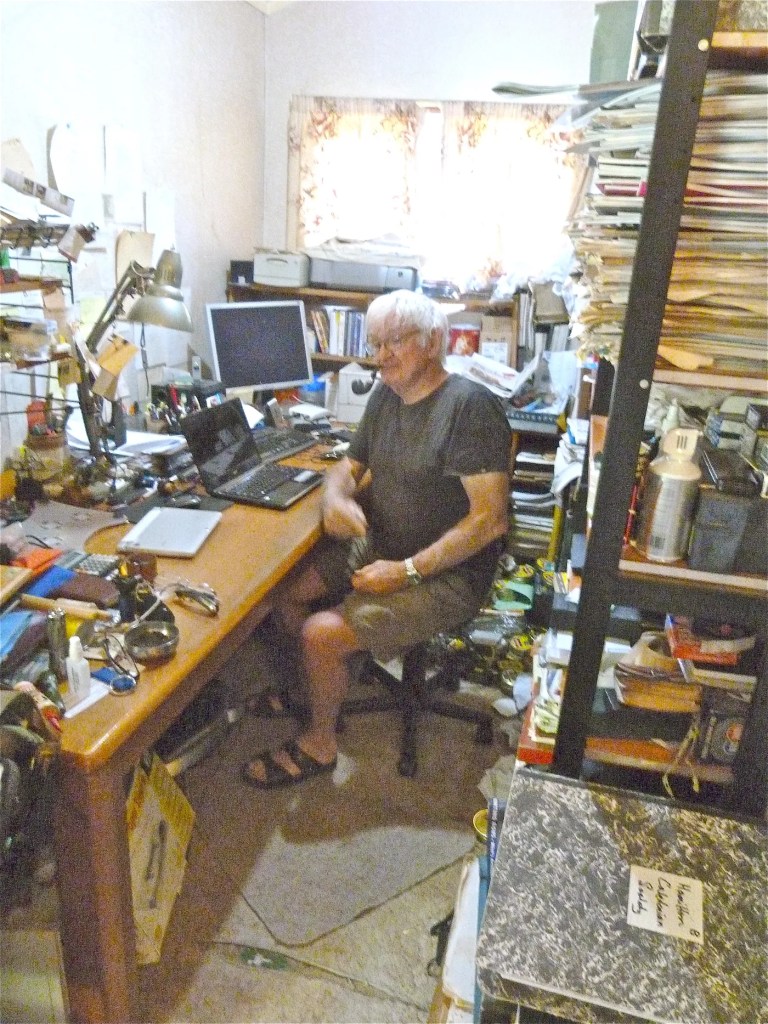
More on Manika Wodzicka-Tomasweska. I was employed as a Technician by Manika starting January 1967. She was a lovely person to work for, was always smiling and had a great sense of humour. I met Mathew on a number of occasions and as mentioned he was unwell and he died towards the end of 1967 and Manika moved to Ruakura and later to Australia. Mathew and Manika had three children Wanda, Ania and Janek who would today be in their late 50-early 60’s. It would be nice to know of their lives.
The following is a bit of history about the family. I was told that Mathew had been in the Polish underground during WW1I and took part in the Warsaw uprising which was a brutal battle against the Germans. He had a lung removed either due to injury or illness. Manika’s parents and their two children escaped Poland in 1939 after the invasion of Germany from the South and Soviets from the north , and eventually got to New Zealand. Manika’s mother Maria was responsible for convincing our Prime Minister Peter Fraser to bring Polish refugees from Persia (now Iran).
Stalin had moved large numbers of Poles to his gulags in Siberia and when Germany attacked the Soviet Union in 1941 Stalin needed Allied help.
One of the Allied stipulations was to release Poles from the gulags. They were released but had to walk a huge distance south to Persia where they were interned. In 1944, 733 orphans and carers arrived by ship to NZ and eventually became citizens. All this information can viewed online. (Stuart Peterson).
The Hogget Shed. This was designed and built to run indoor feeding trials with originally younger, but sometimes older sheep, and was located below and adjacent to the old office sheep yards. It was built on sloping ground and high enough up to allow people to get underneath for hosing out the manure that dropped through the grating. The layout in the shed was for individual animal pens, so the amount of food consumed from each animal could be calculated. One end of the shed was a storage area and also had a large drying oven for drying feed samples and a working area for weighing out food rations, and residuals. When I arrived, Graham Hight was doing trials on hogget ill-thrift which was a problem in those times caused by internal parasites, or sub-clinical facial eczema or both. Graham was harvesting grass from Manutuke research station near Gisborne, and a well-known facial eczema prone area. Bales of dried fodder were brought over and fed to hoggets for about 8 weeks. Some of the pasture grown at Manutuke was shaded with hessian to stimulate the growth of FE spores, to compare with unshaded pasture as control, and pure white clover was the other fodder produced and part of the comparison. The shed was used for numerous other indoor feeding trials over many years. Either feeding sheep dried grass like Graham Hight’s ill thrift trials, or more commonly using lucerne or other types of pellets. Manika Tomaszewska and Murray Bigham were other scientists who used the shed for their trials.
Many sheep didn’t like being penned up individually for long periods and fought boredom and stress by chewing the woodwork and eating their wool. After a few years the hogget shed was extended eastwards and another storage area built on the end. As it was on a sloping site, the far end was quite high off the ground. So high in fact, it was suitable for a double garage where the station motor bikes were housed when not in use. Also space for a maintenance work area.
In the 1980s, pasture nutrition trials were in vogue with visual pasture rating being developed as a skill to calculate pasture intakes in sheep and cattle grazing trials. Calibration cuts of pasture were taken for every trial, both pre and post grazing, as well as for feed budgets at various times. The hogget shed was the ideal place for washing the grass samples, with plenty of space over the sheep grating for the washing troughs, water laid on, and a large drying oven. Another larger drying oven was purchased later, to cope with larger numbers of grass samples to dry. The remainder of the shed was used to store thousands of wool samples in plastic bags and fadges, as well as a lot of other ‘junk’.
After the new offices and administration building were transferred to Ruakura in the 1990s, the grass washing and drying facilities were shifted up to where the new smaller replacement offices had been built, and the hogget shed was used more or less as a storage place. In the early 2000s, with diminishing staff numbers and less research being done, the shed was up for demolition.
Bill Navanua made an offer to take it away and moved it to Raglan where he owned a vacant section. He spent some time upgrading the building and converting it to a backpacker’s hostel on Government Road, but its days ended some years ago as it didn’t meet legal standards. So in its 60 year life, the hogget shed has had a varied life! (JockC).
New office buildings. Before I left the Station in 1979 to go to Ruakura, talk of a new office block had been on the cards for some time. I never trusted architects since my Uni days when their Architecture School was next to our Ag School, and they were there for 5 years — as long as the Medics! They were all wankers in our Agric view, as just look at the crap they come up with! Concrete and glass boxes became the rage at the time and still are!

Kindy kids with Lego could do better we always argued. So when the new buildings were mooted, I made a plea (and even did an Agric drawing) to have a main building that fitted into the site where Woolshed 1 was the natural feature that impressed everyone passing by. And by heck it happened! The buildings were a real feature for the site I thought and very functional. But the planners hadn’t banked on ‘The Tainui Settlement’, or that their work would end up looking like an architectural dog’s breakfast at Ruakura, (and at what cost), on the flattest bit of land you could find in the Waikato. It must have been a massive job, cutting the buildings up into transportable bits to be transported at nights. It took weeks apparently, and reliable sources said that it was quietly accepted that for the cost of shifting, a completely new set of buildings could have been more cost effective. Many of us wonder what Tainui would have done with them if AgResearch had left them. The mind boggles! The only folk you see there now when passing on a Saturday are the ‘naughty boys’ with their boss and van — doing SFA! And now Covid seems to have stopped them operating.(CliveD).
Feral Goats. Clive asked me where did they come from and where did they go? Even before I arrived at the Station there were goats wandering the property, but they could be seen any time over most of the farm. They were a noxious pest doing great damage to bush undergrowth. The boundary fences were mostly sheep proof, but these feral goats could spot a low spot under the bottom wire and work on it until they had dug an escape hole. They could even climb strainer post stays, and on steep slopes slip sideways through the fence spaces. There was a constant flow from Moore’s farm next door, and to and fro from the bush, and each crop of kids soon learned their territory from their parents. It was easy to tell their entries and exits by the scraped turf/holes under the fence bottom wire, and the goat fibre wrapped around the wire. One of the staff jobs (when idle) was to patrol the fences — particularly the boundaries with an axe, hammer and staples. The axe was for chopping stakes from the old logs lying around, and driving them into the ground to support lengths of timber to secure the gaps. But the goats were also a source of pocket money for Christmas parties and other boozy functions, and we held a muster every year or so when the numbers got out of hand.
When a goat muster was planned, we knew we would have to stop them rushing through the holes into Moore’s property and back into the bush, so somebody always quietly sneaked away well before the start. Likewise, when Moores were mustering goats, they would be trying to get back into our property.
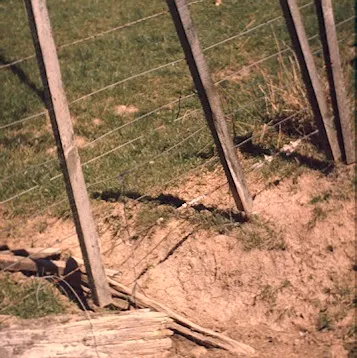
There are many tales of goat musters! In some respects goats were useful in cleaning up gorse, blackberry and thistles, but never more than ‘nibbling’. They loved the thistle flowers, but again never enough for complete control. They were a distraction for dogs when mustering, and after we’d had a goat muster, which the dogs really enjoyed but they were pretty useless for a day or two afterwards! Dr Ron Kilgour did behaviour studies on the Station goats and published the work. (JockC).
Bram’s goat muster. After mustering by getting some sheep with the mob, the plan was to herd the goats into the cattle yards to let them settle down for a day before driving them down to the bottom woolshed to be loaded. In those days most of the rails were just made of manuka and were in need of repair to hold goats. So the first job was to fix the yards. Once the goats were yarded after a lot of effort and some escapes, the next day the task was to get everybody and their dogs in a strategic position to steer the goats along the track down to the old woolshed ready for trucking. On one memorable muster all went well and I saw the goats far below me entering the yards and going into the woolshed. However much to my utter amazement, the goats were coming back out again as someone by the name of ‘The Cook’ had left a blardy woolshed door open! (Bram Uljee).
Stuart’s goat muster. The bush going from Whatawhata through to Ngaruawahia was infested with possums and goats. We had several goat musters each year and one Freezing works in North Island would kill solely goats for about a six week period. We received about $2 a head per goat which went to the social club. The one I remember best was where six of us, which I think were me, John Lane, Dave Hall, Ray Armstrong and probably Jock and Ian, went up the back early in the morning and with one dog each and spread along a bush ridge and moved slowly down the hill towards a paddock making lots of noise. The goats ahead of us went through the fence and we had a huge mob in the paddock.
Our aim was to move them up the hill and through the gate, into the race and into top yards. We had a person coming from the yards opening all gates so there would no holdups. Everything was working well, the goats moved up the hill nicely and we let them flow. However our man who opened all the gates thought as things became quiet there must have been a problem and came to the top of the hill to check, at the same time as the leading goats reached the top.
The sods turned and a tsunami of goats came back towards us, and we lost several hundred back into the bush. We got organised again and moved the remaining goats up the hill and finally into the yards and locked them into the woolshed overnight. Next morning trucks arrived and we opened the woolshed to a hell of a stink and loaded the trucks. I can’t remember the tally but we had over 500. (Stuart Peterson).
Really bad smell. During the winter months I had two Horotiu freezing workers helping me plant poplar poles up the back. It was usually cold foggy mornings and we had our Swannis on, and by lunchtime it would be nice and sunny so we would be down to our shorts. This particular day we hopped in the Land Rover and it smelled real bad, and I was wondering who the person was who had it last as I suspected a dog had been sick in the back. We sat on a log to eat our lunch and one of these guys who lived at Raglan opened his bag the smell came out! He pulled out a stingray wing which he informed me had been hanging on his fence for a couple of weeks and tasted real good and cured colds. I said ‘Yeah Right’ and the smell source became clear. I declined a taste! (Stuart Peterson).
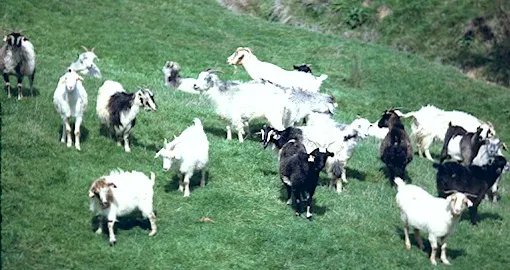
Yarding goats. The Station sheep yards were useless for handling feral goats, as the sods could jump the internal fences, and even jump out of the crush pens and race even when tightly packed in. The big stinking Billies with their massive wide horns couldn’t and wouldn’t move up the drafting race, but they soon learned to hold their heads sideways to progress. So this is why when the Station got into serious goat fibre work (Angora/Cashmere/Cashgora) a separate set of goat handling yards had to be built with very high fences. (CliveD).
Ram’s ride home. The station didn’t have an official car and we used farm vehicles if going off station. Private cars could be used, for which we could claim travel expenses for this. But we did eventually get an official car — a brand new Toyota Corolla, and Graham Hight certainly enjoyed his Director’s rights to have first call on it. Rob Moore managed to borrow it one day to go as he said, to inspect some rams before purchase for his experiments.
But instead of coming home and then arranging for somebody to go and to pick them up in the farm truck, Rob put them in the back of the car, as the back seats could fold down and there was at least a canvas lining in the boot for dirty boots — not blardy rams! The reception from Graham on his return was memorable! Funny that Rob didn’t get the car again! (CliveD).
Scrub cutters. In the 1960s, the Station under Ted Clarke’s control was undergoing a great deal of development from the clearing of scrub and gorse-covered hillsides, and fencing — both repairs to old fences and subdivision. For 3 or 4 years, students from Massey College were employed as scrub cutters for the vacation period between second and third semesters. There was accommodation for them in the single men’s hostel while they stayed at the Station.
They were supplied with heavy slashers and axes, and allocated blocks/patches of manuka to fell by the farm manager Joe McLean, and this was allowed to dry out over the spring/summer period, for burning off in the autumn. The two students who arrived in 1963 were certainly a memorable couple of Bachelor of Agricultural Science students — John Sharp and Ken Geenty.
After graduation, John went to Australia, but Ken stayed in NZ and worked for MAF as an advisor/research scientist, specialising in sheep management and nutrition. What was memorable about these two was that they were beer drinkers — of capacity and speed! After work, and in the weekends down at the Whatawhata Hilton, they were quite happy to show off their ability. Ken at the time was the NZ Universities national champion of the speed beer drinking competitions, run at the college tournaments, with John not far behind.
The competition rules are quite simple in that you had to down a 12 ounce glass of beer in the shortest time. All competitors sit at the bar, or table with the glass of beer in front of them, hands on the bar, and at the ‘GO’ signal, pick up the glass, swallow the beer, and slap both hands down on the bar when done. The record was about 2 seconds. They must have had gullets like a 100mm drain pipe. Nobody could get near them for speed. The student scrub cutters in the next years were far more sobrietous. They were all a lot of fun and shook up hostel life and the cook for 3 weeks! (JockC).
The Fix-it men. Joe McLean was the farm manager and in charge of the farm development and maintenance, and the staff members who were employed to do this work. The stock grazing management, shearing, and stock buying and selling was done by field technical officers and those running the animal breeding and grazing trials.
Joe had an enormous job with land development, fencing, water reticulation, building stock yards, grading roads and access tracks which was never ending. Also, ordering and writing out endless requisitions for fencing supplies, timber for yards and building modifications, fertiliser, herbicides etc, etc. He had a varied team of workers over many years.
Joe’s kind nature was regularly tested during the period, when the Labour Department sent out to worksites unemployed young men to be interviewed for a job to get them off the dole. Most of them didn’t want to work, and almost begged not to be accepted so they could get back to town and enjoy being idle. (JockC).
Joe’s wee cooker. Joe crouched down beside a hole he’d dug in the track, or along side it, was a familiar sight when driving around the station. Beside him would be a tin of rolled sacking soaked in kerosine, slowly smouldering away to heat up the ends of alkathene pipe that he was replacing to mend a leak. It seemed to be an endless task for him. The other item always smouldering away was his fag! In his office he kept an enormous plan of where all the water reticulation pipes were on the property — a classic example of his dedicated management. (CliveD).
Neil Wood. Neil was the tractor maintenance mechanic and workshop engineer, who was called on to fix many a lost cause. When asked, he would give the patient a cursory glance, give it a kick, and if it wasn’t repairable would just say first — ‘she’s buggared’. And then if there was absolutely no hope for one of his magic repairs, another kick and his diagnosis was — ‘she’s fucked’! Decision made, and no need for further analysis or discussion.
Neil was the original bulldozer driver and cleared many old and new fence lines, built access tracks all round the station, and widened some tracks for the gorse spraying contractors and their rigs. Other tractor drivers were Jack Jones (‘Gelly Jack’) with a talent for enthusiastically blowing things up with gelignite when asked. Ex army Jack Beaumont, and Moke McLean. Jack Beaumont was a serious motor cross bike rider and tested most of the station bikes on the steeper hills.
Moke was on station when the BTD6 bulldozer was replaced by the oversized D4 or D6, and followed it to Ruakura from Hopuhopu where it was used to demolish some of the old army buildings — concrete ammunition stores. Mike Marsh — we called him ‘Mad Mike’ as he was always having accidents — some quite serious like when he was doing some trenching with a mechanical trencher.
He somehow got himself tangled in the endless digging chain while it was in motion, and took a hunk out of his leg. Mike worked on many fence repairs and used either a tractor and trailer, a tractor with carry-all, or a 4×4 farm truck. All the gear he needed would be placed on the back and bounced around as he travelled up and down the farm tracks. The boxes of staples were a problem, as staples were always bouncing out onto the decks and falling off. Mike wasn’t too particular in cleaning up the spillage, and with constant vibration travelling uphill, some ‘rubbish’ inevitably ended up on the roads — even the odd half box of staples.
Mike was responsible for most of the punctures in the bike and other farm vehicle tyres. He left his memorial when building the fence on the new downhill track. The hole for one angle strainer post was a bit too shallow, so he just cut 800mm off the top with a chainsaw to even it up with the other posts in the line! (JockC).
Ted and Jim. These were a couple of builders employed to finish off the ‘new’ woolshed. Ted Purcell and Jim Homewood who I think were ‘borrowed’ from Ruakura. There were other sheds and modifications to keep them occupied for some time. Ashley Sexton who owned a farm on Thomas Road, Rototuna, (now all housing) was the gardener and lawn mowing man. Mike Marsh also did lawn mowing, and threatened many a window with the stones he picked up with the mower. (Jock Clayton).
Alec McGowan. Alec was another fix-it man who was actually a Technical Officer working out at the Barkers block involved with agronomy trials. He was very versatile and could fix practically anything — mechanical or electronic. Grass cutting engines and generators, handpieces, motor bikes, and he could even squeeze more life out of a washing machine or refrigerator. He would even help with computer programme malfunctions, particularly for those of us who weren’t too savvy in those pioneering days of computer usage. And willingly help out with anything, if asked. Great bloke. (JockC)
The annual woolshed race. Technician Stuart Blaich had been an English schoolboy cross-country runner so was a good athlete. He won every annual race from the office up to the woolshed usually around Christmas time. Everyone protested that going up was too tough, and racing down-hill would allow more of us to finish. The farm truck was used to go up the hill to pick up stragglers and strugglers.
One year we got up to the top with Stu racing well ahead when John Lane leapt out of the truck, having cadged a ride and a breather at the Cliff’s gate. Stu thought John had caught up with him not realising he had been ‘truck assisted’, so he really buried his boot and left John in the dust. Dave Saunders was the only one who could get close to Stu, but never won.
The biggest laugh was the office clerk Trevor ‘Squeaky’ Gibson who got so much stick from the boys about being overweight and smoking too many fags, that he was determined to show them he still could run. He took off like a rocket down across the creek and actually got to the first gate where it all ended in a slow gasping walk back to the office and a fag! Graham Hight didn’t do much better as he’d had too many fags too to kill his ego. David Hall said it was as much agony coming down hill with aching leg muscles. Stuart sadly died a young man and requested that his ashes be scattered among the cliffs at the top yards. His short-legged dog ‘Race’ of mixed ancestry was his constant loyal companion. (JockC).
Who shut the blardy gate? It was getting late in the evening and I had one more job to do. It was about 6pm and starting to get dark as I headed for Barker’s Block with three dogs on the back of my Jawa bike. I cruised all the way out to Barkers 3 with no gates to open. I mustered the sheep and shifted them into another paddock and as it was starting to get pretty dark by then, I had to turn the bike’s lights on. Coming back from Barkers, I went up round a corner and down towards the gate. as it was a steel gate you couldn’t really see it in the dusk.
So down around the corner I came and hello, someone had shut the gate. I had nowhere to go so I dropped the bike and it went straight into the gate. Dogs went everywhere and the gate popped open. I picked the bike up and I pushed it through the gate which I managed to shut and tie it up. It was a bit bent and so was I. I got down to the bottom and put the dogs away and went home up Kakarariki Road, and as I walked inside, Ruth said what the heck have you done? There was blood all over the top of my head, so she took me into the doctor, and I got 3 stitches in the top of my head. I never found out who shut that blardy gate, but I would like to know if you were guilty and would like to own up! (Ray Armstrong).
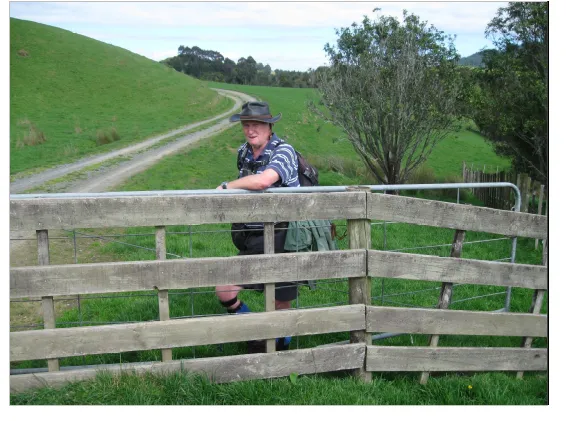
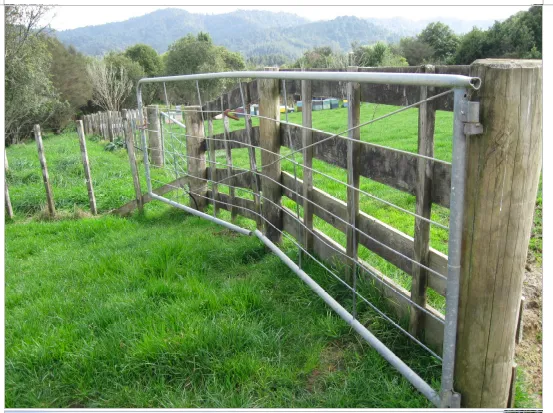
Who nicked my blardy wheels? An old truck must have come out from Ruakura to the Station soon after work had started in the 1950s, presumably to be used in the early days of development. The front of it was cut off and the rest was made into a trailer with a little hut on it. It was used as a fencer’s hut for a number of years out on Back Range, and we think abandoned in the 60s. When I first saw it, it had hard rubber tyres with wheels with wooden spokes. Joe McLean wanted it brought back down from Back Range and put in the dump. So we started by pulling it down with one of the tractors and left it in the dump. After about 12 months, I asked if I could take the wheels off it and use them as garden ornaments which was approved. We had to pull them off with a tractor on each wheel, pulling in opposite directions as they were properly seized on to the shafts. Reo and I drove a tractor each and tried to get them off. We won in the end, and I loaded them on my red ute and took them home to Kakaramea Road.
To get them unloaded I used my little horticulture tractor with bucket and put them on the driveway where many people remarked about how good they looked and chatted about their history. When we sold the house, we took them with us to our next home, and I placed them at the road entrance — one on each side of the gate. I wired them to the posts to keep them safe but it that didn’t keep them safe enough, as one night they disappeared, never to be seen again. But I still keep my eyes open in my travels, and believe that one day the wheels and I will meet again! (Ray Armstrong).

Footnote: Ray also had his entire extra wide wooden front gate stolen that he made for their new house. After that, he reversed the top gudgeon and secured the replacement with No 8 wire! (CliveD).
A gross of condoms. Rob Moore was doing research on ram fertility and had to collect semen from them with as little trauma as possible, without using an electro ejaculator. He had the idea of inserting a condom into the ewe’s vagina so when the ram served the ewe, semen would end up in the condom. So he got office clerk Trevor Gibson to order a gross (12 dozen) of condoms which caused some serious comment, alarm but an opportunity when certain staff members found out.
But there was a slight technical problem he had overlooked, as when the condoms were extracted from the ewes, they were full of the ewe’s urine rather than ram’s semen which was not the intention! Certain members of the staff said that there was concern that all of the gross could not be accounted for. (Tale remembered by technician Sue Rowe). (CliveD).
Our Dinsdale GP. Most of us at the Station went to Dr John Pollard in Dinsdale, and it was always a long wait as he didn’t have appointments. You just went and sat in a sort of add-on sun porch — and waited, and waited. It was a disaster if you heard his Jag go out on a call, as you could write off another hour. Once you got in, he never asked you how he could help before lighting a fresh fag, taking a suck or two and then parking it in his already brim-full ash tray, and then discussing his views on the problems of the world down to the meaning of life! He told me that smoking didn’t cause lung cancer unless accompanied by other factors. He died of lung cancer — a very kind sincere caring man who brought many of our kids into the world. (CliveD).

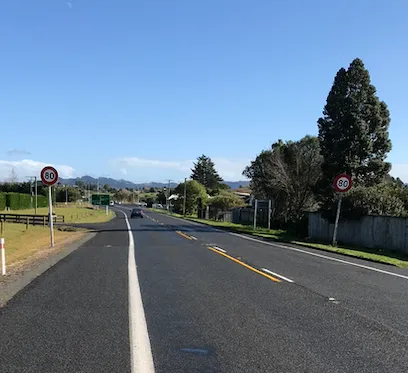
The Raglan cement trucks. When you go to the wharf at Raglan for fish and chips, you can’t miss the large concrete silos used to hold cement that came in by ship, from Golden Bay in the South Island, and then trucked to Hamilton and the wider Waikato. So the most dangerous part of moving stock across the road at the Station was when one of those cement trucks was coming steaming down from the top of the deviation past our gate.
After a slow boring drag up the hill on the Raglan side, the drivers must have enjoyed planting their boot down the long hill past the station. So moving stock across the road was a nightmare, worrying about a truck driving into a mob of sheep. This meant that at least one person and better two had to go well up the road to the second corner with a large stick to wave down any speeding truck, until we were able to get the stock across.
The situation was so hazardous that Doug was able to get permission to put an underpass through below the road, subsequently to be called ‘Doug’s Hole’ which saved so much worry and stress. But it wasn’t just the cement trucks, ordinary motorists were a hazard too, as they had little patience and didn’t watch for the dogs racing around. Peter Burton told the story of a frustrated shepherd he knew (not from the Station) bringing his stick down hard on a car’s bonnet and grabbing the keys and throwing them into the roadside grass! It would have been tempting to do that on many occasions for sure.
I remember seeing a group of Johnstone’s prime Angus steers with skin all sloughed off in the paddock recovering after being hit by a Te Mata Transport truck whose driver (Johnny Bregman) told me he hit and killed four, as some went under the wheels of the trailer. Johnstones were to blame for not providing enough warning before putting stock on the road.
Doug’s underpass -Jock’s memory. The concrete pipes arrived on site initially probably by the cattle yards which was a handy flat site. A huge digger turned up for putting the trench in across the main road. One half at a time was worked on, with traffic control stopping and directing the traffic. Not so many or so fast in those days! It was one way for a couple of days while the work was being done. The controlling lollipop men had to be well up the road to stop/slow down the traffic, particularly those cement trucks. One half of the road was dug up and concrete pipes placed in the trench and back filled to road surface height. Then next day the other half was dug up, pipes installed and back filled as well. As with all under passes (for dairy farms), the road surface was not tar sealed until the trench had consolidated more firmly. A load or two of ready-mix concrete was brought in and spread on the bottom of the pipes, not only to provide a flat surface for stock to walk on, but to anchor the pipes more firmly.We did find it was difficult to get some stock to draw through the tunnel, with the odd beast jumping over the rails and getting out onto the road.Over the years the traffic became even faster and more numerous, and dangerous for anyone on the road – crossing over on a farm bike or tractor.(Jock Clayton)

Roger Johnstone confided in me 20 odd years ago, that he would get very stressed out the night before they were having to shift cattle across the road – usually bulls. They had had a few accidents with vehicles ploughing into a mob of their stock as they crossed the road. Sometimes I was able to help by stopping traffic while coming to work to allow them to get the stock over.(Jock Clayton).
How was it approved? After helping to shift stock across the busy Raglan road and hearing from staff of their anxieties and near misses with traffic, I approached the then Ministry of Works to see what the options were. I had seen in Australia where bridges and galvanised heavy duty steel culverts over small, and mostly dry streams, had been fenced in (illegally) as underpasses. I told them that there was a small culvert through the road which was not big enough to take the water if there was a storm, and I asked if we could run a really big culvert under the road. I suggested that it needed to be something at least 6ft in diameter, Well instead of the usual shake of the head, somebody ‘piped up’ what about those concrete pipes from that other job which had become redundant. I was in shock and as there was always money available at the end of each financial year to use it or lose it, I offered to pay for their trucking to the site. This would resolve the issue and not require any paperwork, and everybody seemed to be in agreement. Joe as usual did the rest!! (Doug Lang).
Rollies. The ritual of rolling and lighting a fag was an art form, and Joe McLean was the master at it, especially while driving the old Land Rover up the track. He had the tobacco pouch in his lap, filling the paper with one hand as he turned the wheel around all the steep corners, then completing the critical stage of spreading out the baccy before rolling the paper, then licking it to make sure it was firm before lighting up. He could even do this while turning his head around to talk to any passengers in the back seats. Joe’s desk had an aluminium ashtray permanently full with fag ends, and also regularly covered with plans of the water reticulation on the station and sheep and cattle yard plans and much more. (CliveD).
Putting you through now Sir! When I left the Station to work at Ruakura’s McMeekan Communication Centre as one of the Scientific Liaison Officers with John Scott, I realised how important the switchboard ladies were. They were often the last to be told what was going on, and I made sure they were the first. To most staff they were only a voice so one day I took the main Ruakura operator Ruth Utting who lived in Raglan, and showed her around all the offices and labs to see what went on and to meet the voices!
‘Oh’ she would say — ‘so that’s Extension 457’? Then I realised how much contact she and her colleague Margaret had with all of us at the Station. So one day I got them into the Ruakura van, along with some other key office ladies who did paper work for us and headed west out of town. On the long straight approaching the Whatawhata crossroads, I pointed out a sharp peak dead ahead, far away on the horizon, and said that was our target! It didn’t mean much to them at that stage of the journey, and may as well have been Australia.
The Station tracks were good so I drove them right out to the new sheep yards in Back Range. These usually endless-yakking ladies were dead silent after the first cattle stop on the way up, and not a word was spoken after that either. I wondered if they were breathing! I helped them out and led the way right up the steep slope zig-zagging on the sheep tracks to the boundary where you can look into Moore’s and down at Cogswell road, and then across the great stretch of land towards Raglan and the Tasman.
It took a while to get up there, zig-zagging on the narrow sheep tracks, but at the top they were both gasping and gobsmacked — especially looking back across the Waikato to Hamilton and identifying the hospital. I kindly told one lady who had crook hips and walked with a bent leg, to stay at the bottom as the climb was too tough for her. But when we were standing yakking at the top fence — bugga me days, she arrived to earn a cheer from us all!
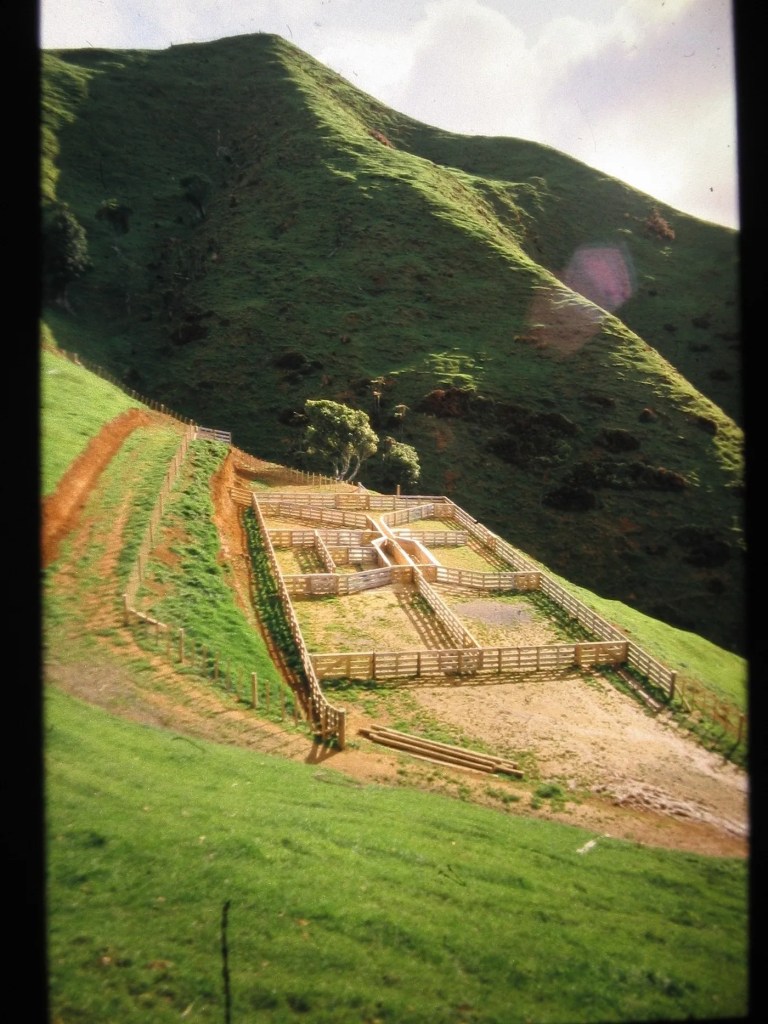
I knew that getting back down was going to be as hard as going up, and I had visions of all sorts of soiled underwear on display till we got to the yards. The trip was talked about for years. (CliveD).
Open days prep. Getting ready for the annual Ruakura Farmers Conference held in the Farmers’ Hall at Ruakura, and then our Open Day at the Station was no mean mission. If any of us had papers to present on the Beef and Sheep day on the Tuesday, (Dairy day was on the Monday), we had to get it written and approved well ahead. Then if we had material to be presented on slides at the conference, or on 8 x 4 hardboard boards at the Open Day, this took longer as it needed the skills of photographer Don McQueen, graphic artist Pauline Hunt, and sign writers Ken Foers and Peter Ballock.
They were a mighty team. Don could be in a lab photographing bacteria down a microscope one day, and a Charolais bull in the yards the next!To make slides, you took your data to Pauline who with stencils and Indian ink converted them into a format which Don then first photographed, and then mounted them between two pieces of thin glass, held together with masking tape. The finished slide was then clearly marked with details and a spot on one corner to hold the slide when put it in the projector cassette, upside down and back to front.
There was a small projection room high up in the back of the upstairs gallery in the Farmer’s Hall , and at the appropriate moment in your talk, you either shouted to Don -‘next slide please’, or banged the pointer on the stage floor which was an accepted change signal. God help you if your slides were loaded the wrong way, and they appeared on the screen upside down, and you expected Don to fix it for you while still talking, hoping the audience would also be able to twist their necks to see! It was best to avoid Don for a day or two after that.
But the mother of all disasters was when you had carefully loaded your slides in order into the projector cassette (which had no top) and on the way up to Don’s pigeon loft, either you weren’t paying attention or you met somebody and stopped for a quick word, and the cassette got a tip and all the slides hit the blardy floor! The panic to check them, and get them back in order and right way up in time does not bear remembering! I well remember this happening to Murray Bigham, and my efforts to help only added to his trauma! The other hazard was the solid wood pointer which was the size of a surf casting fishing rod, needed as the screen was massive covering the entire back of the stage. The pointer was parked up against the curtains on the stage when not needed and had a knob on the thin end to prevent it damaging the screen when in use. Neil Clarke remembers some scientists confusing this know for the handle leaving the heavy end for the pointer! If you didn’t take care to park it properly after use, many a time it started to slowly fall without you knowing. The audience, to their delight saw exactly what was going to happen, and enjoyed when it hit the hard stage floor with a mighty crack — and your surprise reaction. This greatly helped to make your paper memorable!
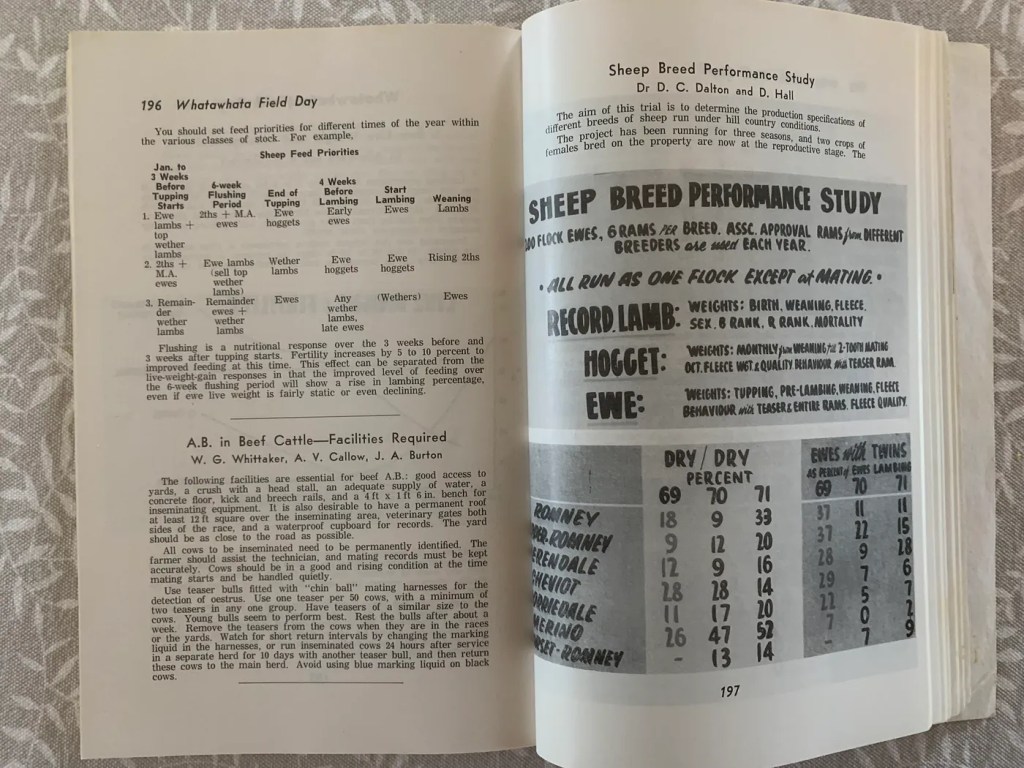
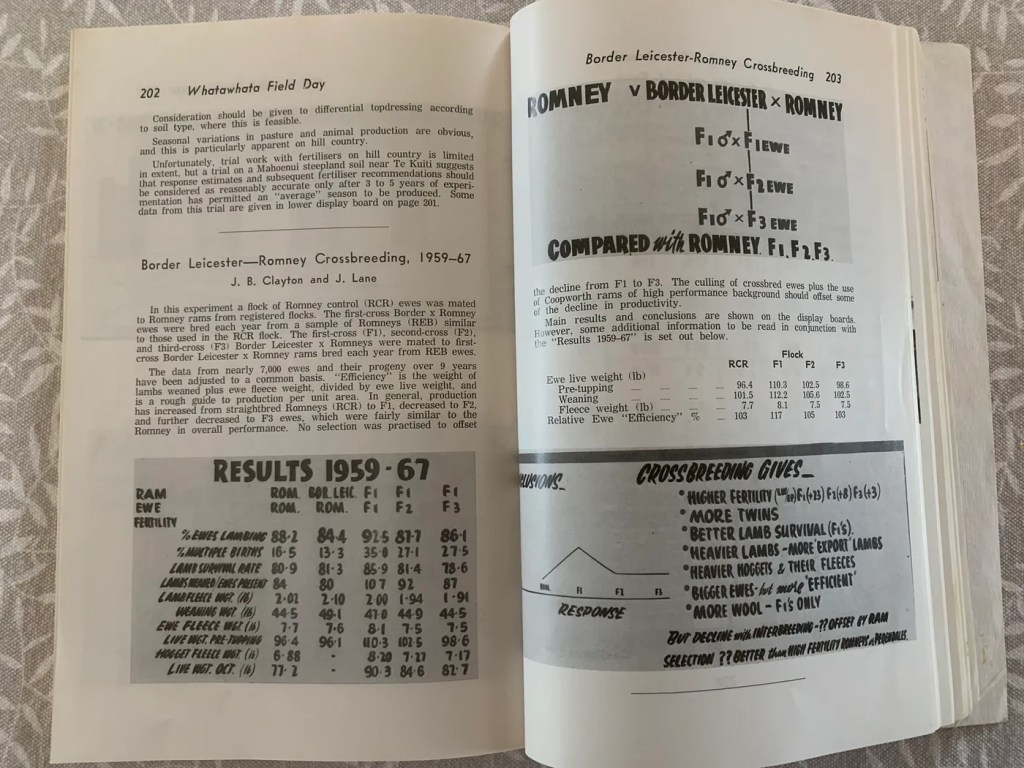
For the Open Day, you took your information in to Ken or Peter on a bit of paper which he then turned into an artistic masterpiece in no time. We had about 50 boards for our Open Day, and he must have done double that for the Ruakura Open Day. When done, you went in to check the boards and he would do any alterations. We needed the farm truck to collect our boards as they were no light weight, and it was no small job putting them up and securing them on frames. After the event they were taken down again to be used with new data next year. What’s interesting about those hundreds of Ruakura and Station boards, is that’s they are often the only place you’ll find the results of so many trials over many years that were never written up formally and published in recognised journals. (CliveD).
Field Day boards. The sign-written boards were photographed, and then printed in the back of the Ruakura Farmers Conference Proceedings. The pictures below were from the 1972 and 1973 Proceedings.(CliveD).

Footnote. Sally Peat (then Okell) remembers being given the job of looking after tea stall set up in the implement shed at the top yards. Contractors came in with their pie cart. It was her first experience, and she remembers her worry about getting enough change from Ruakura, the crockery, and especially the dry tea. She asked around about how much she would need, and Des Whyman (who else) had the answer for her. ‘1400 teaspoons and one for the pot’! (CliveD).
Keep going Madam! After we got the entrance to the Station via Yeoman’s block with a good track to the top yards, we had a complete circuit which was much safer for Open Days, as visitors could enter the Station turning up Heddon road, then go through a bit of Johnstone’s and then Yeoman’s then finally to the displays at the yards. Then go safely down the track to the road home.
Mike Marsh was directing traffic on the main road up Heddon, and he did too good a job, sending most of Raglan traffic via the top yards! One woman with a car full of kids on her way to Raglan was especially unhappy when she got to the top yards display area and wondered what was going on! At least she’d seen a different bit of New Zealand on their journey home! (CliveD).
The day the Germans landed. Over the years, a range of visitors visited the station, ranging from school kids from Auckland, a farmer seeking advice to a problem, groups discussing research results, and the many field days where the gates were flung open to the farming public. In 1978, we were told to expect a visit from the President of Germany who was going to be making a visit to NZ. The fortnight beforehand was spent in the usual tidying up of the relevant parts of the farm and buildings.
The woolshed, sheep yards, cattle yards were cleaned and hosed down. The woolshed tidied up for a display of wool, and demonstration of the different NZ sheep breeds. Even the dogs had to suffer the indignity of a blast of water through their kennels and removal of their favourite ‘toy’ bones. Offal holes along the track had to be covered, and fence battens straightened.
President Scheel duly arrived with his entourage, including security and media. They were greeted by the director, Doug Lang, Graeme Hight, John Scott from Ruakura and other scientists, all immaculately dressed with ties and tweed sports jackets.
They were transported up the hill to the woolshed where they were given the usual demonstration of sheep shearing and mustering by stalwart Ian McMillan. Only essential staff members were allowed to be present and all had to have a security check previously.
Luncheon was served in Clarke Hall afterwards, provided by caterers, and there was even a fashion show by Wool Board models featuring wool garments, the President even being photographed by Don McQueen (Ruakura’s photographer) with a model on each arm! After the entourage left, the left-overs were open for all helpers. Auf Wiedersehen mate! He seemed a decent baarstaard! (JockC).
The Yanks are coming. Another VIP visited the Station in late 1986, was US Secretary of State, George Schultz. The security was even higher rank than for President Scheel, with police, members of the OAS and diplomatic security visiting several days before, with the staff who were involved in the proceedings for the day having security checks. On the day, the place was alive with police etc, armed security officers scattered around the hills and a helicopter patrolling overhead. The airspace for many kilometres surrounding the Station was closed off from normal flying activity. The entourage arrived by helicopter, quite a bit later than scheduled, and had a quick look at our displays.
Ian McMillan did his shearing demo, and I can’t remember if there was time for the mustering demonstration. To catch up with the American schedule, I believe the special luncheon was cancelled, and the yanks flew away. It was open slather after that for anyone living on the station to enjoy the tucker! (JockC).
Spiro Agnew. Spiro was the US Vice President under Lyndon Johnston and he also visited NZ, calling at Togo Johnstone’s home along the main road to the Station (now burned down). Togo at the time was a big cheese on the Meat Board, so I suppose was chosen to let Spiro taste some ‘real meat’ and see how it was produced. The visit didn’t affect us at the Station other than to see the Goons with machine guns at the gate when driving past, and the constant chopper noise over the whole area. Good job Jackie Jones didn’t have a cow to dispose of that day! (CliveD).
Always a prankster. Whenever there is a group of people, there’s always at least one prankster, just as in the early 70s there was often at least one smoker. During one smoko in the main woolshed one day, somebody who I cannot recall, found a pipe inadvertently left by one John Lane. To settle an old score over a forgotten event, somebody had a bright idea.
They carefully emptied John’s pipe of its baccy load, inserted a couple of sheep pellets and re-tamped it. It was not long before John returned and lit his pipe. The coughing, spluttering and general shenanigans was a sight to behold. History decrees that John never mislaid his pipe again and knowing him, he sure would be seeking revenge! (Roland Sumner).
The airstrip. During the autumn of 1970, Raglan local contractor Dave Tuatara, who specialised in moving soil by his bulldozer and scraper, both small units by today’s standards, was awarded a contract to build an airstrip on a steep ridge across the main gully from the new woolshed. Everything was going well as he went back and forwards up and down the strip smoothing the gradient with his scraper.
Joe McLean used to tell the story that mid-afternoon he saw Dave at the top of the strip trundling along towards the row of pine trees on the fence line, when he was ‘buzzed’ by a local top-dressing pilot flying by presumably for a nosey. With his helmet and muffs on Dave couldn’t hear the plane right above him and apparently when he saw it, he got such a fright that he threw on the brakes and raced for cover as fast as he could, as he must have thought the plane was going to land on top of him. He was not a sprightly young man either so no more work that day! (Roland Sumner).
Our own airstrip. Not long after Bev, two wee ones and I settled into the Superintendent’s house up the steep track on the hill, our morning sleep was shattered by the noise of what sounded like a top dressing plane flying through the kitchen. We sat bolt upright and I rushed down the hallway expecting chaos, but no it had missed. It was our first experience of living in the direct line of Moore’s landing strip. The Station used the strip as well, and after a few more episodes I got to thinking that maybe an alternative site on the station was called for. It was not only a strain on our own staff with young families, but also rather risky if a plane ran into problems on take off. So one sunny day I went out to have a chat to Dave Tuatara who was cutting and shaping our tracks with his trusty bulldozer and scraper.
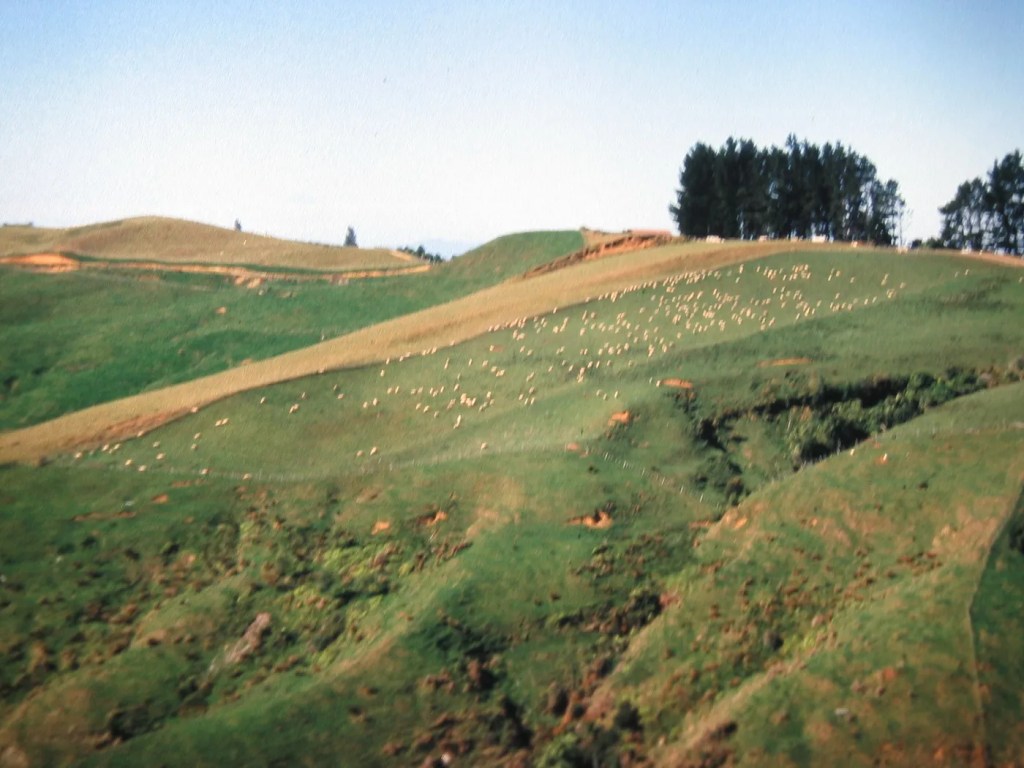
We sat down and I sought his ideas on where we could fit in an airstrip at least cost. I knew I could not get special money for it, but we first of all had to see a best fit. Next day he came in and said he’d had a chat to a pilot friend, and they thought it would be easy to fit one in on the slope heading down towards Barkers. There was a lot of work involved but not a drop of ink was spilled over it, and the paper shufflers at Ruakura probably never knew it existed. And, we all slept happily ever after. (Doug Lang).
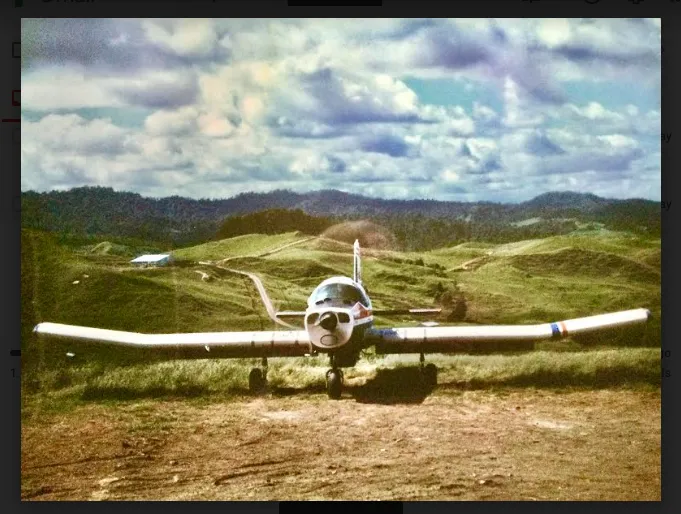
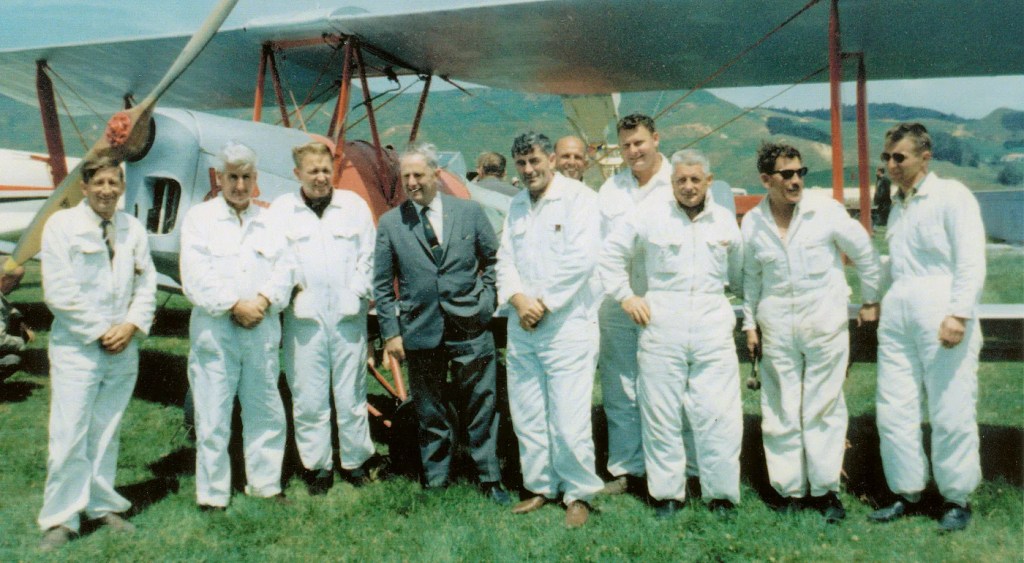
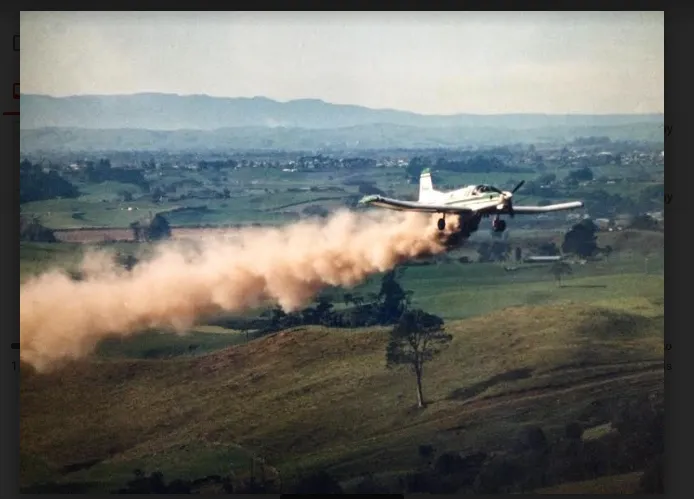
Other airstrips. Before the station’s airstrip was built, in the early days Togo Johnstone’s strip just off Karakariki road was used for Tiger Moths, later with Beavers before the big DC3s came on the scene carrying their massive loads. Then the American Fletcher which was developed during the Vietnam war to land on short runways in the jungle — and ideal for NZ and was made by Aerospace in Hamilton.
Moore’s strip next door was used in the days before the Station built its own, and it was aligned so that on take-off under load and full power, planes flew directly over the station houses often starting at 4am. It was said that this was the cause of many pregnancies on the station, as it’s hard to get back to sleep at that hour! Ossie James did his first top dressing trials after WWII on these strips first with a metal container for fertiliser fixed under a tiger moth. James Aviation became a large company employing 625 staff with 120 aircraft and many subsidiary companies. Ossie retired in 1984 and got an OBE and CNZM for his services to Agriculture. (JNClarke).
Jock’s airstrip memory. Originally we thought it was going to be put in along the ridge line west of the woolshed and heading for Barkers, but it was going to be too flat, so needed a longer length for take-off. The ridge was more razorback at the far end, so wouldn’t be too safe. Indeed, the pilot suggested the present site, on the Long block, with a steep angle down into the gully and good fly-out down the valley towards Yeomans.
Originally, when he heard that the 80ha Yeoman’s block was for sale, Doug went to have a chat with Dougal Barker and came back with the rougher and larger block — now Barkers as well! It took Dave Tuatara quite some time to prepare the strip with a hillock half way down the slope to remove completely. Even then it created some problems for pilots with turbulence if the wind got up. Being on a steep slope it was ages before the grass surface was dense enough to prevent rills and washouts occurring after heavy rain.
Having done a bit of flying myself, I knew what a valuable asset the airstrip was and was always doing repair work to protect it, and hoped others would respect it too. No cows grazing, or screaming down to the bottom with hooves ripping up the grass. Our airstrip was one of the steepest in the Waikato. The pilots liked it in good flying conditions, and could land the aircraft about 50–70m from the top with quick turn-around. However, once rolling down the hill, there was no alternative but to take off! There were a few hairy ones over time. (JockC).
Whew! Clean-underpants landing. We all loved going up to the new airstrip when the Fletchers were flying, and especially taking visitors to see them landing half way up the steep slope, and then after loading, racing down the hill again and lifting off half way down before a full power climb heading for Back Range. It was spectacular for visitors who had never seen NZ rural aviation at work. On one visit on my own when lime was being spread, the loader pulled away from the plane which immediately hit full power and took off.
But then I lost sight of it as it disappeared very low down the valley to the right of the strip towards Johnstone’s property, very soon to return, and when the pilot landed, he killed engines, got out and sat on the ground for a while in silence. He didn’t look well the poor bloke. Then I saw a fair heap of lime on the left wing right up against the fuselage which the loader driver unknowingly must have spilled when filling the hopper.
Being heavy, the lime had not been blown off the wing by the wind on take off like pelleted super would have done, and would have affected the flaps hence made the climb very hazardous. So when the pilot got airborne he didn’t try to climb, and jettisoned the whole load. Don’t know which farm received the gift, but the pilot sure had got a fright. I quietly departed. (CliveD).
Heave lads, Heave! One of the new small Bell helicopters arrived at the airstrip to spread urea from a spinner slung underneath it. The fertiliser was all in 40kg bags in those days, so willing helpers had to open the bags and empty them into the spinner bucket, with the chopper parked nearby and ready to take off. Once loaded, the chopper would rise until the wire cable attached to the hopper was taut, then the pilot would lift off, fly down the airstrip to gain speed and altitude and then distribute the load. While he was away, we would get the next 4 bags opened and ready to heave into the hopper of the spinner.
All went very well, so we decided to put another bag in to speed up the job. Well, with 5 bags in the hopper, the helicopter struggled to get lift-off. So, four of us grabbed the bottom rail of the hopper and heaved it off the ground and ran a short distance down the strip to help the pilot get away. Fortunately, he didn’t have to jettison the load and on to us and it was spread ok. When he got back the pilot said, just stick to four bags boys! (Jock Clayton).
A dribble. When the first jet-prop turbo powered Fletcher turned up to do the topdressing, many staff were interested in viewing its performance. At one knock-off time when the pilot and loader driver were ready to fly back to base, a small mob of on-lookers had gathered. The pilot duly did a demo for us and flew about 50 metres down the strip then took off with a mighty roar almost vertically. At about 100 feet off the ground, a small puff of dust flew out of the hopper that almost landed on to us. Des Whyman wryly remarked ‘that’s loader driver pissing himself’ with glee’! (Jock Clayton).
The fertiliser bin. I recall having the idea to get a kitset shed made by a guy I think from Cambridge. I suggested that I would buy it as ‘material’, corrugated iron and steel, to be used ostensibly to repair another shed. We would construct it ourselves and that’s when Neil came into play to complete the job. I suggested that for a decent discount the maker could use the shed for advertising and promotion on our Field Days. But some buggar dobbed me in a year or so latter, so I had a trip to Head Office for a friendly chat with Dr Alan Johns, the DG of Agriculture at the time with what was ostensibly a stern warning not to do it again. Of course I wouldn’t, as we only needed one fertiliser bunker on the Station. (Doug Lang).
First up the airstrip. Once the Station airstrip was ‘formed’ in 1970, it was a ‘bare clay’ surface, and it was a year or two before Joe McLean was able to establish a good sole of grass on it to prevent rivulets forming. Legend has it that late in the afternoon of Tuesday 13 June 1972, at the conclusion of the station Field Day, an attendee was so impressed with the strip that he went home and flew his plane back to land on the new airstrip, spin around, and then quickly take off. This is purported to be the first time the strip was used. (RolandS).
New sheep yards. Along with the new woolshed and so much sheep handling going on, we needed massive changes to the old sheep yards up top. So the first job was to remove Don Clark’s whare and his mountain of empty grog bottles! So as usual, Joe took over with a new plan that included the ability to draft off sheep 6 ways. Learning to handle the 3 gates for the 4-way draft was fun, and I kept well away from that job if possible.
The whole set up required a wide roof with a large span which Joe had planned, but for some reason that nobody can remember, he ran into a problem by the MOW, who insisted that a massive laminated beam had to go right across the structure. It was about 18in deep and 6in wide as we were told it had to pass the test of a hurricane and tsunami!
Don’t know what was used to lift it into place but it must have needed a decent crane. The other Joe masterpiece built again with Neil’s engineering genius, was the sheep loading ramp that could be adjusted up and down using counterweights to fit any level of truck deck. (CliveD).
Joe’s yard building bible. As well as the permanently brim full aluminium ash tray on Joe’s desk, the other permanent feature was a booklet called — ‘Design and construction of sheep- drafting yards’. Bulletin No 353. J.E. Duncan, Chief Advisory Officer (Wool), Department of Agriculture, Wellington. Reprinted in 1951 from ‘The New Zealand Journal of Agriculture’ and revised in 1956 and 1962. Price 1s 6d. It was and still is a masterpiece of a publication but would be hard to find these days. I once sent a copy to a scientist in Georgia (Russia) where they needed yards for large mobs of sheep on their annual trek from winter to summer grazing. Joe could have built it for them! (CliveD).
A whiz at finding things. In the early days the station owned a dark red International crawler tractor fitted with a front blade. One of its principal drivers in the early 70s was Jack Jones who had a great knack for finding things! One thing he found was the main telephone cable to Raglan that ran along the roadside near the gateway, to the track to the centre of the property. Joe had a map to refer to while Jack was realigning a fence line by the gate.
But Jack found the cable with his bulldozer, but it was NOT where it was surveyed to be! Later when the new sheep yards were built by the new woolshed in the centre of the property, Jack was again driving the bully and tidying up the site of the old yards by the office block and old woolshed. He hit a gusher — a 2inch alkathene water line running across the site, just under the surface. Joe was heard to say — ‘I always wondered where that pipe went!’ (RolandS).
Ian Inkster. Ian was an entertaining scientist at the Station and always had a fund of stories, many told on himself. One I remember was about a battle he had with the Raglan milk delivery man about his milk and cream order, and a note to the milkman which said -‘Please leave my order on the shady side of the milk box in case I forget to pick it up’. The milkman said aloud and thought to himself — ‘Right you are Vicar, but please stop changing your bloody order every day’. Ian heard all of this as he was standing just the other side on the scrubby track which led to his home. So Ian’s cottage residence became known as ‘The Vicarage’. (JNClarke).
The Vicarage. This wee cottage was resurrected from somewhere unknown, with two parts joined up and sited near Joe MacLean’s house and main road cattle yards. The two parts were on skids, so they must have been transportable at some stage by bulldozer. Originally, it probably was a saw millers’ or fencers’ accommodation. It was used by a ‘more mature’ single male staff member who had had a gutsful of the single men’s hostel and hostel cooking.
As far as I know, the first renter was Ian Inkster who was a scientist at Whatawhata in the early years. He was also acting Superintendent in those days because Ted Clarke was still working in Uruguay on a two-year government project. Ian had moved to Clarke’s new house up on the hill and Harry Foskett, an old bachelor was then current occupier of the Vicarage when I arrived at Whatawhata in 1963. Harry was a bit of an old fusspot, and one of his duties was doing the ‘town run’ to Ruakura twice a week, as well as some light menial research work.
He also did all the requisitions, but his perceived main job was to ‘guard’ the vehicle keys. His favourite was the old Mk1 Landrover, but this was used on the farm most of the time, so he had to negotiate with the farm staff if he particularly wanted it. After about 4 or 5 years, Harry left, and I was able to move into the Vicarage where I remained until I married Jan in 1972, and we lived in it for about 6 months until our house, which had been moved up from the Te Pahu/Raglan Road corner just out of Whatawhata, had been restored.
The Vicarage could tell many tales of social events over its history, and I’m not divulging any from my time in residence! I can’t remember who moved in after I left, but it was another single male scientist. Over the years, it was added onto again, and when Ian Balme bought the village after the millennium, it looked a more respectable cottage for a couple. (JockC).
The Homestead. I heard many tales of what went on in both the (note) separate womens’ and mens’ quarters of the hostel or homestead, but nobody who was a resident then will document them and spill the beans! But I do remember being told that the house-keeper/cook Ma Smith, despite having her own cottage separate to the staff bed rooms, had exceptionally acute hearing, especially for rhythmical squeaking wire mattress noises. One morning I swear I saw a male resident outside Neil’s workshop door, welding a leg back on to an iron bed base. It’s a long time ago now, but I must accept his statement (checked recently) that it wasn’t him, and that I must have experienced a brain fade due to age, and hence it was a case of misplaced identity. I always thought my long-term memory was pretty blardy good! (CliveD).
The sign of the cross. Trevor Smyth who was very religious, told me that on his way to the Station for his interview as experimental stockman/shepherd, when he looked up going along the Johnstone’s strait approaching the station, there in the sky the clouds had formed the sign of the cross. He took it as a positive omen from God and indeed it was, as not only did he get the job, he ended up marrying my records technician Sharon Knight, whose father was a sheep farmer on Raglan harbour.
So God had indeed delivered. Trevor went farming and dog trialling in the Waitomo area, as well as local preaching. The last time I saw him was in Te Kuiti preaching to a small group by the railway station. He passed away some years ago. (CliveD).
Shepherd’s tweeds. I was preparing a publication on dog training and needed some photos. It just so happened at the time, that Ian McMillan had a lovely new young heading pup which was ideal to show the early stages of the job, in the little steep paddock behind the woolshed. It was perfect, so I told Iris to make sure he looked like a shepherd for our appointed photo shoot.

I arrived ready to go but noticed that Iris had not only washed all his clothes, but she’d also pressed his blardy tweeds. So a shepherd with obvious razor-sharp creases in his tweeds can now officially be seen in print! But that was Iris! We all loved her. (CliveD).
Bill Binder. Bill was a private contractor hired to spray the massive beds of 6ft tall old-man gorse on the station. His vehicle was an ex-army Daimler Scout Car where the gun turret had been removed and in its place had been fitted a large water tank with auxiliary engine, spray pump and a couple of hose reels, plus chemical and red rhodamine dye containers. He kept one of the Station staff almost permanently employed carting water to him. Neil Wood had to widen and tidy up the tracks with the station International bulldozer to allow Bill’s over-wide vehicle to get to the gorse areas, much of it on suicidal slopes. Bill also carried chains to go on all four wheels if extra traction was needed. Bill must have been immune to gorse spikes as he just walked through the middle of the blocks of man-high gorse, dragging his hose, dressed only in shorts and a singlet. Station staff often gave him a hand to drag the hoses into difficult areas to get at the gorse with his vehicle. Bill hated gorse and that’s why he was so dedicated to getting rid of it. He was permanently a pink colour from the dye put in the mix to mark where he had been.
He retired to Coromandel and amazingly lived into his 90s, dying of cancer which is not surprising after the amount of 245D and 24T he must have absorbed. We should have mounted his vehicle in a prominent place up Back Range to his memory. (JockC).
Dick Silver. Dick was another early member of the Station staff who initially stayed with us Clarkes in our Ruakura house before joining Ken Davey in the Pink House at the station. He used to borrow my 0.22 rifle for rabbit shooting in the evenings, but he didn’t always follow father Clarke’s shooting Golden Rule, and one evening while climbing a fence his loaded and cocked rifle went off and shot him in the Willie! He spent some time in hospital where he (it) was successfully repaired. He ended up marrying his nurse, so at least she would know a thing or two! I believe they moved to Flock House and were successfully productive. So I guess the surgeon and the nurse had got his plumbing sorted. You could truthfully say that Dick had a very lucky Dick! (JNClarke).
Tagging calves. One of the first jobs I had after arriving at the station was the calving beat. I suspect the scientists wanted to test me and see if I was competent in recording data ‘in the field’. There were about 120 Angus cows and ten Hereford cows on the Station, and the intention was to build up the Herefords to compare performance with the Angus, as these two breeds were the dominant ones in NZ at the time. No exotic breeds then, thank you! The recording equipment consisted of two pairs of tag applicators, for the inevitable brass tag which was used on every animal born on the Station, and one for the larger aluminium tag which could be read without holding on to the ear for yard weighing etc.
There was one set of Salter scales with clock face dial, a notebook to record the IDs and a plastic bag to protect it from rain and mud etc. A set of elastrator applicators and rubber rings in a small container completed the kit.
We were docking the males at birth, as it would probably be some time before the stock would be brought to the yards, and we weren’t keeping any as bull calves. All this was kept in an ex-army gas mask bag. There was a canvas sling thing with loops, for putting the usually struggling calf in to weigh, and this was hooked onto the scales. The whole combination, calf in the sling and scales were heaved off the ground with the scale at eye level to observe the weight.
You also had to keep an eye on the cow at the same time that could be very unhappy at the sight of her little darling being man-handled, especially if it let out a blare! It was good practice to have the calf between you and the cow, so if she charged, the calf would get hit first! There are many stories of cow behaviour at calf tagging! (JockC).
Plastic tag revolution. The cows at this time, and for a few more years after before a durable plastic ear tag was developed, were identified by a large brass- numbered disc (about 80mm in diameter and 4mm thick) shackled to a chain around the cows neck. When the herd was being brought into the yards, you could hear this jingling from the chains before they appeared. The shackle pin wore away first, then links on the chain and finally the hole in the tag got bigger.
The cow had to be facing side-on to read the number so if she was facing you, you would have to wait until she moved. Once the calf had been weighed and tagged then released, you could record all the necessary data, pick up all the bits and pieces and place them into the bag and move on to the next birth.
It was very important that everything was put back, as many a time we all got to the next tagging job and found something had been lost in the grass at the last site!
This was basically the same equipment used for the 30 odd years I was at the Station. Variations were possible if you were working on flat farms like Ruakura and could drive around the paddocks in a vehicle.
Other methods were bathroom scales, suspension load cells on a gantry off the side of the vehicle, or from which the Salter scales were hung. I didn’t like the canvas sling, as it was something extra to carry and wouldn’t fit in the bag. It also got very dirty and unhygienic. I preferred a stirrup made from half-inch pipe and bent to shape.

Neil Wood made some in the workshop and they had a small hook to connect with the loop on the Salter scales and could be slung over the shoulders leaving the arms free to do other things. They could also be used as a crook to catch the calf around the neck or belt the cow over the nose if she was threatening. The whole system of identifying livestock has developed and changed enormously in the last 60 years, and continues apace in the age of electronics! (JockC).
Tags for honours. One day I called in to the cattle yards up top, and surrounding the head-bail and the crush, the floor was littered with those round solid brass cattle tags. Clearly, they had been cut off the cows’ neck chains when plastic tags had replaced them, but some lazy bugga hadn’t bothered to pick them up. Well I did, and the box was so heavy I was struggling to get it to the car. I had great fun with them over the years, polishing them up on a wire wheel and presented them to folk as ‘The Whatawhata Research Station Gold Medal’ for a variety of reasons — some not always polite but certainly memorable!

I remember formally presenting one to Joe and Neil at Joe’s retirement farewell, along with reading my ‘Ode to Joe’. Martin McLean tells me he still has it, hanging from a bit of that green tape we used in the office to keep files shut. How they were made of solid brass, all with different numbers on them is a mystery, as nobody could remember where they came from. They must have all been cast separately. I took those I had left to the scrap yard and now wish I hadn’t, as I still meet folk who deserve a medal — many for not very memorable achievements! (CliveD).
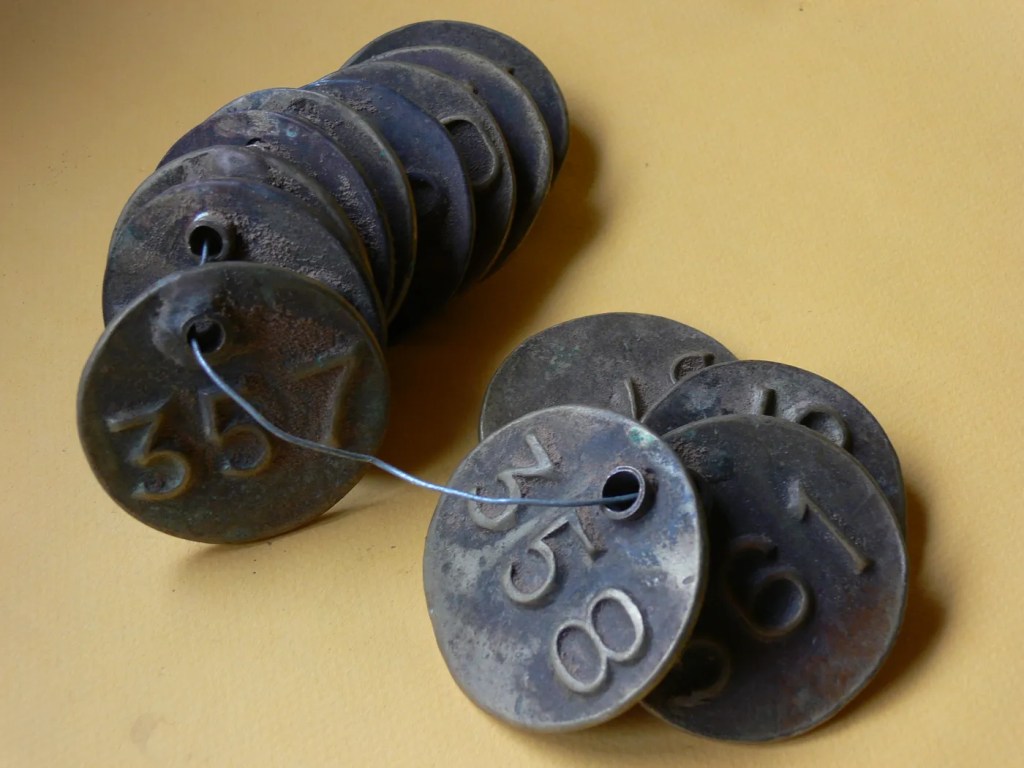
Allflex tags. These were fairly new on the market when we started the breed comparison trial at the Station, so we saw them as ideal to ID all the sheep sourced by Breed Societies that arrived for the trial. We must have bought thousands of them, and it was no fun working in the small race stuck on to the back of the woolshed with sheep that had never been close handled, or had a painful tag pierced through their ear. One good idea was to punch the hole one day, give it time to heal, so the arrow tag going through was painless. And of course, Allflex never intended their tags to be recycled, so once you put them in you couldn’t force the pin out. You had to cut it with side cutters. But David Hall didn’t like the idea, as being able to reuse tags was a great saving, so he took the Allflex conventional pliers, disappeared into the workshop and changed the needle so they could force the pin backwards and out.
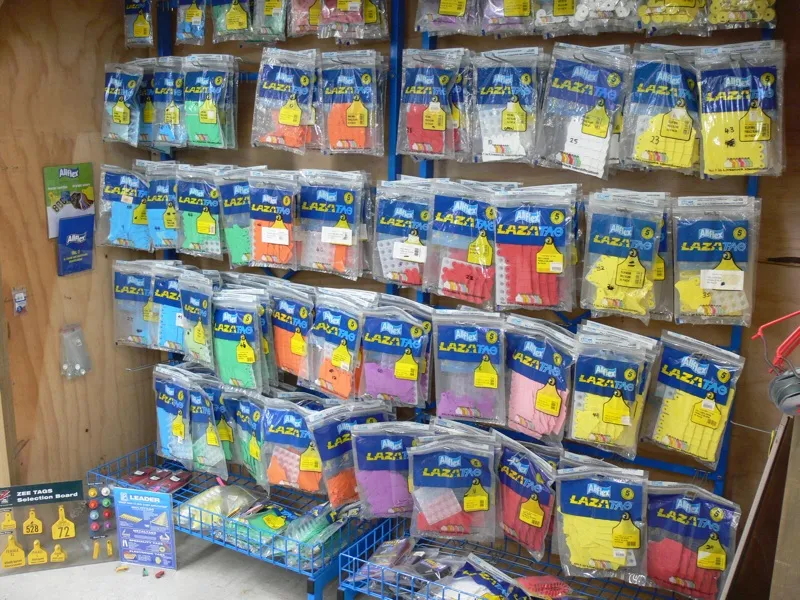
We kept quiet about David’s bit of engineering innovation, and certainly kept it from Allflex. But sometime later I saw that Allflex had developed pliers to remove their tags. Millions of tags must have gone in sheep to the works that could have been recycled by farmers. David’s idea went unrewarded! (CliveD).